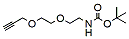
t-Boc-N-Amido-PEG2-propargyl is crosslinker consisting of a propargyl group and a t-Boc protected amine group. The propargyl group reacts with azide-bearing compounds or biomolecules via copper catalyzed Click Chemistry reactions. The t-Boc protected amine can be deprotected under mild acidic conditions. Reagent grade, for research purpose. Please contact us for GMP-grade inquiries.
Detail
t-Boc-N-Amido-PEG2-propargyl is crosslinker consisting of a propargyl group and a t-Boc protected amine group. The propargyl group reacts with azide-bearing compounds or biomolecules via copper catalyzed Click Chemistry reactions. The t-Boc protected amine can be deprotected under mild acidic conditions. Reagent grade, for research purpose. Please contact us for GMP-grade inquiries.
Other Products
Propargyl-PEG3-acid
Product Info
Document
Product Info
Propargyl-PEG3-acid is a reagent with an alkyne group and a carboxylic acid. The terminal carboxylic acid can form amide bond with primary amines (activation is needed). The alkyne can form triazole linkage with azide containing molecules via copper catalyzed reactions. Reagent grade, for research purpose. Please contact us for GMP-grade inquiries.
Document
Propargyl-PEG3-acid is a reagent with an alkyne group and a carboxylic acid. The terminal carboxylic acid can form amide bond with primary amines (activation is needed). The alkyne can form triazole linkage with azide containing molecules via copper catalyzed reactions. Reagent grade, for research purpose. Please contact us for GMP-grade inquiries.
Propargyl-PEG10-t-butyl ester is a crosslinking reagent that can react with azide-bearing compounds or biomolecules via copper catalyzed Click Chemistry reactions. The carboxyl group can be deprotected under acidic conditions. Reagent grade, for research purpose. Please contact us for GMP-grade inquiries.
Document
Propargyl-PEG10-t-butyl ester is a crosslinking reagent that can react with azide-bearing compounds or biomolecules via copper catalyzed Click Chemistry reactions. The carboxyl group can be deprotected under acidic conditions. Reagent grade, for research purpose. Please contact us for GMP-grade inquiries.
Usages: Determination of coliform and fecal coliform for multiple tube fermentation.
Principle: Tryptone provide carbon and nitrogen sources to meet the needs of bacterial growth; sodium chloride osmotic pressure balance can be maintained; Lactose is a coliform fermentable sugars; potassium dihydrogen phosphate and dipotassium phosphate is a buffer; lauryl sodium can inhibit the growth of non-coliform bacteria.
How to use: 1. Suspend 35.6g of the product, adding 1 L of distilled or deionized water, heated to boiling stirring until completely dissolved, packed in a test tube with a small down tube, 121 ℃ autoclave 15min, leave to cool to room temperature, standby . 2.Sample handling and dilution. 3.Selected three consecutive dilution, each dilution was inoculated three LST broth tubes, each tube was inoculated 1mL. 4. Put the tubes in an incubator 36 ± 1 ℃ cultured for 48 ± 2h. 5. Observe the results. if all LST broth don’t pruduse gas, can be reported as negative for E. coli, if gas production then will have to make further confirmed by experiments.
Quality control: Quality control strains were inoculated and culuture at 36 ± 1 ℃ for 24h ,results are as follows: Bacterial Name Bacterial No. Growth Status Gassing Escherichia coli ATCC25922 good +
Salmonella typhimurium CMCC (B) 50115 good —
Staphylococcus aureus ATCC6538 inhibited —
Storage: Store in a dark, cool and dry place, tighten the cap immediately after use. Storage period of three years.