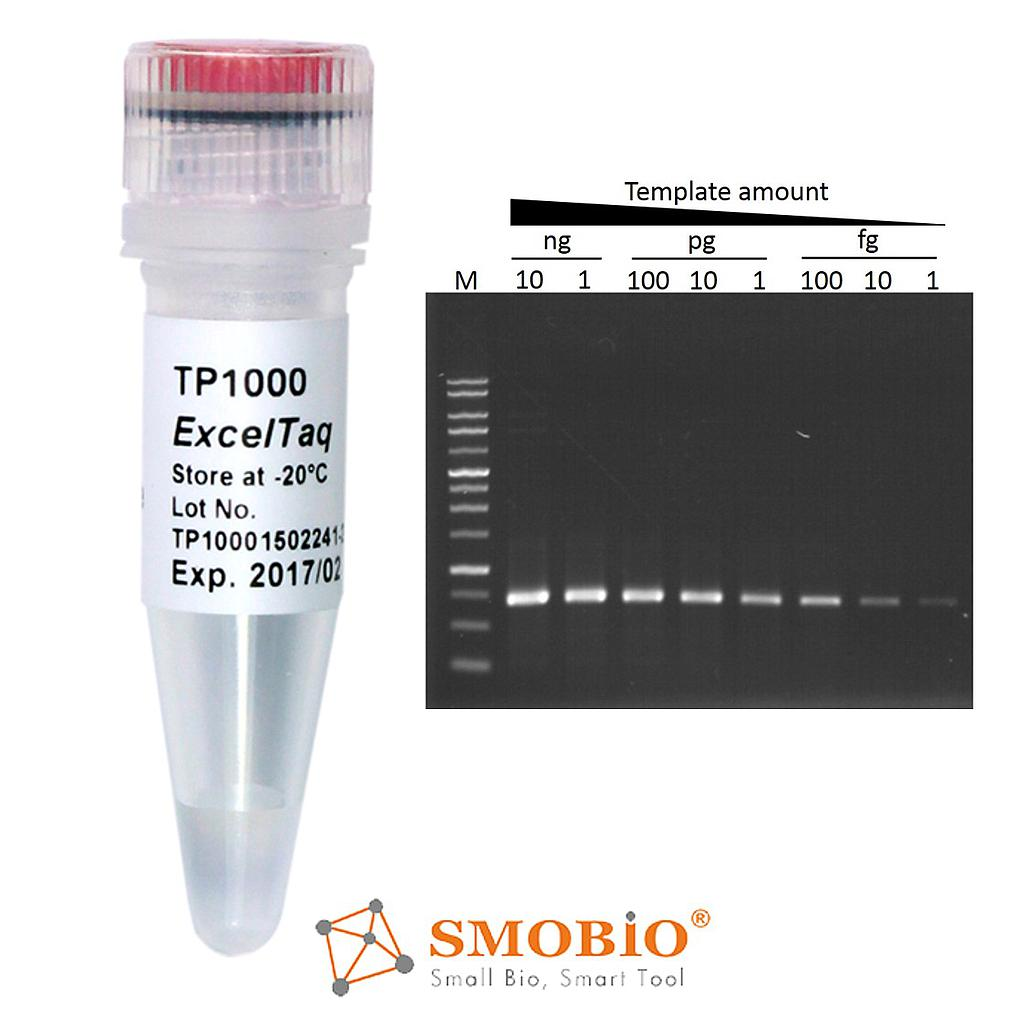
[TP1000] ExcelTaq™ Taq DNA Polymerase, 5 U/μl, 500 U
Facebook
X
Pinterest
Email
ExcelTaq™ Taq DNA Polymerase is a recombinant thermo-stable Taq DNA polymerase expressed and purified from an E. coli strain carrying the cloned gene. With a high DNA synthesis rate and high thermo-stability, ExcelTaq™ Taq DNA Polymerase is suitable for common and specialized PCR applications.
Detail
Description
ExcelTaq™ Taq DNA Polymerase is a recombinant thermo-stable Taq DNA polymerase expressed and purified from an E. coli strain carrying the cloned gene. With a high DNA synthesis rate and high thermo-stability, ExcelTaq™ Taq DNA Polymerase is suitable for common and specialized PCR applications.
Features
5’→3′ DNA polymerase activity
5’→3′ exonuclease activity
No detectable 3’→5′ exonuclease (proofreading) activity
Generates PCR products with 3’-dA overhangs
Thermo-stable – half-life lasts for more than 40 min at 95°C
Applications
Routine PCR
Amplification of DNA fragments up to 8 kb
Generation of PCR products for TA cloning
DNA labeling
Storage
-20°C for 24 months
Other Products
Cylindrospermopsin Detection Kit (Rapid – Freshwater Streams and Source Water)
Product Info
Document
Product Info
Screening of Cylindrospermopsin in water samples at or above 30ppt
Format: 15 tests (5 samples at 2 dilutions/5 controls)
Attogene’ s Cylindrospermopsin Lateral Flow Kit can be used to detect Cylindrospermopsin in source water samples.
Format: Rapid-Water – Run Time: 30 Minutes, enough to run two samples (undiluted and a 10 fold dilution) and negative control.
Cylindrospermopsin (CYN) is a potent cyanotoxin synthesized by select species of cyanobacteria, prominently including Cylindrospermopsin raciborskii. It belongs to the tricyclic alkaloid class, exhibiting a molecular weight of approximately 415 Da. Structurally, cylindrospermopsin features an uracil ring fused with a hydantoin moiety, alongside a guanidino group, attributes that render it highly soluble and polar in aqueous environments.
Cylindrospermopsin is notorious for its profound toxicity towards aquatic organisms and its potential threat to human health through exposure via contaminated water and food sources. Consequently, rigorous monitoring protocols are essential in regions prone to cyanobacterial blooms, where cylindrospermopsin can accumulate in freshwater reservoirs and other aquatic habitats. In recognition of these risks, regulatory bodies such as the United States Environmental Protection Agency (EPA) have implemented an action level guideline. As of 2019, EPA 10-day drinking water health advisory for cylindrospermopsin recommended a threshold of 0.7 parts per billion (ppb), or 700 parts per trillion (ppt) for children under the age of six, and 3 parts per billion, 3000 parts per trillion for anyone older, to effectively manage cylindrospermopsin levels. This precautionary measure aims to uphold both environmental sustainability and public health integrity by minimizing exposure risks. The EPA has also drafted a human health recreational water quality criterion to protect human health at 8,000ppt.
CE-IVD marked version available for in vitro diagnostic use
Available in TaqMan format for analysis.
Listeria monocytogenes have emerged as significant foodborne pathogens that pose a serious public health problem. As the causative agent of Listeriosis, L. monocytogenes has the highest rate of fatality rate among all foodborne pathogens. L. monocytogenes is a facultatively intracellular, Gram-positive bacterium that could survive high and low temperatures, low pH. It is a rare causative agent of mastitis in cow. However, due to its ability to resist various food processing technologies as well as to grow at low temperature, L. monocytogenes is know to be associated with both raw and pasteurized milk, as well as dairy products such as cheese. As little as 1000 organisms may cause the disease with pregnant, new-born, and immunocompromised individuals the most susceptible.
Storage Conditions and Product Stability All kit components can be stored for 2 years after the date of production without showing any reduction in performance.
All kit components should be stored at -20°C upon arrival. Repeated thawing and freezing (> 2 x) of the Master Mix and Positive Control should be avoided, as this may affect the performance of the assay. If the reagents are to be used only intermittently, they should be frozen in aliquots.
All-in-one solution for inclusion body protein isolation and purification
Fast and convenient spin column protocol
Complete kit with Cell Lysis Reagent, Inclusion Body Solubilization Reagent, buffers and spin columns to purify proteins
Purification is based on spin column chromatography that uses Norgen’s resin separation matrix
These kits provide everything required to isolate and purify inclusion body proteins from induced bacterial cultures. First a proprietary Cell Lysis Reagent is used to selectively lyse the cells and release inclusion bodies in their solid form. Next, inclusion bodies are dissolved and their contents released using the provided IB Solubilization Reagent. Inclusion body proteins are then further purified using spin columns for rapid and convenient buffer exchange and desalting. This kit provides a convenient way to screen recombinants prior to scaling up.
ProteoSpin™ Inclusion Body Protein Isolation Micro Kit
The process is efficient and streamlined and can process up to 12 samples in only 60 minutes. Each spin column is able to recover up to 50 µg of acidic or basic proteins. Purified recombinant proteins are then ready for SDS-PAGE, 2D gels, Western blots, Mass Spectrometry analysis, and other applications.
ProteoSpin™ Inclusion Body Protein Isolation Maxi Kit
The procedure is efficient and streamlined and can process up to 4 samples in approximately 2 hours. Each spin column is able to recover up to 12 mg of acidic or basic proteins from 100 mL of induced bacterial culture. Purified recombinant proteins are then ready for SDS-PAGE, 2D gels, Western blots, Mass Spectrometry analysis, and other applications.
About Inclusion Bodies
Bacteria are widely used for the expression of different proteins. However, 70-80% of the proteins expressed in bacteria by recombinant techniques are typically contained in insoluble inclusion bodies (i.e., protein aggregates). The protein of interest found in these subcellular structures is often inactive, due to incorrect folding. The production rate of recombinant proteins stored in inclusion bodies is invariably higher than those synthesized as soluble proteins. The reason behind this is thought to be the resistance of insoluble proteins to proteolysis by cellular enzymes. In addition, separation of insoluble recombinant proteins in inclusion bodies is considerably easier than that of soluble proteins. These factors have been the major influences favoring scale-up of high-value proteins using bacterial fermentation for example. Procedures for the purification of the expressed proteins from inclusion bodies are often labour-intensive, time-consuming and not cost-effective. This kit provides the essential reagents for cell disruption, inclusion body solubilization and purification using spin column chromatography – all optimized to work together thereby simplifying the process and saving a tremendous amount of time and cost.
Storage Conditions The Cell Lysis Reagent and IB Solubilization Reagent should be stored at 4°C upon receipt of this kit. This kit is stable for 2 years after the date of shipment. Once opened, the solutions should be stored at 4°C when not in use except for Binding Buffer C and Binding Buffer N. Some precipitation will occur with 4°C storage. This precipitation should be dissolved with slight heating to room temperature before using.
Component
Cat. 10300 (Micro – 25 preps)
Cat. 17700 (Maxi – 4 preps)
Wash Solution C
30 mL
130 mL
Wash Solution N
30 mL
130 mL
Binding BUffer A
4 mL
20 mL
Binding Buffer N
4 mL
20 mL
Elution Buffer C
8 mL
2 x 30 mL
Protein Neutralizer
4 mL
4 mL
Cell Lysis Reagent
15 mL
110 mL
IB Solubilization Reagent
2 mL
50 mL
Syringes, 1cc, slip tip
25
–
Needles (Bev, 20G x 1 inch)
25
–
Syringes, 10 mL, Luer-Lok™ Tip
–
4
Needles (18G x 1.5 inch)
–
4
Micro Spin Columns
25
–
Maxi Spin Columns (filled with SiC) inserted into 50 mL collection tubes