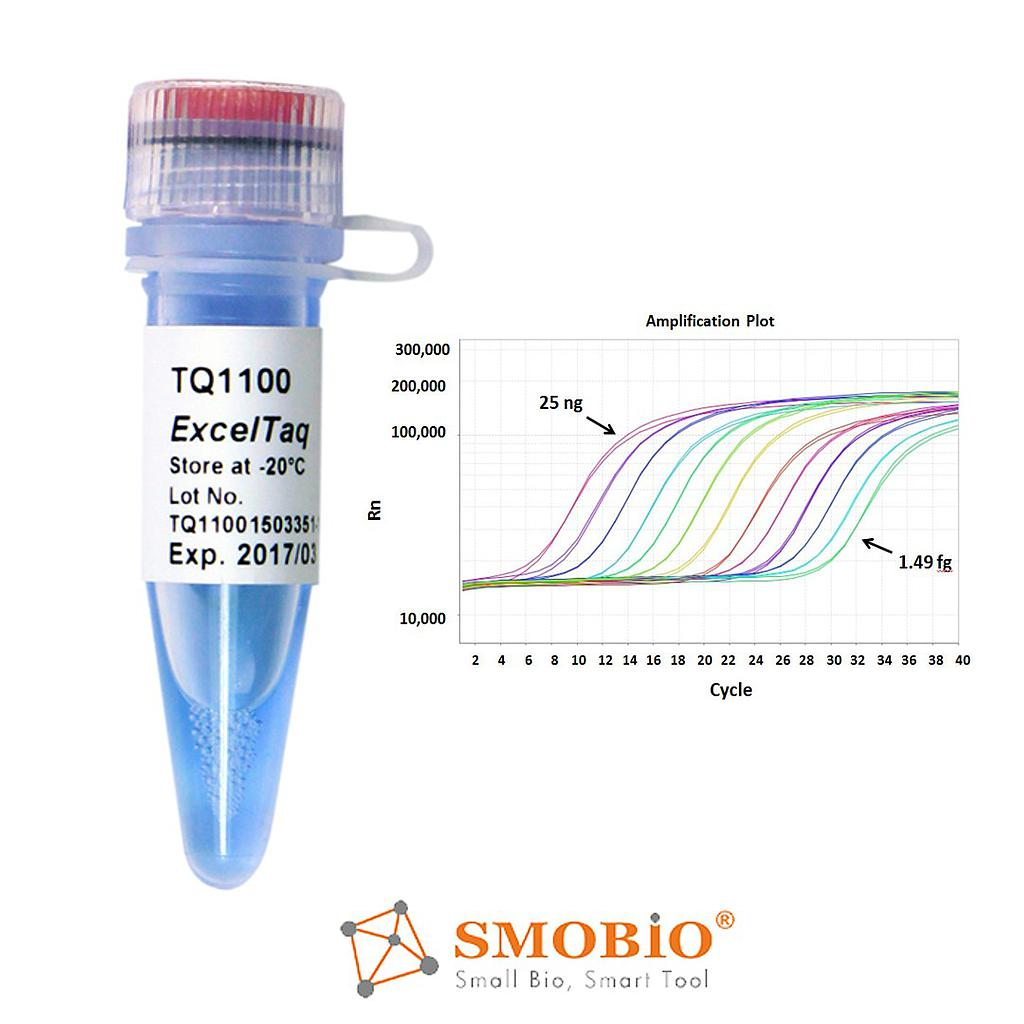
The ExcelTaq™ 2X Q-PCR Master Mix (SYBR, no ROX) is a ready-to-use reagent with all the essential components for quantitative real-time PCR (qPCR) except primers and template. The master mix features high sensitivity and signal intensity as well as low background and better compatibility with cDNA templates derived directly from reverse transcription reaction mixture. The ExcelTaq™ 2X Q-PCR Master Mix (SYBR, no ROX) contains hot-start Taq polymerase in an optimized buffer with dsDNA specific SYBR green fluorescent dye. This master mix allows for sensitive, precise amplification, real-time tracking of the amplification process, and simultaneous quantification for targeted DNA molecules. With inert smart blue contrast dye, the ExcelTaq™ 2X Q-PCR Master Mix (SYBR, no ROX) is ready-to-use and greatly reduces pipetting errors, while largely improving the reproducibility of the process. The ExcelTaq™ 2X Q-PCR Master Mix is also compatible with a ROX reference dye if recommended by the manufacturer of the qPCR system.
Detail
Description
The ExcelTaq™ 2X Q-PCR Master Mix (SYBR, no ROX) is a ready-to-use reagent with all the essential components for quantitative real-time PCR (qPCR) except primers and template. The master mix features high sensitivity and signal intensity as well as low background and better compatibility with cDNA templates derived directly from reverse transcription reaction mixture. The ExcelTaq™ 2X Q-PCR Master Mix (SYBR, no ROX) contains hot-start Taq polymerase in an optimized buffer with dsDNA specific SYBR green fluorescent dye. This master mix allows for sensitive, precise amplification, real-time tracking of the amplification process, and simultaneous quantification for targeted DNA molecules. With inert smart blue contrast dye, the ExcelTaq™ 2X Q-PCR Master Mix (SYBR, no ROX) is ready-to-use and greatly reduces pipetting errors, while largely improving the reproducibility of the process. The ExcelTaq™ 2X Q-PCR Master Mix is also compatible with a ROX reference dye if recommended by the manufacturer of the qPCR system.
Features
High sensitivity and signal intensity
Smart blue contrast dye as a visual aid for reaction setup
Better compatibility for reverse transcription
Low background
Storage
Protected from light. Aliquot to avoid multiple freeze-thaw cycles. -20°C for 12 months
Short term stability: 2-8oC, Long term stability: See individual component labels
Stability:
> 2 years under recommended storage conditions
Analyte:
D-Glucose
Assay Format:
Spectrophotometer, Microplate, Auto-analyser
Detection Method:
Absorbance
Wavelength (nm):
340
Signal Response:
Increase
Linear Range:
4 to 80 µg of D-glucose per assay
Limit of Detection:
0.66 mg/L
Reaction Time (min):
~ 5 min
Application examples:
Wine, beer, fruit juices, soft drinks, milk, jam, dietetic foods, bakery products, candies, fruit and vegetables, tobacco, cosmetics, pharmaceuticals (e.g. infusions), feed, paper (and cardboard) and other materials (e.g. biological cultures, samples, etc.).
Method recognition:
Methods based on this principle have been accepted by AOAC, EN, NEN, NF, DIN, GOST, OIV, IFU, AIJN, MEBAK and ASBC Method Malt 6-D
The D-Glucose HK (Regular) test kit is a high purity reagent for the measurement and analysis of D-glucose in plant and food products. Can be used in combination with other Megazyme’s products that require glucose determination.
Note for Content: The number of manual tests per kit can be doubled if all volumes are halved. This can be readily accommodated using the MegaQuantTM Wave Spectrophotometer (D-MQWAVE).
Introducing the Fastin Assay Kit: Your Straightforward Solution for Elastin Quantification! Our user-friendly kit utilizes a dye-based method to measure elastin from in-vivo and in-vitro sources. It can be used to quantify various elastin forms, spanning from immature tropoelastin to mature, ‘insoluble’ elastin fibers.
Colorimetric Detection (513nm) (Endpoint)
Understanding Elastin: The Key to Tissue Flexibility
Tissues like lungs and arteries must maintain the ability to stretch and recoil repeatedly throughout an organism’s life. Elastin, a mature protein, is responsible for this elasticity and is usually present as insoluble fibers within the ECM. During development, these fibers are initially formed from a soluble precursor called tropoelastin.
What is the Fastin Assay?
The Biocolor Fastin assay is a user-friendly, dye-based means of quantifying elastins derived from both in-vivo and in-vitro sources. A variety of elastin forms can be assayed, from immature tropoelastin to mature ‘insoluble’ elastin fibres.
Further information on how the assay works can be found on the ‘Mode of Action‘ tab.
A list of suggested sample types can be found under the ‘Assay Specification‘ tab.
How does the Fastin assay detect Elastin?
The Fastin Dye Reagent contains an elastin-binding synthetic porphyrin, TPPS (5,10,15,20-tetraphenyl- 21H,23H-porphine). This affinity of TPPS for elastin was first observed when used as a ‘vital stain’ on live animals. Most tissues took up the dye initially but only elastin retained the TPPS molecules over time. [Winkelman, J. (1962), Cancer Res. 22, 589-596; Winkelman, J & Spicer, S. (1962), Stain Technol. 37, 303-305].
It has been proposed that the elastin binding of TPPS may be due to the retention of the acidic dye (which contains four charged sulfate groups) by the basic amino acid side chain residues of elastin.
How does the Fastin assay work?
Step 1. Incubation of samples containing soluble elastin with the Fastin Dye Reagent causes an elastin-dye complex to form. This insoluble complex then precipiates.
Step 2. Dye-labelled elastin is then isolated by centrifugation and the unbound dye removed. Elastin-bound dye is then eluted and measured spectrophotometrically.
Step 3. The elastin content of unknown samples can be calculated by comparison against a calibration curve prepared using a standard comprising water-soluble elastin (supplied with the kit).
Assay range
50 – 500µg/ml
Limit of Detection
50µg/ml
Detection Method
Colorimetric Detection (513nm) (Endpoint)
Measurements per kit
110 in total (allows a maximum of 48 samples to be run in duplicate alongside a standard curve).
Suitable Samples
In-vivo: tissues and fluids. Insoluble elastin will first require conversion to water soluble α-elastin using the oxalic acid reagents and extraction protocol supplied with the kit.
In-vitro: Elastin produced by cells during 2D/3D cell culture. NB elastin in conditioned cell media is typically below the detection limit of the kit.
Precautions
This kit is designed for research use only. Not for use in diagnostic procedures. Kit requires access to a centrifuge, heated water bath or block, as well as a spectrophotometer or colorimeter capable of absorbance detection at 513nm. Specific sample preparation protocols may require customer to provide further reagents, consult assay manual for further information.
Fastin elastin kit contents:
1. Dye Reagent (1x110ml)
2. α-elastin Reference Standard (1x5ml, 1.0 mg/ml soluble Bovine elastin)
6. 1.5ml micro-centrifuge tubes for dye-labelling reaction.
7. Assay kit manual
NB: Additional reagents may be required for sample preparation prior to assay. Consult manual or contact us for further details.
Document
Introducing the Fastin Assay Kit: Your Straightforward Solution for Elastin Quantification! Our user-friendly kit utilizes a dye-based method to measure elastin from in-vivo and in-vitro sources. It can be used to quantify various elastin forms, spanning from immature tropoelastin to mature, ‘insoluble’ elastin fibers. Colorimetric Detection (513nm) (Endpoint)
Nucleic acid testing (NAT) is the method of choice for detection and quantification of a wide range of micro organisms. Primerdesign manufactures and supplies high quality quantitative real-time PCR kits for the detection and simultaneous quantification of numerous significant pathogens . A copy number standard curve is provided for quantification and an the internal extraction template (DNA or RNA), controls for the quality of the nucleic acid extraction and eliminates false negative results.
The kit is designed with the broadest possible detection profile to ensure that all clinically relevant strains and subtypes are detected. Target sequences are selected by working with data from key opinion leaders in the field. Multiple sequence alignments and unprecedented real-time PCR expertise in design and validation ensure the best possible kit.
Details of the target and priming specificity are included in the individual handbooks above.
Packaged, optimised and ready to use. Expect Better Data.
Document
Exceptional value for money Rapid detection of all clinically relevant subtypes Positive copy number standard curve for quantification Highly specific detection profile High priming efficiency Broad dynamic detection range (>6 logs) Sensitive to < 100 copies of target
Accurate controls to confirm findings