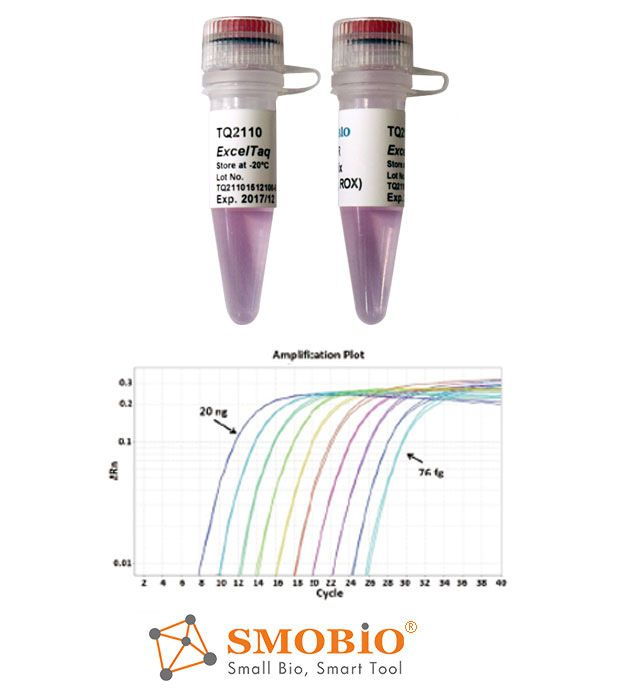
The ExcelTaq™ 2X Q-PCR Master Mix (TaqMan, ROX) is a ready-to-use reagent with all the essential components for quantitative real-time PCR (qPCR) except primers, TaqMan probes and templates. The master mix includes a 5’ to 3’ exonuclease activity to cleave TaqMan probes that hybridize to target sequences, releasing fluorophore during probe displacement. With TaqMan probes, the master mix features high specificity and high sensitivity. The ExcelTaq™ 2X Q-PCR Master Mix (TaqMan, ROX) contains hot-start Taq polymerase in an optimized buffer that allows for sensitive and precise amplification, real-time tracking of the amplification process, and simultaneous quantification for targeted DNA molecules. The master mix includes ROX reference dye for the normalization of each qPCR assay. The ExcelTaq™ 2X Q-PCR Master Mix (TaqMan, ROX) is ready-to-use and greatly reduces pipetting errors, while largely improving the reproducibility of the process.
Detail
Description
The ExcelTaq™ 2X Q-PCR Master Mix (TaqMan, ROX) is a ready-to-use reagent with all the essential components for quantitative real-time PCR (qPCR) except primers, TaqMan probes and templates. The master mix includes a 5’ to 3’ exonuclease activity to cleave TaqMan probes that hybridize to target sequences, releasing fluorophore during probe displacement. With TaqMan probes, the master mix features high specificity and high sensitivity. The ExcelTaq™ 2X Q-PCR Master Mix (TaqMan, ROX) contains hot-start Taq polymerase in an optimized buffer that allows for sensitive and precise amplification, real-time tracking of the amplification process, and simultaneous quantification for targeted DNA molecules. The master mix includes ROX reference dye for the normalization of each qPCR assay. The ExcelTaq™ 2X Q-PCR Master Mix (TaqMan, ROX) is ready-to-use and greatly reduces pipetting errors, while largely improving the reproducibility of the process.
Features
High Specificity
High Sensitivity
With ROX Reference Dye
Storage
Protect from light. Aliquot to avoid multiple freeze-thaw cycles. -20°C for 12 months
Fasciolosis is one of the most frequently encountered autochthonous helminthic infections in Central Europe. The immunodiagnosis of Fasciola hepatica infections is challenged by high serological cross-reacitivity with other (hepatic) parasitological infections encountered in Central Europe, such as alveolar echinococcosis, toxocarosis and ascariosis, but also other parasitic infections acquired during overseas travel. The SAP-2 recombinant antigen shows a high specificity, especially with patients with other parasitic infections. It is a suitable serological test for routine diagnosis of human fasciolosis, particularly if the results are supported by clinical history.
This product is manufactured by Bordier Affinity Products in Switzerland and distributed in Germany exclusively by Milenia Biotec.
Method/Platform
ELISA in microplate format
Range/Assay Sensivity
77% sensitivity, 98% specificity
Test Principle
The kit provides all the material needed to perform 96 enzyme-linked immunosorbant assays (ELISA) on breakable microtitration wells sensitized with Fasciola hepaticarecombinant antigen. Specific antibodies in the sample will bind to the antigen and washing will remove unspecific antibodies. The presence of parasite specific antibodies is detected with a Protein A – alkaline phosphatase conjugate. A second washing step will remove unbound conjugate. Revealing bound antibodies is made by the addition of pNPP substrate which turns yellow in the presence of alkaline phosphatase. Color intensity is proportional to the amount of Fasciola hepatica specific antibodies in the sample. Potassium phosphate is added to stop the reaction. Absorbance at 405 nm is read using an ELISA microplate reader.The test can be performed with automatic systems, but this must be validated by the user.
12 x 8 strips (96 tests) Fasciolosis is one of the most frequently encountered autochthonous helminthic infections in Central Europe. The immunodiagnosis of Fasciola hepatica infections is challenged by high serological cross-reacitivity with other (hepatic) parasitological infections encountered in Central Europe, such as alveolar echinococcosis, toxocarosis and ascariosis, but also other parasitic infections acquired during overseas travel. The SAP-2 recombinant antigen shows a high specificity, especially with patients with other parasitic infections. It is a suitable serological test for routine diagnosis of human fasciolosis, particularly if the results are supported by clinical history.
Cluster of differentiation 44 (CD44) is a glycoprotein receptor for hyaluronic acid, which plays a fundamental role in cellular adhesion, stromal binding, migration, and cell-cell interactions. Studies have suggested that the CD44-hyaluronate interaction is central to tumor invasiveness. Positive staining with Anti-CD44 is implicated in a multitude of different cancer types, including breast, prostatic, renal cell, colonic, hepatocellular, and genitourinary carcinomas, as well as Non-Hodgkin’s Lymphoma, metastatic melanoma, gastric cancer, and some soft tissue tumors. It has also been demonstrated that there is a positive correlation between tumor progression and increased expression of CD44v, a high molecular weight CD44 isoform that has been described in epithelial cells. Given the expression of CD44 in a wide range of cancers, the most practical application of CD44 immunostaining is its use in discriminating between urothelial transitional cell carcinoma in situ from non-neoplastic changes in the urothelium.