Real-time fluorescent DNA amplification in a flexible liquid format. Recommended for users who want to combine RPA with the use of TwistDx’s proprietary fluorescent TwistAmp® exo Probes. In addition to the basic components, a powerful nuclease (Exonuclease III) is provided which will process TwistAmp® exo Probes during the amplification reaction itself and generate a real-time readout. The user need only supply primers, probe, dNTPs and template.See manual for more information. Click to order oligonucleotides.
Detail
Real-time fluorescent DNA amplification in a flexible liquid format. Recommended for users who want to combine RPA with the use of TwistDx’s proprietary fluorescent TwistAmp® exo Probes. In addition to the basic components, a powerful nuclease (Exonuclease III) is provided which will process TwistAmp® exo Probes during the amplification reaction itself and generate a real-time readout. The user need only supply primers, probe, dNTPs and template.See manual for more information. Click to order oligonucleotides.
Perfect for: Real-time fluorescent DNA detection, facilitating use of different RPA reaction volumes, or variation of component ratios.
Product code: TALQEXO01
Other Products
PACE® GENOTYPING ASSAY
Product Info
Document
Product Info
ABOUT
PACE (PCR Allelic Competitive Extension) genotyping chemistry is a homogeneous, PCR-based allele-specific technology for the analysis of DNA sequence variants, most commonly SNPs (Single Nucleotide Polymorphisms) and Indels (insertion / deletions).
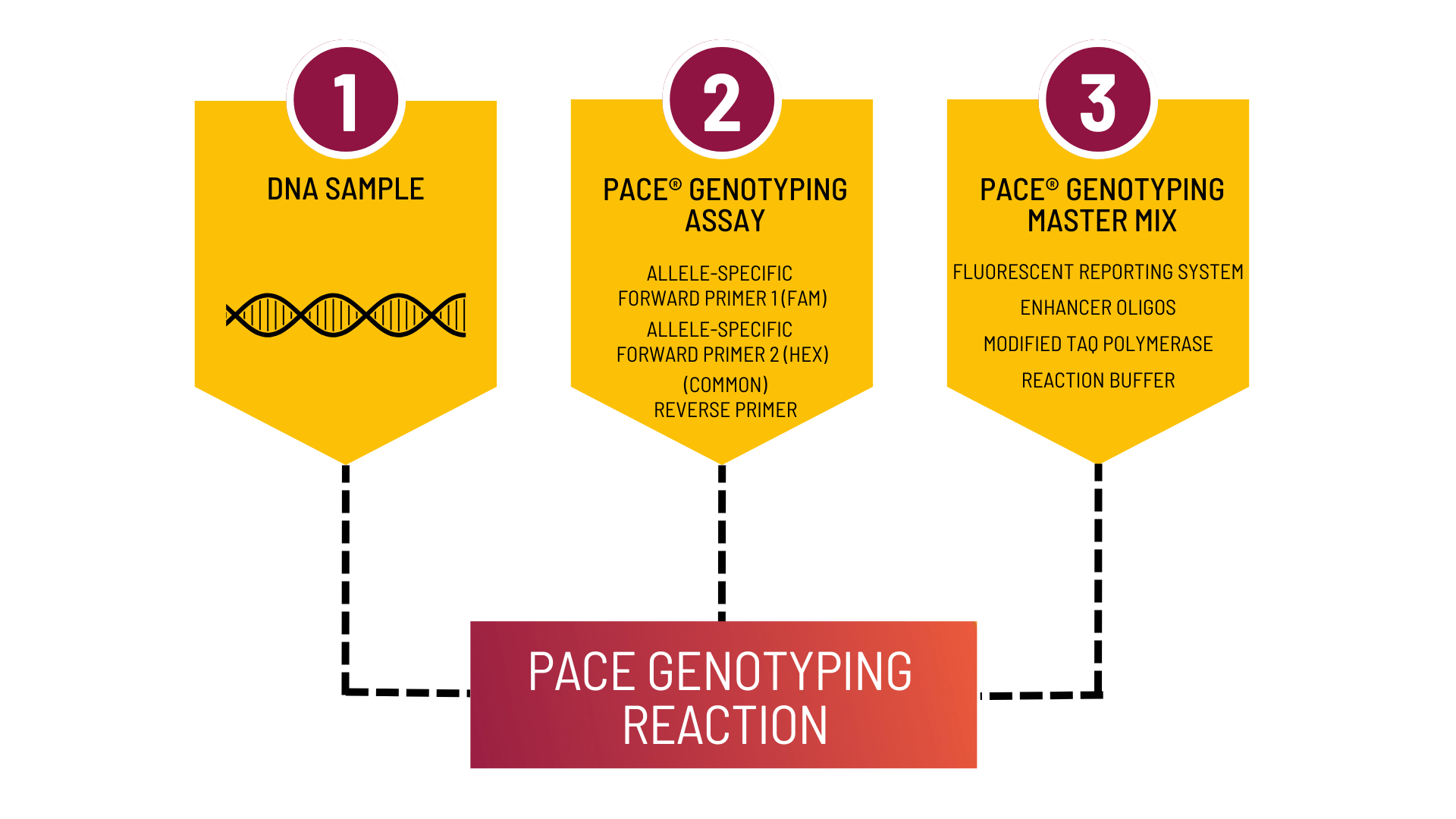
PACE genotyping chemistry is comprised of two parts:
PACE Genotyping Assay: two allele-specific forward primers and one common, reverse primer. The allele-specific forward primers each have different 3′ terminal bases reflecting the target variant, and a unique 5’ tail sequence which is incorporated as part of the fluorescent signal mechanism.
PACE Genotyping Master Mix: containing all remaining components required for PCR and the generation of fluorescent signals. PACE Genotyping Master Mix contains a novel, universal, fluorescent reporting cassette to produce machine-readable fluorescent signals (FAM and HEX) corresponding to the assay genotypes.
When combined with sample DNA, these components create a PACE Genotyping Reaction, as illustrated in the figure below.
We have extensive knowledge and experience in assay design, especially when it comes to allele-specific PCR. PACE Genotyping Assays are available to purchase either Validated and Unvalidated. Validated assays require customer DNA to validate and optimise, for guaranteed performance. Unvalidated assays are designed in silico and supplied untested.
REQUIRED COMPONENTS
qPCR machine or Thermocycler + Fluorescent plate reader
PCR plate or equivalent and appropriate optically clear seal
Template DNA
PCR-grade water
PACE Genotyping Master Mix or PACE 2.0 Genotyping Master Mix
STEPS TO YOUR PACE GENOTYPING ASSAY DESIGN
Place your order on this page. Our support team will contact you by email.
Fill out an Assay Design Template form with all the information we need to process your custom PACE Genotyping Assay order. We will email you a copy of the template when we first contact you, or your can download a copy here.
Using the information you provide us, we will create your PACE Genotyping Assay designs, order the oligos, and send you design sequences.
Once we receive the oligos, we assemble the assay(s) and then ship an aliquot to you (unvalidated) or test on your DNA samples before shipping the aliquot to you (validated).
The CellG3 assay reagent for the measurement of endo-cellulase (endo-1,4-β-glucanase) contains two components; 1) 4,6-O-benzylidene-2-chloro-4-nitrophenyl-β-D-cellotrioside (BCNPG3) and 2) thermostable β-glucosidase. The benzylidene blocking group prevents any hydrolytic action by the β-glucosidase on BCNPG3. Incubation with an endo-cellulase generates a non-blocked colourimetric oligosaccharide that is rapidly hydrolysed by the ancillary β-glucosidase. The rate of formation of 2-chloro-4-nitrophenol is therefore directly related to the hydrolysis of BCNPG3 by the endo-cellulase. The reaction is terminated and the phenolate colour is developed on addition of Tris buffer solution (pH 9.0).
Please note that a new assay kit (K-CellG5) is now available for the measurement of endo-cellulase. The CellG5 reagent contains a cellopentaose core and exhibits vastly improved sensitivity for some cellulases. In addition, the exchange of the benzylidene blocking group in CellG3 for 3-keto-butylidene in CellG5 improves the substrate’s water solubility significantly, allowing for a reduction in the concentration of DMSO required in the assay. As DMSO is known to inhibit certain cellulases, this is another benefit in using CellG5. Megazyme now recommends the use of K-CellG5 for all assays for the measurement of endo-cellulase.
The CellG3 assay reagent for the measurement of endo-cellulase (endo-1,4-β-glucanase) contains two components; 1) 4,6-O-benzylidene-2-chloro-4-nitrophenyl-β-D-cellotrioside (BCNPG3) and 2) thermostable β-glucosidase. The benzylidene blocking group prevents any hydrolytic action by the β-glucosidase on BCNPG3. Incubation with an endo-cellulase generates a non-blocked colourimetric oligosaccharide that is rapidly hydrolysed by the ancillary β-glucosidase. The rate of formation of 2-chloro-4-nitrophenol is therefore directly related to the hydrolysis of BCNPG3 by the endo-cellulase. The reaction is terminated and the phenolate colour is developed on addition of Tris buffer solution (pH 9.0).