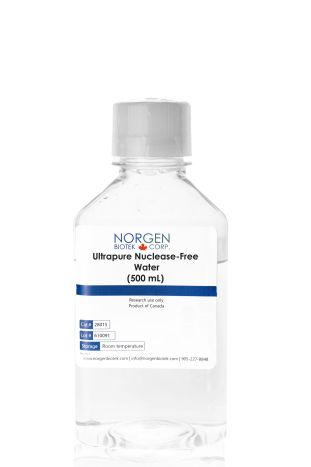
Produced by reverse osmosis, ion-exchange, electro-deionization, ultrafiltration, UV treatment (UVC & 185 nm), 0.1 μm membrane filtration
Nuclease-free, protease-free, endotoxin-free
Suitable for molecular biology applications (qPCR, NGS etc.)
Suitable for cell culture applications
Produced in an ISO certified GMP laboratory
Water system is routinely monitored for compliance with QC standards
The Norgen water purification system has been designed in conjunction with experts from Millipore Sigma. The Ultrapure NFW is purified in a two-stage process. The first stage, to produce type II water, includes pre-treatment with activated charcoal and polyphosphate, this water then undergoes reverse osmosis, electro-deionization and ion exchange to remove contaminants as well as UV treatment for disinfection. The Pure water then flows to a second system in a clean room with an additional 4 layers of purification. After passing through an additional ion exchange column, the water is then subjected to Ultrafiltration to remove particulates, bacteria, & ionic contaminants down to trace level, the water is then treated with UV light (182 nm wavelength) to break down organic matter. Lastly a second Ultrafilter for the production of pyrogen-, nuclease- and bacteria-free water at 18.2 MΩ. This water is of utmost purity and suitable for direct use in molecular biology applications such as qPCR and NGS, as well as cell culture and other applications.
Product Specifications
pH
n/a (highly pure water does not contain enough ions for an exact pH determination.)
Recommended Storage
Room Temperature
Grade
Ultrapure (ASTM Type I)
Biological Activity
DNase-, RNase-, Protease-, Endotoxin- Free
TOCs
< 50 ppb
Resistivity
> 18 MΩ-cm
Treatment
Not DEPC-Treated
Quantity
100 mL, 500 mL, 1000 mL
Purification Methods
Activated charcoal, polyphosphate, reverse osmosis, electro-deionization, ion exchange, UV, ultrafiltration
Shipping Conditions
Room Temperature
Details
Applications For use in any molecular biology application
Storage Conditions Norgen’s Nuclease-Free Water should be stored at room temperature. Storage at +4°C or -20°C is optional.
Precautions and Disclaimers This product is designed for research purposes only. It is not intended for human or diagnostic use.
Other Products
IVD6672 MagPure Pathogen DNA/RNA Kit
Product Info
Document
Product Info
Introduction
This product is suitable for extracting total pathogen nucleic acid from biological samples with no/low cell content such as body fluid, serum, plasma, soaking solution, tissue homogenate supernatant, culture medium supernatant, etc. The purified DNA/RNA can be used for clinical in vitro detection.
Details
Specifications
Features
Specifications
Main Functions
Extract total pathogen nucleic acid from cell-free/low-content cell biological samples such as body fluids, serums, plasma, tissue homogenate supernatant.
Applications
RT-PCR,PCR
Products
Pathogen DNA / RNA
Purification method
Polydisperse magnetic beads
Purification technology
Magnetic beads technology
Process method
Manual or automatic
Sample type
cell-free/low-content cell biological samples such as body fluids, serums, plasma, tissue homogenate supernatant
Sample amount
200-300μl
Adaptive instrument
Nucleic acid extractor, pipetting workstation
Principle
This product is based on the purification method of high binding magnetic particles. The sample is lysed and digested under the action of lysate and Protease. After adding magnetic particles and binding solution, DNA/RNA will be adsorbed on the surface of magnetic particles, and impurities such as proteins will be removed without adsorption. The adsorbed particles were washed with washing solution to remove proteins and impurities, washed with ethanol to remove salts, and finally DNA/RNA was eluted by Buffer NFW.
Advantages
Fast – several samples can be extracted in 40 minutes by column method
High quality – high purity total RNA / DNA can be directly used in various sensitive downstream applications
Safe – no phenol chloroform extraction required
Sensitive – DNA/RNA can be recovered at the level of PG
Kit Contents
Contents
IVD6672-50
IVD6672
Purification Times
50 Preps
200 Preps
Bead Tube C
50
4 x 50
MagPure Particle
1.6 ml
7.0 ml
Proteinase K
24 mg
100 mg
Protease Dissolve Buffer
1.8 ml
6 ml
Buffer MLBN
30 ml
120 ml
Buffer MW1*
22 ml
53 ml
Buffer MW2*
20 ml
50 ml
Buffer NFW
10 ml
30 ml
Storage and Stability
MagPure Particles and Proteinase K should be stored at 2–8°C upon arrival. However, short-term storage (up to 8 weeks) at room temperature (15–25°C) does not affect their performance. The remaining kit components can be stored at room temperature (15–25°C) and are stable for 18 months under these conditions.
Document
This product is suitable for extracting total pathogen nucleic acid from biological samples with no/low cell content such as body fluid, serum, plasma, soaking solution, tissue homogenate supernatant, culture medium supernatant, etc. The purified DNA/RNA can be used for clinical in vitro detection.
Blood samples contain rich DNA, including mitochondrial DNA, genomic DNA, circulating DNA (mostly released into blood after tumor cell apoptosis) in white blood cells, as well as parasitic viral or microbial DNA. These DNA are important parameters in clinical testing or diagnosis, which are also valuable materials for medical research. There are three main issues with extracting DNA from blood samples:
1. The sample is highly infectious, posing great harm to operators and the environment.
2. The source of DNA is complex and aportion of the nucleic acid, such as viral DNA or free DNA, may be lost during the operation, leading to downstream detection failure;
3. Blood sample contains a large amount of impurities and inhibitory factors.
Currently there are many methods available for extracting DNA from whole blood samples, such as phenol chloroform extraction, salting out method, etc. However, these methods require pre-treatment of blood sample, which removes red blood cells and isolate white blood cells in the first step. Due to the requirement that it cannot inactivate or kill pathogens during the process of removing red blood cells, the waste liquid (red blood cell lysate) and consumables may be contaminated by pathogens and become infectious, posing a danger to the entire laboratory environment and operators. In addition, during the process of removing red blood cells, useful nucleic acid information such as viruses, microorganisms, or circulating DNA is also lost, leading to experiment or detection failures.
The HiPure Blood DNA Kits series provided by Magen Company uses silica gel column purification technology, which can directly lyse whole blood samples without the need for white blood cell separation. Whole blood samples are directly mixed with lysates and proteases, resulting in the inactivation of pathogens, greatly reducing the infectivity, environmental pollution, and the chance of operators being infected. Due to the direct lysis and digestion of samples, except lymphocyte DNA, other circulating DNA as well as DNA from viruses and microorganisms, can also be recovered.
This product provides fast and easy methods for purification of total DNA for reliable PCR and Southern blotting. Total DNA (e.g., genomic, viral, mitochondrial) can be purified from whole blood, tissue and culture cells.
Details
Specifications
Features
Specifications
Main Functions
Isolation total DNA from 10ml blood and 1g tissue using Maxi column
Applications
PCR, southern bolt and virus detection, etc
Purification method
Maxi spin column
Purification technology
Silica technology
Process method
Manual (centrifugation or vacuum)
Sample type
Tissue, cell, blood, saliva, swab, blood spot, semen and other clinical samples
Sample amount
3-10ml
Elution volume
≥700μl
Time per run
≤90 minutes
Liquid carrying volume per column
4ml
Binding yield of column
5mg
Principle
This product is based on silica column purification. The sample is lysed and digested with lysate and protease, DNA is released into the lysate. Transfer to an adsorption column. Nucleic acid is adsorbed on the membrane, while protein is not adsorbed and is removed with filtration. After washing proteins and other impurities, Nucleic acid was finally eluted with low-salt buffer (10mm Tris, pH9.0, 0.5mm EDTA).
Advantages
High quality DNA – meet a variety of downstream applications, including PCR, qPCR, enzyme digestion, hybridization, etc.
Fast – without separation of leukocytes, organic extraction or ethanol precipitation
Simple – all nucleic acids can be obtained by direct digestion
Pertinence – specially designed for isolating DNA from 3-10ml blood and related body fluids
Wide applicability – handle a variety of liquid samples
Proteinase K, RNase A should be stored at 2-8°C upon arrival. However, short-term storage (up to 12 weeks) at room temperature (15-25°C) does not affect their performance. The remaining kit components can be stored at room temperature (15-25°C) and are stable for at least 18 months under these conditions.
*Note:Leukocyte protocol can be used when large volume whole blood samples need to be processed. Whole blood was treated with red blood cell lysate, and white blood cells were obtained by centrifugation before extraction
Document
Blood samples contain rich DNA, including mitochondrial DNA, genomic DNA, circulating DNA (mostly released into blood after tumor cell apoptosis) in white blood cells, as well as parasitic viral or microbial DNA. These DNA are important parameters in clinical testing or diagnosis, which are also valuable materials for medical research. There are three main issues with extracting DNA from blood samples:
DBCO-PEG4-PABA is an analog of DBCO-Acid with PEG linker and a 4-Aminobenzoic acid (PABA) group. The DBCO groups is commonly used for copper-free Click Chemistry reactions due to its strain promoted high energy. The hydrophilic PEG chain allows for increased water solubility. Reagent grade, for research use only.
Document
DBCO-PEG4-PABA is an analog of DBCO-Acid with PEG linker and a 4-Aminobenzoic acid (PABA) group. The DBCO groups is commonly used for copper-free Click Chemistry reactions due to its strain promoted high energy. The hydrophilic PEG chain allows for increased water solubility. Reagent grade, for research use only.