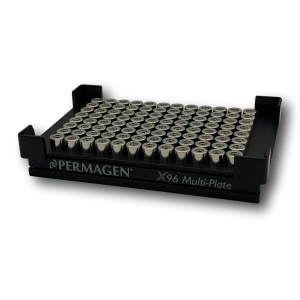
X96 Dual Ring Magnetic Plate 96-well with Integrated Cushion Base
Facebook
X
Pinterest
Email
Permagen’s most universal ring magnet plate. From Low elution PCR applications up to 2 mL deep well, the X96 has you covered. No need to purchase two separate plates anymore. Smaller inner ring magnet allows for volumes as low as 5 µL (from PCR plates), larger outer magnet handles up to 2 mL deep well assays
Detail
Permagen’s most universal ring magnet plate. From Low elution PCR applications up to 2 mL deep well, the X96 has you covered. No need to purchase two separate plates anymore. Smaller inner ring magnet allows for volumes as low as 5 µL (from PCR plates), larger outer magnet handles up to 2 mL deep well assays
ANSI/ SBS Footprint (127.75mm x 85.50mm) to fit into any automated liquid handling robot on bottom, SBS/ SLAS fit on top to accept any microplate
Integrated Cushion base for maximum recovery. Helps aid in set-up, robot positioning inconsistencies, and labware consumable differences
Features include solid aluminum alloy construction and hard coat anodized finish for years of trouble-free use, and compatible with any magnetic beads
Brucella abortus is an intracellular, blood-borne parasite. It is a Gram-negative coccobacillus that causes an infectious and contagious disease called Brucellosis. The disease primarily affects cattle but it can also be transmitted to humans from infected animals and consuming their products. The disease can lead to great economic loss especially in the dairy and agricultural industry. The Brucella abortus genome contains two DNA chromosomes in a circular confirmation; the first chromosome is approximately 2.1 Mb and the second chromosome is approximately 1.2Mb. Unusually it does not contain any plasmids or genomic islands that relate to pathogenicity and lacks many other genes that code for common virulence factors including capsules, fimbriae, exotoxins, cytolysins, resistance forms, or antigenic variation. The most common mode of transmission to humans is through the ingestion of unpasteurized milk and cheese products as the bacteria are present in the milk glands of infected female cows. In cattle transmission can also be through ingestion but in addition, the bacteria can persist in the reproductive tracts of males, namely seminal vesicles, ampullae, testicles, and epididymides, allowing sexual transmission. In humans the bacteria enter macrophages by phagocytosis and then live in compartments of vacuolar space along the endoplasmic reticulum. They persist by inhibiting host apoptosis and go onto form chronic disease causing lesions in the liver, spleen, bone marrow and kidneys. In cattle the bacteria additionally infect the trophoblast epithelial cells, which provide nutrition to the embryo. The trophoblast cells eventually lyse, releasing further bacteria into the blood stream of the embryo. The B. abortus cells in the blood stream go on to colonize the placenta and fetus in pregnant female cows, resulting in abortion of the fetus. Abortion can also result from insufficient anti-Brucella activity in the amniotic fluid. In humans, the disease can be either acute or chronic and some of the symptoms include fluctuating fever, chills, sweating, headache, muscle pain and weight loss. Once a person becomes infected they are prescribed a combination of tetracycline and streptomycin for 3-6 weeks. In cattle, additional symptoms include arthritic joints and retained after-birth.
Document
Exceptional value for money Rapid detection of all clinically relevant subtypes Positive copy number standard curve for quantification Highly specific detection profile High priming efficiency Broad dynamic detection range (>6 logs) Sensitive to < 100 copies of target
Accurate controls to confirm findings
The ExcelRT™ One-Step RT-qPCR kit (TaqMan, ROX) is designed for reverse transcription and quantitative real-time analysis of a specific target RNA by one-step reaction. The ExcelRT™ One-Step RT-qPCR kit (TaqMan, ROX), consisting of One-Step RT Enzyme Mix and 2X One-Step Master Mix, is a convenient kit designed for highly efficient cDNA synthesis and highly specific real-time PCR in a single tube. The One-Step RT Enzyme Mix contains a thermostable ExcelRT™ Reverse Transcriptase and a RNAok™ RNase inhibitor. Consequently, One-Step RT Enzyme Mix can reverse transcribe RNA to cDNA at a wide temperature range from 42 to 60°C and active against RNase A, RNase B and RNase C. By containing specialized hot-start Taq DNA polymerase, which greatly reduce primer-dimer formation and can be activated within 2 minutes, the 2X One-Step Master Mix features high specificity and is suitable for fast cycle program. This master mix includes ROX reference dye for normalization of each RT-qPCR assay.
Features
Reverse transcription at wide temperature range (42-60°C)
High specificity
Suitable for fast cycle program
With ROX reference dye
Storage
Aliquot to avoid multiple freeze-thaw cycles (stable within 30 freeze-thaw cycles)
Protect from light
-20°C for 12 months
Document
The ExcelRT™ One-Step RT-qPCR kit (TaqMan, ROX) is designed for reverse transcription and quantitative real-time analysis of a specific target RNA by one-step reaction. The ExcelRT™ One-Step RT-qPCR kit (TaqMan, ROX), consisting of One-Step RT Enzyme Mix and 2X One-Step Master Mix, is a convenient kit designed for highly efficient cDNA synthesis and highly specific real-time PCR in a single tube. The One-Step RT Enzyme Mix contains a thermostable ExcelRT™ Reverse Transcriptase and a RNAok™ RNase inhibitor. Consequently, One-Step RT Enzyme Mix can reverse transcribe RNA to cDNA at a wide temperature range from 42 to 60°C and active against RNase A, RNase B and RNase C. By containing specialized hot-start Taq DNA polymerase, which greatly reduce primer-dimer formation and can be activated within 2 minutes, the 2X One-Step Master Mix features high specificity and is suitable for fast cycle program. This master mix includes ROX reference dye for normalization of each RT-qPCR assay.
DBCO-PEG1-acid is an analog of DBCO-Acid with hydrophilic PEG linker and a DBCO group. The DBCO groups is commonly used for Click Chemistry reactions. The hydrophilic PEG chain allows for increased water solubility of compounds in aqueous media. The terminal carboxylic acid can react with primary amine groups in the presence of activators (e.g. EDC, or HATU) to form a stable amide bond. Reagent grade, for research purpose. Please contact us for GMP-grade inquiries.
Document
DBCO-PEG1-acid is an analog of DBCO-Acid with hydrophilic PEG linker and a DBCO group. The DBCO groups is commonly used for Click Chemistry reactions. The hydrophilic PEG chain allows for increased water solubility of compounds in aqueous media. The terminal carboxylic acid can react with primary amine groups in the presence of activators (e.g. EDC, or HATU) to form a stable amide bond. Reagent grade, for research purpose. Please contact us for GMP-grade inquiries.