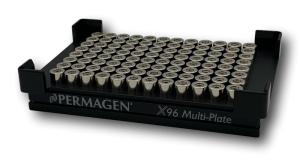
Permagen’s most universal ring magnet plate. From Low elution PCR applications up to 2 mL deep well, the X96 has you covered. No need to purchase two separate plates anymore. Smaller inner ring magnet allows for volumes as low as 5 µL, larger outer magnet handles up to 2 mL deep well
Detail
Permagen’s most universal ring magnet plate. From Low elution PCR applications up to 2 mL deep well, the X96 has you covered. No need to purchase two separate plates anymore. Smaller inner ring magnet allows for volumes as low as 5 µL, larger outer magnet handles up to 2 mL deep well
ANSI/ SBS Footprint (127.75mm x 85.50mm) to fit into any automated liquid handling robot on bottom, SBS/ SLAS fit on top to accept any microplate
Integrated Cushion base for maximum recovery. Helps aid in set-up, robot positioning inconsistencies, and labware consumable differences
Features include solid aluminum alloy construction and hard coat anodized finish for years of trouble-free use, and compatible with any magnetic beads
Produced by reverse osmosis, ion-exchange, electro-deionization, ultrafiltration, UV treatment (UVC & 185 nm), 0.1 μm membrane filtration
Nuclease-free, protease-free, endotoxin-free
Suitable for molecular biology applications (qPCR, NGS etc.)
Suitable for cell culture applications
Produced in an ISO certified GMP laboratory
Water system is routinely monitored for compliance with QC standards
The Norgen water purification system has been designed in conjunction with experts from Millipore Sigma. The Ultrapure NFW is purified in a two-stage process. The first stage, to produce type II water, includes pre-treatment with activated charcoal and polyphosphate, this water then undergoes reverse osmosis, electro-deionization and ion exchange to remove contaminants as well as UV treatment for disinfection. The Pure water then flows to a second system in a clean room with an additional 4 layers of purification. After passing through an additional ion exchange column, the water is then subjected to Ultrafiltration to remove particulates, bacteria, & ionic contaminants down to trace level, the water is then treated with UV light (182 nm wavelength) to break down organic matter. Lastly a second Ultrafilter for the production of pyrogen-, nuclease- and bacteria-free water at 18.2 MΩ. This water is of utmost purity and suitable for direct use in molecular biology applications such as qPCR and NGS, as well as cell culture and other applications.
Product Specifications
pH
n/a (highly pure water does not contain enough ions for an exact pH determination.)
Recommended Storage
Room Temperature
Grade
Ultrapure (ASTM Type I)
Biological Activity
DNase-, RNase-, Protease-, Endotoxin- Free
TOCs
< 50 ppb
Resistivity
> 18 MΩ-cm
Treatment
Not DEPC-Treated
Quantity
100 mL, 500 mL, 1000 mL
Purification Methods
Activated charcoal, polyphosphate, reverse osmosis, electro-deionization, ion exchange, UV, ultrafiltration
Shipping Conditions
Room Temperature
Details
Applications For use in any molecular biology application
Storage Conditions Norgen’s Nuclease-Free Water should be stored at room temperature. Storage at +4°C or -20°C is optional.
Precautions and Disclaimers This product is designed for research purposes only. It is not intended for human or diagnostic use.
R-Phycoerthyrin (R-RPE) Streptavidin Conjugate designed for Lateral Flow
Our Streptavidin R-Phycoerythrin conjugates are manufactured from a red algae and the first of its kind protein based fluorescent particles specifically desinged for lateral flow applications. R-RPE is a highly absorptive fluorescent molecule that has excellent detectability. It is the fluorochrome of choice when the brightest signal is needed and is therefore used most often when high sensitivity is essential for detectability and/or accuracy.
Consistent lot-to-lot performance resulting from continuous culture of source organisms and high purity. – Very high water solubility – Homogeneous structure with defined molecular weights – Total control on growth conditions and nutrition, which avoids contamination from extraneous organisms and waste found in the open ocean. Proteins are harvested at the optimal stage of the growth cycle to assure uniform product characteristics. The pigment is extracted and stabilized within minutes of harvest, virtually eliminating risks from the action of proteases.
250ul stock ready to use for lateral flow
50mL lateral flow running buffer designed for Streptavidin R-Phycoerythrin particles
Excitation max: 566nm
Emission max: 575nm
Document
R-RPE is manufactured from a red algae
Protein based fluorescent particles specifically desinged for lateral flow applications
Highly absorptive fluorescent molecule with excellent detectability
With the development of molecular biology, stool, a new non-invasive sample, has been widely used in the research of animal molecular genetics, population ecology, behavioral ecology and some intestinal disease diagnosis. Stool samples includes gut microbial DNA, food residue sample DNA, and alimentary tract exfoliated cell DNA.
The primary problem encountered when using stool sample for molecular biology research is the low content of exfoliated cells in the digestive tract and a certain degree of degradation of genetic material in stool. Another issue in molecular scatology research based on PCR is the presence of a large number of inhibitors in stool that can affect Taq enzyme activity, leading to downstream detection inactivation. These inhibitors include polysaccharides, plant polysaccharides, bile acids, bile salts, bile pigments, digestive juices, mucus, etc. Therefore, selecting appropriate extraction methods to obtain high-quality DNA is the key to successful downstream detection of stool DNA.
At present, the pretreatment methods used in the laboratory, such as phenol/chloroform extraction, cetyltrimethyl bromide (CTAB) lysis, and guanidine isothiocyanate lysis, lack universality in different species, and the success rate of extracting DNA for PCR amplification is also very low. The HiPure Stool DNA Kit provided by Magen Company has opened up a new approach for DNA extraction from stool samples with good universality, high cost-effectiveness, high yield and purification. The reagent kit adopts a unique solution system and inhibitory factor adsorbent, which can efficiently remove various impurities in stool samples. The purified DNA can be directly used for PCR, quantitative PCR and other applications.
This product allows rapid and reliable isolation of high-quality genomic DNA from various stool samples. Up to 100 mg soil samples can be processed in 60 minute. The system combines the reversible nucleic acid binding properties of HiPure matrix with the speed and versatility of spin column technology to eliminate PCR inhibiting compounds such as humic acid from soil samples. Purified DNA is suitable for PCR, restriction digestion, and next-generation sequencing. There are no organic extractions thus reducing plastic waste and hands-on time to allow multiple samples to be processed in parallel.
Details
Specifications
Features
Specifications
Main Functions
Isolation total DNA from 50-100mg stool samples
Applications
PCR, Southern Blot, enzyme digestion and NGS, etc.
Purification method
Mini spin column
Purification technology
Silica technology
Process method
Manual (centrifugation or vacuum)
Sample type
Stool
Sample amount
50-100mg
Yield
3-15μg
Elution volume
≥30μl
Time per run
≤60 minutes
Liquid carrying volume per column
750μl
Binding yield of column
100μg
Principle
Stool sample is homogenized and then treated in a specially formulated buffer containing detergent to lyse bacteria, yeast, and fungal samples. Humic acid, proteins, polysaccharides, and other contaminants are removed using our proprietary Absorber Solution. Binding conditions are then adjusted and the sample is applied to a DNA Mini Column. Two rapid wash steps remove trace contaminants and pure DNA is eluted in low ionic strength buffer. Purified DNA can be directly used in downstream applications without the need for further purification.
Advantages
High purity – unique adsorbent can completely remove inhibitory factors
High concentration – maximum extraction of total DNA from stool samples
High recovery – DNA can be recovered at the level of PG
Good repeatability – silica technology can obtain ideal results every time
Kit Contents
Contents
D314102
D314103
Purification Times
50 Preps
250 Preps
HiPure DNA Mini Columns II
50
250
2ml Collection Tubes
50
250
2ml Bead Tubes
50
250
Proteinase K
24 mg
120 mg
Protease Dissolve Buffer
1.8 ml
10 ml
Buffer SPL
40 ml
200 ml
Buffer PCI
40 ml
200 ml
Buffer AL
20 ml
80 ml
Buffer GW1
22 ml
88 ml
Buffer GW2
20 ml
2 x 50 ml
Buffer AE
15 ml
30 ml
Storage and Stability
Proteinase K and Buffer PCI should be stored at 2-8°C upon arrival. However, short-term storage (up to 12 weeks) at room temperature (15-25°C) does not affect their performance. The remaining kit components can be stored at room temperature (15-25°C) and are stable for at least 18 months under these conditions. The entire kit can be stored at 2–8°C, but in this case buffers should be redissolved before use. Make sure that all buffers are at room temperature when used.
Document
With the development of molecular biology, stool, a new non-invasive sample, has been widely used in the research of animal molecular genetics, population ecology, behavioral ecology and some intestinal disease diagnosis. Stool samples includes gut microbial DNA, food residue sample DNA, and alimentary tract exfoliated cell DNA.
The primary problem encountered when using stool sample for molecular biology research is the low content of exfoliated cells in the digestive tract and a certain degree of degradation of genetic material in stool. Another issue in molecular scatology research based on PCR is the presence of a large number of inhibitors in stool that can affect Taq enzyme activity, leading to downstream detection inactivation. These inhibitors include polysaccharides, plant polysaccharides, bile acids, bile salts, bile pigments, digestive juices, mucus, etc. Therefore, selecting appropriate extraction methods to obtain high-quality DNA is the key to successful downstream detection of stool DNA.
At present, the pretreatment methods used in the laboratory, such as phenol/chloroform extraction, cetyltrimethyl bromide (CTAB) lysis, and guanidine isothiocyanate lysis, lack universality in different species, and the success rate of extracting DNA for PCR amplification is also very low. The HiPure Stool DNA Kit provided by Magen Company has opened up a new approach for DNA extraction from stool samples with good universality, high cost-effectiveness, high yield and purification. The reagent kit adopts a unique solution system and inhibitory factor adsorbent, which can efficiently remove various impurities in stool samples. The purified DNA can be directly used for PCR, quantitative PCR and other applications.
This product allows rapid and reliable isolation of high-quality genomic DNA from various stool samples. Up to 100 mg soil samples can be processed in 60 minute. The system combines the reversible nucleic acid binding properties of HiPure matrix with the speed and versatility of spin column technology to eliminate PCR inhibiting compounds such as humic acid from soil samples. Purified DNA is suitable for PCR, restriction digestion, and next-generation sequencing. There are no organic extractions thus reducing plastic waste and hands-on time to allow multiple samples to be processed in parallel.