Norgen’s EXTRAClean Urine Cell-Free Circulating RNA Purification Kits provide a fast, reliable, reproducible, and simple procedure for isolating circulating RNA and exosomal RNA from various urine inputs ranging from 250 μL and up to 30 mL. The purified RNA is of the highest integrity, and can be used in a number of downstream applications including real-time PCR, reverse transcription PCR, Northern blotting, RNase protection and primer extensions, and expression array assays.
EXTRAClean Cell-Free Circulating RNA Purification Mini Kit: For sample volumes ranging from 250 μL to 2 mL
EXTRAClean Cell-Free Circulating RNA Purification Midi Kit: For sample volumes ranging from 2mL to 10mL. The first column will handle the large volume input of urine that is followed by a concentration on a mini column for a final elution of 50 μL to 100 μL
EXTRAClean Cell-Free Circulating RNA Purification Maxi Kit: For sample volumes ranging from 10 mL to 30 mL. The first column will handle the large volume input of urine that is followed by a concentration on a mini column for a final elution of 50 μL to 100 μL.
All sizes, including miRNA and small RNA (< 200 nt)
Average Yields ¥
Variable depending on specimen
¥Please check page 5 of protocol for average urine yields and common RNA quantification methods.
Storage Conditions and Product Stability
All buffers should be kept tightly sealed and stored at room temperature. These kits are stable for 2 years after the date of shipment. It is recommended to warm Lysis Buffer A for 20 minutes at 60°C if any salt precipitation is observed.
Produced by reverse osmosis, ion-exchange, electro-deionization, ultrafiltration, UV treatment (UVC & 185 nm), 0.1 μm membrane filtration
Nuclease-free, protease-free, endotoxin-free
Suitable for molecular biology applications (qPCR, NGS etc.)
Suitable for cell culture applications
Produced in an ISO certified GMP laboratory
Water system is routinely monitored for compliance with QC standards
The Norgen water purification system has been designed in conjunction with experts from Millipore Sigma. The Ultrapure NFW is purified in a two-stage process. The first stage, to produce type II water, includes pre-treatment with activated charcoal and polyphosphate, this water then undergoes reverse osmosis, electro-deionization and ion exchange to remove contaminants as well as UV treatment for disinfection. The Pure water then flows to a second system in a clean room with an additional 4 layers of purification. After passing through an additional ion exchange column, the water is then subjected to Ultrafiltration to remove particulates, bacteria, & ionic contaminants down to trace level, the water is then treated with UV light (182 nm wavelength) to break down organic matter. Lastly a second Ultrafilter for the production of pyrogen-, nuclease- and bacteria-free water at 18.2 MΩ. This water is of utmost purity and suitable for direct use in molecular biology applications such as qPCR and NGS, as well as cell culture and other applications.
Product Specifications
pH
n/a (highly pure water does not contain enough ions for an exact pH determination.)
Recommended Storage
Room Temperature
Grade
Ultrapure (ASTM Type I)
Biological Activity
DNase-, RNase-, Protease-, Endotoxin- Free
TOCs
< 50 ppb
Resistivity
> 18 MΩ-cm
Treatment
Not DEPC-Treated
Quantity
100 mL, 500 mL, 1000 mL
Purification Methods
Activated charcoal, polyphosphate, reverse osmosis, electro-deionization, ion exchange, UV, ultrafiltration
Shipping Conditions
Room Temperature
Details
Applications For use in any molecular biology application
Storage Conditions Norgen’s Nuclease-Free Water should be stored at room temperature. Storage at +4°C or -20°C is optional.
Precautions and Disclaimers This product is designed for research purposes only. It is not intended for human or diagnostic use.
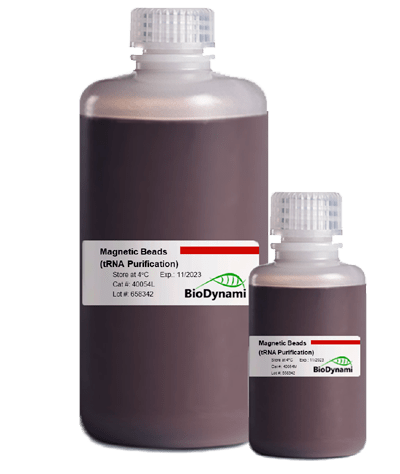
Solid Phase Reversible Immobilization magnetic beads has been used for nucleic acids purification because they are effective, simple, and fast. The carboxyl groups coated beads are paramagnetic particles that reversibly bind to nucleic acid. However, there is a drawback for magnetic beads that it can only purify DNA/RNA that are 100 base pairs or longer. tRNA and other DNA/RNA fragments shorter than 100 base pairs are not effectively recovered. We have developed Magnetic Beads(tRNA Purification) to overcome the hurdle.
The Magnetic Beads(tRNA Purification) solves the tRNA and short DNA/RNA purification problem. The beads with our proprietary technology purify tRNA effectively by removing impurities and unwanted components such as dNTPs, detergents, salts, proteins, and other contaminants. The magnetic bead reagents can be used for oligo (>70 nt) applications.
Workflow without large RNA/DNA contamination
In the case of samples contaminated with RNA/DNA such as rRNA and DNA, our magnetic beads can effectively remove RNA/DNA that are 180 nt and larger. Purified tRNA are ideal for applications requiring high quality, as the fragments are free of impurities and contaminants.
Workflow with large RNA/DNA contamination
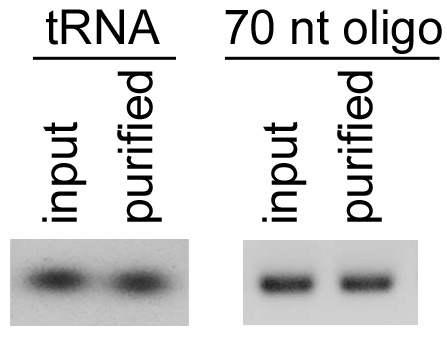
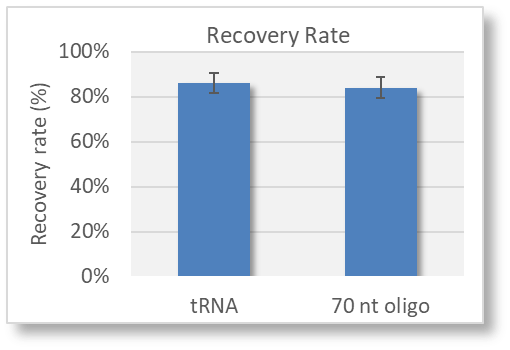
Comparison of tRNA and 70 nt oligos recovery. BioDynami beads (tRNA purification) successfully recovered DNA fragments both yeast tRNA and 70 nt oligos.
Recovery of tRNA and 70 nt oligos with BioDynami magnetic Beads (tRNA Purification). Yeast tRNA and 70 nt oligos were used as input. Input and recovered oligos were quantified with ssDNA Quantification kit (BioDynami Cat. # 40043) and RNA Quantification kit (BioDynami Cat. # 40044).
Depletion of larger RNAs. Left panel: depletion of 28S rRNA and 18S rRNA. Right panel: depletion of RNA of 180 nt and larger.
Features
Removal of unwanted components and other impurities
Purification of tRNA and oligos (>70 nt)
tRNA
RNA fragments 70 nt or longer
DNA/RNA hybrid fragments 70 nt or longer
Oligo and chimeric oligo 70 nt or longer
dsDNA fragments 70 bp or longer
ssDNA fragments 70 nt or longer
Removal of larger RNA/DNA contamination:
18S rRNA
28S rRNA
RNA/DNA> 180 nt
Document
Solid Phase Reversible Immobilization magnetic beads has been used for nucleic acids purification because they are effective, simple, and fast. The carboxyl groups coated beads are paramagnetic particles that reversibly bind to nucleic acid. However, there is a drawback for magnetic beads that it can only purify DNA/RNA that are 100 base pairs or longer. tRNA and other DNA/RNA fragments shorter than 100 base pairs are not effectively recovered. We have developed Magnetic Beads (tRNA Purification) to overcome the hurdle.