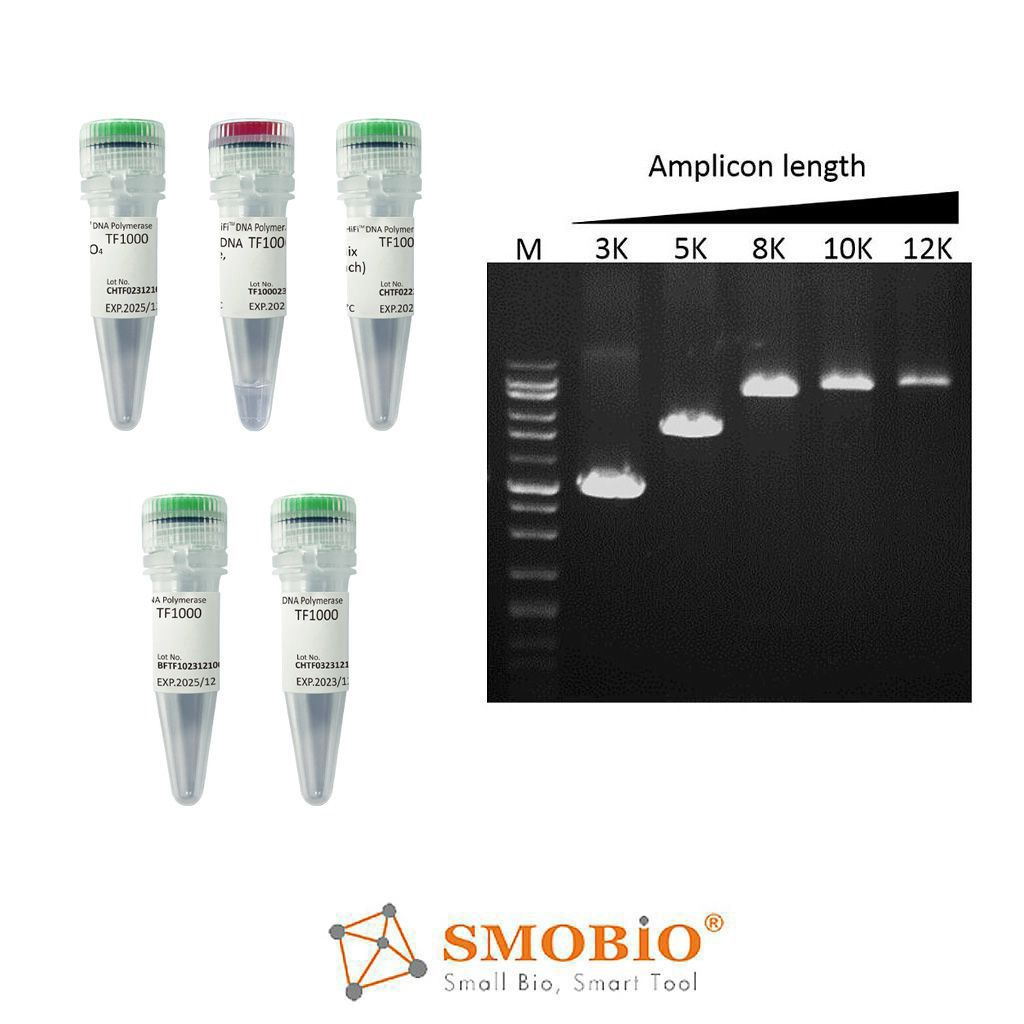
The SMO-HiFi™ DNA Polymerase is a new genetically modified, recombinant DNA polymerase with fidelity 70 times higher than Taq DNA polymerase during amplification, as well as very high elongation rate. Being highly thermostable, SMO-HiFi™ DNA Polymerase can remain viable even after being subjected to boiling for 2 minutes. The SMO-HiFi™ DNA Polymerase is also designed to operate in much lower Mg2+ concentration as compared to other DNA polymerase products.
Detail
Description
The SMO-HiFi™ DNA Polymerase is a new genetically modified, recombinant DNA polymerase with fidelity 70 times higher than Taq DNA polymerase during amplification, as well as very high elongation rate. Being highly thermostable, SMO-HiFi™ DNA Polymerase can remain viable even after being subjected to boiling for 2 minutes. The SMO-HiFi™ DNA Polymerase is also designed to operate in much lower Mg2+ concentration as compared to other DNA polymerase products.
Features
5’→3′ DNA polymerase activity
3’→5′ exonuclease (proofreading) activity
High reaction rate (up to 1 kb/10 seconds)
High fidelity, 70 times higher than Taq DNA polymerase
Blunt end amplicons
Thermo-stable: half-life is more than 10 hrs at 95°C
Storage
[TF1000] SMO-HiFi™ DNA Polymerase
-20°C for 24 months
Other Products
Bis-propargyl-PEG8
Product Info
Document
Product Info
Bis-propargyl-PEG8 consists of two propargyl groups which can react with azide-bearing compounds or biomolecules in copper catalyzed Click Chemistry to form stable triazole linkage. Reagent grade, for research purpose. Please contact us for GMP-grade inquiries.
Document
Bis-propargyl-PEG8 consists of two propargyl groups which can react with azide-bearing compounds or biomolecules in copper catalyzed Click Chemistry to form stable triazole linkage. Reagent grade, for research purpose. Please contact us for GMP-grade inquiries.
Storage term: stored at ≤-20℃,keep away from light, avoid heavy weight and repeated freezing and thawing.
Term of Validity: 14 months
Isothermal nucleic acid Principle Summary
This kit is based on a rapid nucleic acid amplification technology at room temperature and constant temperature:at room temperature and constant temperature(generally 39℃~42℃),reverse transcriptaseuses specific primers and template RNA tosynthesize cDNA strands,and binds the auxiliary protein and single strand with the help of the protein, the recombinase and the primer form a complex; perform a homology search and bind the target homology domain, at this time a D-loop region is formed at the homology positionand strand exchange begins; accompanied by the recombinase from the complex upon dissociation,the polymerase also bindsto the 3′ end of the primer,initiating chainextension.It is suitable for laboratory-level RNA amplification and RNA amplification for other detection purposes.
Isothermal nucleic acid Product Features
1/ High sensitivity and specificity, short reaction time.
2/ The reagent form is freeze-dried, stable and easy to operate.
3/ The reaction can be operated by metal bath and water bath pot without purchasing expensive PCR apparatus.
Technical Parameters:
Parameters
Details
Product Name
RNA Isothermal Amplification Kit Basic
Manufacturer
Amp-future
Storage Temperature
-20°C
Kit Components
Enzymes, Buffers ,Reagents
Packaging
48 Tests/box
Detection Limit
500-1000copies/µL
Shipping
ICE
Test Time
5-20mins
Isothermal nucleic acid Applications
Suitable for RNA isothermal rapid amplification kit(Basic type)
Primer: Require pair of nucleotide primers with the length of 25-35 bp.
RNA basic kit reaction temperature is 39 to 42℃ and time is 5-20 minutes.
Notes
1/ Please avoid nucleic acid contamination and set blank control during reaction due to the high sensitivity of the kit.
2/ Please take out the required quantity of MIRA reaction units for the experiment, and put the rest under storage conditions when performing the experiment.
Our SNPsig® kits use our own proprietary genotyping method to enable the identification of SARS-CoV-2 variants of concern. These products can be used on any real-time PCR machine using familiar protocols, whilst resulting in exceptional genotyping data.
Positive control templates for wild-type and variants are supplied in every kit to make data interpretation simple.
Our SNPsig® technology provides an alternative to sequencing as well as S gene target failure (SGTF) that enables scientists to analyse and monitor these specific genomic mutations. Our kits can provide a pivotal role in screening for SARS-CoV-2 variants for the purpose of genomic surveillance and studies.
Document
Detection of the SARS-CoV-2 variants with the 20B/S.484K mutation, also known as P2 Rapid detection of specific detection profiles High priming efficiency Sensitive to < 100 copies of target
Positive copy number standard curve for quantification
Accurate controls to confirm findings
96 reactions, includes master mix