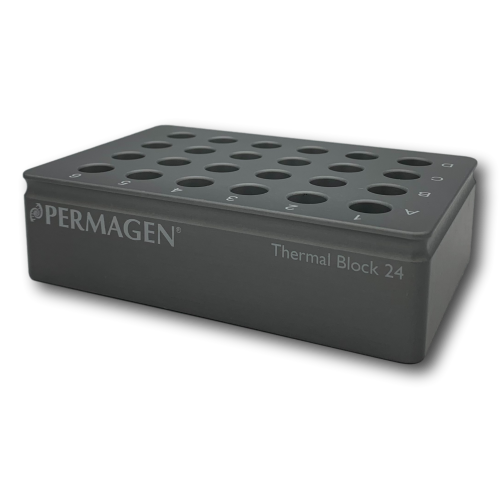
Permagen’s SBS/ANSI footprint 24-Tube thermal block allows the use of up to twenty four 1.5 mL -2 mL Microcentrifuge tubes, or screw-cap vials for keeping sample temperatures consistent. Can be used for heating as well
Detail
1.5 mL – 2 mL Micro-centrifuge Tube or Screw-Cap Vial Chiller Block
SKU: CB024
Permagen’s SBS/ANSI footprint 24-Tube thermal block allows the use of up to twenty four 1.5 mL -2 mL Microcentrifuge tubes, or screw-cap vials for keeping sample temperatures consistent. Can be used for heating as well
Other Products
Cellulase Assay Kit (CellG3 Method)
Product Info
Document
Product Info
K-CellG3
180 / 360 assays per kit
Content:
180 / 360 assays per kit
Shipping Temperature:
Ambient
Storage Temperature:
Short term stability: 2-8oC, Long term stability: See individual component labels
Stability:
> 2 years under recommended storage conditions
Analyte:
endo-Cellulase
Assay Format:
Spectrophotometer, Auto-analyser
Detection Method:
Absorbance
Wavelength (nm):
400
Signal Response:
Increase
Limit of Detection:
0.05 U/mL
Reproducibility (%):
~ 3%
Total Assay Time:
~ 20 min
Application examples:
Fermentation broths, industrial enzyme preparations and biofuels research.
The CellG3 assay reagent for the measurement of endo-cellulase (endo-1,4-β-glucanase) contains two components; 1) 4,6-O-benzylidene-2-chloro-4-nitrophenyl-β-D-cellotrioside (BCNPG3) and 2) thermostable β-glucosidase. The benzylidene blocking group prevents any hydrolytic action by the β-glucosidase on BCNPG3. Incubation with an endo-cellulase generates a non-blocked colourimetric oligosaccharide that is rapidly hydrolysed by the ancillary β-glucosidase. The rate of formation of 2-chloro-4-nitrophenol is therefore directly related to the hydrolysis of BCNPG3 by the endo-cellulase. The reaction is terminated and the phenolate colour is developed on addition of Tris buffer solution (pH 9.0).
Please note that a new assay kit (K-CellG5) is now available for the measurement of endo-cellulase. The CellG5 reagent contains a cellopentaose core and exhibits vastly improved sensitivity for some cellulases. In addition, the exchange of the benzylidene blocking group in CellG3 for 3-keto-butylidene in CellG5 improves the substrate’s water solubility significantly, allowing for a reduction in the concentration of DMSO required in the assay. As DMSO is known to inhibit certain cellulases, this is another benefit in using CellG5. Megazyme now recommends the use of K-CellG5 for all assays for the measurement of endo-cellulase.
The CellG3 assay reagent for the measurement of endo-cellulase (endo-1,4-β-glucanase) contains two components; 1) 4,6-O-benzylidene-2-chloro-4-nitrophenyl-β-D-cellotrioside (BCNPG3) and 2) thermostable β-glucosidase. The benzylidene blocking group prevents any hydrolytic action by the β-glucosidase on BCNPG3. Incubation with an endo-cellulase generates a non-blocked colourimetric oligosaccharide that is rapidly hydrolysed by the ancillary β-glucosidase. The rate of formation of 2-chloro-4-nitrophenol is therefore directly related to the hydrolysis of BCNPG3 by the endo-cellulase. The reaction is terminated and the phenolate colour is developed on addition of Tris buffer solution (pH 9.0).
All-in-one solution for inclusion body protein isolation and purification
Fast and convenient spin column protocol
Complete kit with Cell Lysis Reagent, Inclusion Body Solubilization Reagent, buffers and spin columns to purify proteins
Purification is based on spin column chromatography that uses Norgen’s resin separation matrix
These kits provide everything required to isolate and purify inclusion body proteins from induced bacterial cultures. First a proprietary Cell Lysis Reagent is used to selectively lyse the cells and release inclusion bodies in their solid form. Next, inclusion bodies are dissolved and their contents released using the provided IB Solubilization Reagent. Inclusion body proteins are then further purified using spin columns for rapid and convenient buffer exchange and desalting. This kit provides a convenient way to screen recombinants prior to scaling up.
ProteoSpin™ Inclusion Body Protein Isolation Micro Kit
The process is efficient and streamlined and can process up to 12 samples in only 60 minutes. Each spin column is able to recover up to 50 µg of acidic or basic proteins. Purified recombinant proteins are then ready for SDS-PAGE, 2D gels, Western blots, Mass Spectrometry analysis, and other applications.
ProteoSpin™ Inclusion Body Protein Isolation Maxi Kit
The procedure is efficient and streamlined and can process up to 4 samples in approximately 2 hours. Each spin column is able to recover up to 12 mg of acidic or basic proteins from 100 mL of induced bacterial culture. Purified recombinant proteins are then ready for SDS-PAGE, 2D gels, Western blots, Mass Spectrometry analysis, and other applications.
About Inclusion Bodies
Bacteria are widely used for the expression of different proteins. However, 70-80% of the proteins expressed in bacteria by recombinant techniques are typically contained in insoluble inclusion bodies (i.e., protein aggregates). The protein of interest found in these subcellular structures is often inactive, due to incorrect folding. The production rate of recombinant proteins stored in inclusion bodies is invariably higher than those synthesized as soluble proteins. The reason behind this is thought to be the resistance of insoluble proteins to proteolysis by cellular enzymes. In addition, separation of insoluble recombinant proteins in inclusion bodies is considerably easier than that of soluble proteins. These factors have been the major influences favoring scale-up of high-value proteins using bacterial fermentation for example. Procedures for the purification of the expressed proteins from inclusion bodies are often labour-intensive, time-consuming and not cost-effective. This kit provides the essential reagents for cell disruption, inclusion body solubilization and purification using spin column chromatography – all optimized to work together thereby simplifying the process and saving a tremendous amount of time and cost.
Storage Conditions The Cell Lysis Reagent and IB Solubilization Reagent should be stored at 4°C upon receipt of this kit. This kit is stable for 2 years after the date of shipment. Once opened, the solutions should be stored at 4°C when not in use except for Binding Buffer C and Binding Buffer N. Some precipitation will occur with 4°C storage. This precipitation should be dissolved with slight heating to room temperature before using.
Component
Cat. 10300 (Micro – 25 preps)
Cat. 17700 (Maxi – 4 preps)
Wash Solution C
30 mL
130 mL
Wash Solution N
30 mL
130 mL
Binding BUffer A
4 mL
20 mL
Binding Buffer N
4 mL
20 mL
Elution Buffer C
8 mL
2 x 30 mL
Protein Neutralizer
4 mL
4 mL
Cell Lysis Reagent
15 mL
110 mL
IB Solubilization Reagent
2 mL
50 mL
Syringes, 1cc, slip tip
25
–
Needles (Bev, 20G x 1 inch)
25
–
Syringes, 10 mL, Luer-Lok™ Tip
–
4
Needles (18G x 1.5 inch)
–
4
Micro Spin Columns
25
–
Maxi Spin Columns (filled with SiC) inserted into 50 mL collection tubes
Short term stability: 2-8oC, Long term stability: See individual component labels
Stability:
> 2 years under recommended storage conditions
Analyte:
Pyruvic Acid
Assay Format:
Spectrophotometer, Microplate, Auto-analyser
Detection Method:
Absorbance
Wavelength (nm):
340
Signal Response:
Decrease
Linear Range:
0.3 to 40 µg of pyruvic acid per assay
Limit of Detection:
0.39 mg/L
Reaction Time (min):
~ 3 min
Application examples:
Wine, beer, fruit juices, soft drinks, cheese, dietary supplements, pharmaceuticals and other materials (e.g. biological cultures, samples, etc.).
Method recognition:
Novel method
For the specific and rapid measurement and analysis of pyruvic acid in beer, wine, fruit juice, food products and bodily fluids.
Note for Content: The number of manual tests per kit can be doubled if all volumes are halved. This can be readily accommodated using the MegaQuantTM Wave Spectrophotometer (D-MQWAVE).
Display our full list of assay kits for various organic acids.
Advantages
Very cost effective
All reagents stable for > 2 years after preparation
Very rapid reaction (~ 3 min)
Mega-Calc™ software tool is available from our website for hassle-free raw data processing
Standard included
Suitable for manual, microplate and auto-analyser formats
Document
For the specific and rapid measurement and analysis of pyruvic acid in beer, wine, fruit juice, food products and bodily fluids.