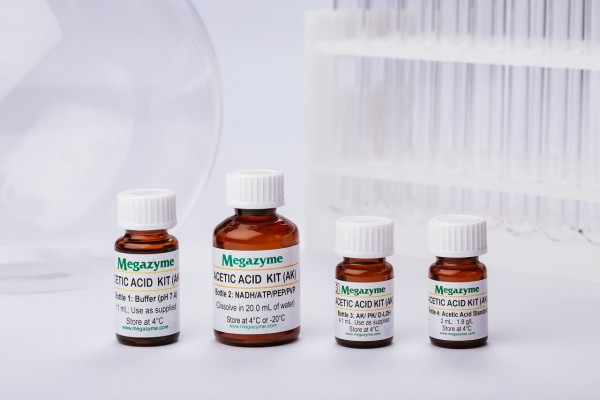
The Acetic Acid analyser format test kit is suitable for the specific measurement and analysis of acetic acid (acetate) in beverages and food products. On calibration, the prepared reagent is linear to > 28 micrograms of acetic acid per mL of assay solution.
Detail
K-ACETAK
SKU: 700004256
170.5 mL of prepared reagent (e.g. 550 assays of 0.31 mL)
Content:
170.5 mL of prepared reagent (e.g. 550 assays of 0.31 mL)
Shipping Temperature:
Ambient
Storage Temperature:
Short term stability: 2-8oC, Long term stability: See individual component labels
Stability:
> 2 years under recommended storage conditions
Analyte:
Acetic Acid
Assay Format:
Auto-analyser
Detection Method:
Absorbance
Wavelength (nm):
340
Signal Response:
Decrease
Linear Range:
up to 1.8 g/L of acetic acid per assay
Limit of Detection:
10 mg/L (recommended assay format)
Reaction Time (min):
~ 10 min
Application examples:
Wine, beer, fruit and fruit juices, soft drinks, vinegar, vegetables, pickles, dairy products (e.g. cheese), meat, fish, bread, bakery products (and baking agents), ketchup, soy sauce, mayonnaise, dressings, paper (and cardboard), tea, pharmaceuticals (e.g. infusion solutions), feed and other materials (e.g. biological cultures, samples, etc.).
Method recognition:
Improved method
The Acetic Acid analyser format test kit is suitable for the specific measurement and analysis of acetic acid (acetate) in beverages and food products. On calibration, the prepared reagent is linear to > 28 micrograms of acetic acid per mL of assay solution.
View our complete list of organic acid assay kits.
Advantages
Very stable reagent when prepared for auto-analyser applications (> 7 days at 4oC)
PVP incorporated to prevent tannin inhibition
Linear calibration (R2 ~ 0.9995) up to 30 μg/mL of acetic acid in final reaction solution
Validated by the University of Wine, Suze la Rousse, France
Very rapid reaction
Very competitive price (cost per mL of reagent)
All reagents stable for > 2 years
Extended cofactors stability
Other Products
D3117 HiPure Tissue&Blood DNA 96 Kit
Product Info
Document
Product Info
Introduction
Blood samples contain rich DNA, including mitochondrial DNA, genomic DNA, circulating DNA (mostly released into blood after tumor cell apoptosis) in white blood cells, as well as parasitic viral or microbial DNA. These DNA are important parameters in clinical testing or diagnosis, which are also valuable materials for medical research. There are three main issues with extracting DNA from blood samples:
1. The sample is highly infectious, posing great harm to operators and the environment.
2. The source of DNA is complex and aportion of the nucleic acid, such as viral DNA or free DNA, may be lost during the operation, leading to downstream detection failure;
3. Blood sample contains a large amount of impurities and inhibitory factors.
Currently there are many methods available for extracting DNA from whole blood samples, such as phenol chloroform extraction, salting out method, etc. However, these methods require pre-treatment of blood sample, which removes red blood cells and isolate white blood cells in the first step. Due to the requirement that it cannot inactivate or kill pathogens during the process of removing red blood cells, the waste liquid (red blood cell lysate) and consumables may be contaminated by pathogens and become infectious, posing a danger to the entire laboratory environment and operators. In addition, during the process of removing red blood cells, useful nucleic acid information such as viruses, microorganisms, or circulating DNA is also lost, leading to experiment or detection failures.
The HiPure Blood DNA Kits series provided by Magen Company uses silica gel column purification technology, which can directly lyse whole blood samples without the need for white blood cell separation. Whole blood samples are directly mixed with lysates and proteases, resulting in the inactivation of pathogens, greatly reducing the infectivity, environmental pollution, and the chance of operators being infected. Due to the direct lysis and digestion of samples, except lymphocyte DNA, other circulating DNA as well as DNA from viruses and microorganisms, can also be recovered.
This product provides fast and easy methods for purification of total DNA for reliable PCR and Southern blotting. Total DNA (e.g., genomic, viral, mitochondrial) can be purified from tissue, whole blood, plasma, serum, buffy coat, bone marrow, other body fluids, lymphocytes, cultured cells.
Details
Specifications
Features
Specifications
Main Functions
Isolation total DNA from blood, tissue, culture cells, swab, blood spots using 96 plate
Applications
PCR, southern bolt and virus detection, etc
Purification method
96 well plate
Purification technology
Silica technology
Process method
Manual (centrifugation or vacuum)
Sample type
Blood, serum, plasma, milk, saliva, and other liquid samples and cultured cells
Sample amount
Elution volume
Time per run
Liquid carrying volume per column
Binding yield of column
Principle
This product is based on silica column purification. The sample is lysed and digested with lysate and protease, DNA is released into the lysate. Transfer to an adsorption column. Nucleic acid is adsorbed on the membrane, while protein is not adsorbed and is removed with filtration. After washing proteins and other impurities, Nucleic acid was finally eluted with low-salt buffer (10mm Tris, pH9.0, 0.5mm EDTA).
Advantages
High quality DNA – meet a variety of downstream applications, including PCR, qPCR, enzyme digestion, hybridization, etc.
High throughput – 96 samples can be processed simultaneously
Kit Contents
Contents
D311701
D311702
Purification Times
1 x 96
4 x 96
HiPure gDNA Plate
1
4
96 well Plate (2.2ml)
1
4
1.6ml Collection Plate
1
4
0.5ml Collection Plate
1
4
Silicon Seal Tape
1
4
Seal Film
5
25
Buffer ATL
30 ml
100 ml
Buffer AL
30 ml
100 ml
Buffer DW1
60 ml
250 ml
Buffer GW2
50 ml
2 x 100 ml
Proteinase K
50 ml
200 ml
Protease Dissolve Buffer
5 ml
15 ml
Buffer AE
30 ml
120 ml
Storage and Stability
Proteinase K should be stored at 2-8°C upon arrival. However, short-term storage (up to 12 weeks) at room temperature (15-25°C) does not affect their performance. The remaining kit components can be stored at room temperature (15-25°C) and are stable for at least 18 months under these conditions.
Blood samples contain rich DNA, including mitochondrial DNA, genomic DNA, circulating DNA (mostly released into blood after tumor cell apoptosis) in white blood cells, as well as parasitic viral or microbial DNA. These DNA are important parameters in clinical testing or diagnosis, which are also valuable materials for medical research. There are three main issues with extracting DNA from blood samples:
Opentrons OT-2 Tips, 1000µL. Optimized for volumes 100µL to 1000µL Clear Tips, Polypropylene. These tips are DNAse/RNAse, pyrogen and protease free – they are sterilized from ebeam irradiation. Not autoclavable.