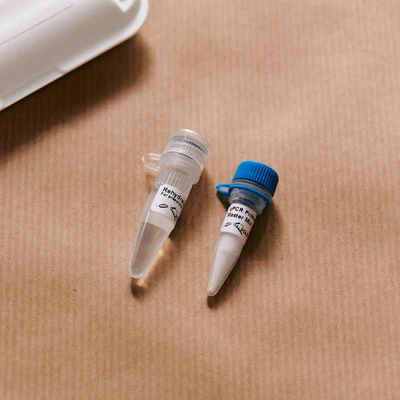
qPCR Probe 2x LyoCake Master Mix simplifies your PCR setup and can be stored at room temperature. A cool chain is not needed anymore. The Master Mix is freeze-dried and dissolves within a few seconds after addition of the included rehydration buffer.
Detail
qPCR Probe 2x LyoCake Master Mix simplifies your PCR setup and can be stored at room temperature. A cool chain is not needed anymore. The Master Mix is freeze-dried and dissolves within a few seconds after addition of the included rehydration buffer.
After rehydration of the LyoCake, only primers, probes and template need to be added as the 2x Master Mix contains all components for a successful and reliable qPCR. This ensures reproducible results, significantly reduces set-up times and the risk of pipetting errors. The robustness of qPCR performance allows the application of this mix in a wide range of PCR applications.
For research use and further manufacturing.
In case you are aiming to use our RUO products as components or for your development of e.g. an IVD medical device, please contact us.
1X MOPS-SDS Running Buffer Powder is used for electrophoresis on Q-PAGE™ Bis-Tris Precast Gel or polyacrylamide gels in Bis-Tris buffer system. It is convenient and universal for electrophoresis in Bis-Tris buffer system.
Features
Reliable: Rigorous quality control for reproducible separation of protein electrophoresis.
Convenient: Premeasured pouches make 1 liter of 1X buffer solution; No pH adjustment is necessary.
Fast: Dissolving in minutes and then ready to use.
Stable: Powder packaging suitable for long-term storage.
Contents
50mM Tris Base, 50mM MOPS, 0.1% SDS, 1mM EDTA
Applications
Running buffer for sodium dodecyl sulfate-polyacryamide gel electrophoresis (SDS-PAGE) in Bis-Tris buffer system
Storage
Room temperature for 24 months
Document
1X MOPS-SDS Running Buffer Powder is used for electrophoresis on Q-PAGE™ Bis-Tris Precast Gel or polyacrylamide gels in Bis-Tris buffer system. It is convenient and universal for electrophoresis in Bis-Tris buffer system.
HiPure Insect DNA Kits provides a simple and rapid solution for total DNA extraction of insect tissue samples. This kit is based on silica gel column purification technology without toxic phenol chloroform extraction and time-consuming alcohol precipitation. The whole extraction process only takes 30 minutes. HiPure Insect DNA Kit can process tissue samples less than 10mg at a time. Hipure Insect DNA 96 kit can process 96 insect tissue samples at a high throughput. The obtained DNA can be directly used in PCR, Southern blot, viral DNA detection and other experiments.
Details
Specifications
Features
Specifications
Main Functions
Isolation total DNA from <10 mg insect tissue
Applications
PCR, southern bolt and virus detection, etc
Purification method
Midi spin column
Purification technology
Silica technology
Process method
Manual (centrifugation or vacuum)
Sample type
Insect tissue samples
Sample amount
<10 mg
Elution volume
≥15μl
Time per run
≤30 minutes
Liquid carrying volume per column
800μl
Binding yield of column
100μg
Principles
This product is based on silica column purification. The sample is lysed and digested with lysate and protease, DNA is released into the lysate. Transfer to an adsorption column. Nucleic acid is adsorbed on the membrane, while protein is not adsorbed and is removed with filtration. After washing proteins and other impurities, Nucleic acid was finally eluted with low-salt buffer (10mm Tris, pH9.0, 0.5mm EDTA).
Advantages
High purity DNA – can be used in sensitive downstream applications such as multiplex and quantitative pcr
Fast – several samples can be extracted in less than 30 minutes
Good repeatability – suitable for extracting high-yield DNA from insect tissue samples
Safe – without phenol chloroform extraction and alcohol precipitation
Kit Contents
Contents
D312902
D312903
Purification Times
50
250
HiPure DNA Mini Columns I
50
250
2ml Collection Tubes
50
250
Buffer ITL
30 ml
120 ml
Buffer IL*
30 ml
120 ml
Buffer GW1*
22 ml
110 ml
Buffer GW2*
20 ml
2 x 50 ml
Proteinase K
24 mg
120 mg
Protease Dissolve Buffer
1.8 ml
15 ml
Buffer AE
15 ml
60 ml
Storage and Stability
Proteinase K should be stored at 2-8°C upon arrival. However, short-term storage (up to 12 weeks) at room temperature (15-25°C) does not affect their performance. The remaining kit components can be stored at room temperature (15-25°C) and are stable for at least 18 months under these conditions. The entire kit can be stored at 2–8°C, but in thiscase buffers should be redissolved before use. Make sure that all buffers areat room temperature when used.
Document
HiPure Insect DNA Kits provides a simple and rapid solution for total DNA extraction of insect tissue samples. This kit is based on silica gel column purification technology without toxic phenol chloroform extraction and time-consuming alcohol precipitation. The whole extraction process only takes 30 minutes. HiPure Insect DNA Kit can process tissue samples less than 10mg at a time. Hipure Insect DNA 96 kit can process 96 insect tissue samples at a high throughput. The obtained DNA can be directly used in PCR, Southern blot, viral DNA detection and other experiments.
For the rapid detection and of coliforms and E. coli.
Principle:
Peptone and yeast extract powder provides carbon and nitrogen sources and trace elements; sodium chloride maintains osmotic equilibrium; agar as medium coagulant; dodecyl sulfate inhibit Gram-positive bacteria; chromogenic substrate were mixed occurrence of coliforms and E. coli enzyme corresponding specific reactions, hydrolysis of the substrate, the release of the color groups, in a pale yellow plates coliforms appears orange-red colonies while E.coli appears blue-green colonies.
Formulation (per liter):
Peptone 15.0g
Yeast extract powder 3.0g
Sodium chloride: 5.0g
Sodium lauryl sulfate: 0.1g
Agar: 12.0g
Mixed chromogenic substrate: 6.77g
Final pH 7.0 ± 0.2
How to use: 1. Weigh 41.9g of the product, adding , 1.0 L of distilled or deionized water, heated to boiling stir until completely dissolved, dispensing into flask, 115 autoclaved 10minutes.
2, Take 25.0g or 25.0mL of sample with sterile procedures, added to the flask containing 225.0mL of sterile phosphate buffered saline (or saline) ,shaken thoroughly homogenized with a homogenizer or a 1:10 dilution of 1min solution, diluted 1:10 and then continue to select the appropriate serial dilutions of three, the two plates inoculated with each dilution, poured dissolved by heating and cooled to about 45 medium.
3, observe the results.
Quality control:
This product appears light yellow after pouring on plate, these strains were inoculated after 36 ± 1 18 ~ 24h culture growth in the following table.
Bacteria name bacteria NO. growth situation feature
Escherichia coli ATCC25922 good blue-green colonies
Citrobacter ATCC8090 good orange-red colonies
Salmonella typhimurium CMCC50115 good colorless colonies
Enterococcus faecalis ATCC29212 suppressed —–
Storage: Store in a dark, cool and dry place, tighten the caps immediately after use. Storage period of two years.