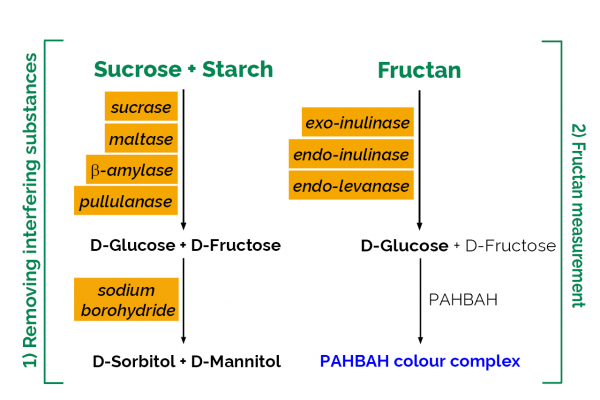
The Fructan Assay Kit is suitable for the specific measurement of fructan in plant extracts, animal feed and food products containing starch, sucrose and other sugars. It is used in three validated methods for the determination of fructan: AOAC method 999.03 (foods), AOAC method 2018.07 (Animal Feed) and AOAC method 2016.14 (infant formula and adult nutritionals).
Detail
K-FRUC
SKU: 700004285
100 assays per kit
Content:
100 assays per kit
Shipping Temperature:
Ambient
Storage Temperature:
Short term stability: 2-8oC, Long term stability: See individual component labels
Stability:
> 2 years under recommended storage conditions
Analyte:
Fructan
Assay Format:
Spectrophotometer
Detection Method:
Absorbance
Wavelength (nm):
410
Signal Response:
Increase
Linear Range:
2.3 to 55 µg of D-fructose or D-glucose per assay
Limit of Detection:
0.16 g/100 g
Total Assay Time:
~ 90 min
Application examples:
Flours, infant formula, animal feed, pet foods, plant materials (e.g. onion), food products and other materials
Method recognition:
AACC Method 32-32.01, AOAC Method 999.03, AOAC Method 2016.14, AOAC Method 2018.07 and CODEX Method Type III
The Fructan Assay Kit is suitable for the specific measurement of fructan in plant extracts, animal feed and food products containing starch, sucrose and other sugars. It is used in three validated methods for the determination of fructan: AOAC method 999.03 (foods), AOAC method 2018.07 (Animal Feed) and AOAC method 2016.14 (infant formula and adult nutritionals).
New, improved procedure.
In the most recent development, a recombinant endo-levanase has been incorporated into the fructanase mixture, extending the use of the method to the measurement of levan-type fructans as are present in grasses such as timothy, cocksfoot, ryegrass and red fescue.
The method described in this booklet employs ultra-pure, recombinant enzymes and specifically measures fructans including inulin-type fructans from chicory, dahlia, jerusalem artichoke; highly branched fructans from onion and wheat stems and leaves; and levan-type fructans from pasture grasses such as timothy grass. The enzymes employed are completely devoid of contaminating enzymes active on β-glucan or gluco-oligosaccharides.
All kit reagents stable for > 2 years after preparation
Unaffected by high sucrose / reducing sugar concentrations
Fructan kits are only available from Megazyme
Simple format
Mega-Calc™ software tool is available from our website for hassle-free raw data processing
Standard included
Other Products
Cat.# 20109S, 20109L: Size range 1-5 kb
Product Info
Document
Product Info
The series of DNA Size Selection Kits (Magnetic Beads) were developed for DNA size selection using magnetic beads. A total of 11 kits are available, with different selection ranges spanning from 50 bp to over 10 kb. The kits provide a simple and quick approach for the enrichment of a specific range of DNA fragments. The kit workflow allows double-sided or single-sided size selection for specific size cutoffs.
Gel images of different ranges of size selection. Sheared human genomic DNA was used as input.
.
DNA size selection is a selective capture of DNA fragments of a specific range of size for next-generation sequencing (NGS) library preparations, PCR, ChIP assay, DNA ligations, endonuclease digestions, adapter removal, and other genomics and molecular biology applications. DNA size selection is preferred after NGS library prep in most of the cases. The NGS library preparation is related to the quality of the sequencing data. Precise NGS library size selection can increase sequencing efficiency, improve data quality, and reduce costs.
There are two types of sequencing technologies: short-read sequencing and long-read sequencing. Short-read sequencing uses DNA libraries that contain small insert DNA fragments of similar sizes, usually several hundred base pairs. The sequencing efficiency can be improved if the DNA size selection is in the right range. Cat.# 20104S and 20104L are the best kits for NGS library size selection of illumina paired-end 100 (PE100) sequencing with 100-200 bp library inserts; Cat.# 20105S and 20105L are the best kits for NGS library size selection of illumina paired-end 150 (PE150) sequencing with 150-300 bp library inserts; and Cat.# 20106S and 20106L are the best kits for NGS library size selection of illumina paired-end 300 (PE300) sequencing with 300-600 bp library inserts.
Long-read sequencing uses a large DNA fragment as input and makes very long reads. Usually, library size selection is preferred to remove smaller fragments. Cat.# 20110S and 20110L are the best kits for long-read sequencing size selection with DNA sizes >5 kb, and Cat.# 20111S and 20111L are the best kits for long-read sequencing size selection with DNA sizes >10 kb.
The magnetic beads technology uses paramagnetic particles, also known as SPRI (Solid Phase Reversible Immobilization) beads, to bind DNA reversibly and selectively. DNA fragments can be size-selected and purified by changing the properties of the magnetic beads or SPRI beads. The magnetic beads can easily separate the beads-binding DNA from the contaminants and unwanted components in the samples. The samples after DNA size selection are free of contaminants such as buffer components, enzymes, proteins, salts, dNTPs, primers, and adapters. Our proprietary magnetic beads reagents improve yield, selectivity, and reproducibility.
Specific DNA fragments at a certain length range can be purified simply using magnetic separation with different beads components, avoiding tedious and time-consuming gel extraction and column-based purification. The magnetic beads method is popular for common DNA size selection, including library size selection. The first beads-binding step, referred to as the right-side clean-up, removes large DNA fragments. The large DNA fragments are bound to the beads and are discarded. The desired DNA fragments in the supernatant are transferred to a new well, and new beads are added to the supernatant for the second beads-binding, referred to as the left-side clean-up. The double-size selected DNA fragments are eluted after ethanol rinsing.
DNA size selection with dual clean-ups.
.
A single clean-up is needed for DNA size selection with large fragments. In this case, only the large DNA fragments are bound to the beads. The selected larger DNA fragments are eluted after ethanol rinsing.
DNA size selection with single clean-up for >5 kb and >10 kb DNA.
.
Features of DNA size selection and library size selection
High specificity and high recovery of size selection
11 selection ranges are available, including 5 ranges for NGS library size selection
50-100 bp
100-200 bp
200-500 bp
250-350 bp: ideal for illumina PE100 sequencing
300-450 bp: ideal for illumina PE150 sequencing
450-750 bp: ideal for illumina PE300 sequencing
500-1000 bp
1-3 kb
1-5 kb
>5 kb: ideal for long-read sequencing
>10 kb: ideal for long-read sequencing
Fast and simple
20-min protocol
No gel purification required
No columns required
No centrifugation required
Efficient removal of contaminants and unwanted components
Double-Strand Specific dsDNase (dsDNase) is ideal for fast and effective removal of contaminating DNA from PCR master mixes.
Taq polymerases are commonly contaminated by bacterial DNA. This is a problem in PCR based bacterial typing and detection as it might cause false positive results. The unique properties of dsDNase make it suited for removal of contaminating DNA from PCR master mixes prior to addition of DNA template.
In figure 1, a PCR master mix was treated with different amounts of dsDNase before performing a qPCR to measure the contaminating bacterial DNA in the master mix. ArcticZymes dsDNase effectively removed contaminating DNA below known levels of the assay detection limits.
The dsDNase from Arctic shrimp (Pandalus borealis) is recombinantly produced in Pichia pastoris. It cleaves phosphodiester linkages in DNA to yield oligonucleotides with 5’-phosphate and 3’-hydroxyl termini.
The specific activity is estimated to be 30 times higher than that of bovine DNase I. In the presence of magnesium as only divalent cation and using oligos as a substrate, the activity towards dsDNA is 5000-fold higher than towards ssDNA.
The unique double strand-specificity allows specific degradation of dsDNA while leaving shorter ssDNA as primers and probes essentially intact. Easy inactivation by moderate heat (65°C) allows addition of DNA intended for analysis directly after removal of contaminating DNA.
Can be heat-inactivated by moderate heat treatment (65°C for 15 minutes)
Producing 5′-phospho-oligonucleotide products
Figures
Figure 1. The dsDNase effectively removes contaminated DNA
The dsDNase effectively removes contaminated DNA:
A PCR master mix was preincubated with various concentrations of dsDNase. After treatment, no DNA was amplified in non-template controls.
Properties
Specificity towards double-stranded DNA
Nucleic acid specificity has been tested towards double- and single-stranded DNA and RNA oligonucleotides. The specificity of dsDNase towards the substrate has been measured using 15-mer oligonucleotides with FAM at 5′ and DarkQuencher® 3′ (Eurogentec). The fluorescence is proportional to enzyme activity. Assay conditions: 25 mM Tris pH 7.5, 5 mM MgCl2, and 2 μM oligonucleotide.
Double-Strand Specific dsDNase (dsDNase) is ideal for fast and effective removal of contaminating DNA from PCR master mixes.
Taq polymerases are commonly contaminated by bacterial DNA. This is a problem in PCR based bacterial typing and detection as it might cause false positive results. The unique properties of dsDNase make it suited for removal of contaminating DNA from PCR master mixes prior to addition of DNA template.