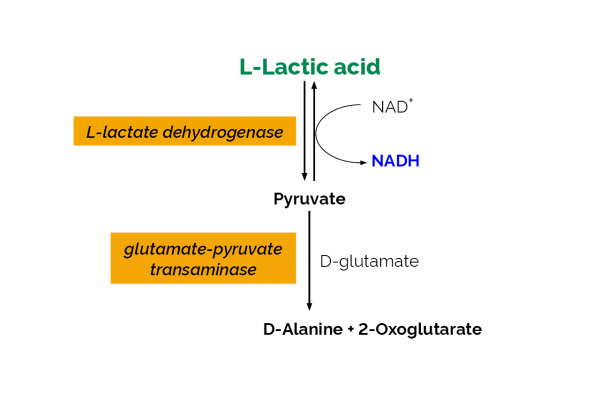
The L-Lactic Acid (L-Lactate) Assay Kit is used for the specific measurement and analysis of L-lactic acid (L-lactate) in beverages, meat, dairy and food products.
Short term stability: 2-8oC, Long term stability: See individual component labels
Stability:
> 1 year under recommended storage conditions
Analyte:
L-Lactic Acid
Assay Format:
Spectrophotometer, Microplate, Auto-analyser
Detection Method:
Absorbance
Wavelength (nm):
340
Signal Response:
Increase
Linear Range:
0.3 to 30 µg of L-lactic acid per assay
Limit of Detection:
0.21 mg/L
Reaction Time (min):
~ 10 min
Application examples:
Wine, beer, soft drinks, milk, dairy products (e.g. cream, milk / whey powder, cheese, condensed milk and yogurt), foods containing milk (e.g. dietetic foods, bakery products, baby food, chocolate, sweets and ice-cream), egg, egg products (e.g. egg powder), baking additives, vinegar, fruit and vegetables, processed fruit and vegetables (e.g. tomatoes), meat products, food additives, feed, paper (and cardboard), cosmetics, pharmaceuticals and other materials (e.g. biological cultures, samples, etc.).
Method recognition:
Methods based on this principle have been accepted by DIN, GOST, IDF, EEC, EN, ISO, OIV, IFU, AIJN and MEBAK
The L-Lactic Acid (L-Lactate) Assay Kit is used for the specific measurement and analysis of L-lactic acid (L-lactate) in beverages, meat, dairy and food products.
Note for Content: The number of manual tests per kit can be doubled if all volumes are halved. This can be readily accommodated using the MegaQuantTM Wave Spectrophotometer (D-MQWAVE).
Extended cofactors stability. Dissolved cofactors stable for > 1 year at 4oC.
Very competitive price (cost per test)
All reagents stable for > 2 years after preparation
Rapid reaction
Mega-Calc™ software tool is available from our website for hassle-free raw data processing
Standard included
Suitable for manual, microplate and auto-analyser formats
Other Products
HCM078 Sabouraud Dextrose Broth
Product Info
Document
Product Info
Introduction
Usages:
For cultivations of yeasts , moulds and acidophilic bacteria.
Principle:
Peptone and yeast extract powder provides carbon and nitrogen sources and trace elements; lactose are fermentable sugars; sodium chloride maintains osmotic equilibrium; the 3rd bile salts and crystal violet inhibiting gram-positive bacteria, especially against Gram positive bacteria and fecal streptococci; neutral red as pH indicator.
Formulation(per liter):
Peptone 5g
Tryptone 5g
Glucose 20g
Final pH 5.7 ± 0.1
How to use:
1.Suspend 30g in 1 L of distilled water , stirring heated to boiling until completely dissolved, dispensing flask, 121 autoclave for 15min.
2.Diluted and treated samples.
Quality control:
Item
The name and number of strain
Growth
Colony Color
1
Aspergillus niger ATCC16404
Good
Spore surface growth
2
Candida albicans ATCC10231
Good
Cloudy broth
3
Escherichia coli ATCC25922
Inhibition
—
Storage: Keep container tightly closed, store in a cool, dry place, away from bright light. Storage period of 3 years.
Attogene has developed a set of RNase-Free Lateral Assay Buffers specifically designed for developers of Nucleic Acid-based lateral flow tests
Components
RNase Free Running Buffer Screening Buffer Pack – Five 10 mL bottles of diverse running buffers
Set of 5 RNase-Free Lateral flow running buffers at specifically developed for optimizing nucleic acid based lateral flow assays. Each buffer is certified RNase-Free and tested functionally in RNA and DNA based lateral flow tests.
Features & Benefits
Can be used for development of a lateral flow assay for detection of a nucleic acids.
Cost-effective way to screen multiple buffers for lateral flow assay development knowing they have been functionally tested to be RNase-Free.
Chlamydia trachomatis, the causative agent of Chlamydia, is a Gram negative bacteria. Transmission of the bacteria occurs via contact with infected bodily fluids which then infect mucosal membranes. It can be transmitted from mother to child during pregnancy and infect the eyes causing conjunctivitis. The genital infection causes urethritis, epididymitis and prostatitis in males and Pelvic Inflammatory Disease (PID) in females with an increased risk of contracting HIV. The infection can be treated with a course of antibiotics. Sexually transmitted infections in females are most often asymptomatic, but can be noticeable in chronic pain of the pelvic region, vaginal bleeding and painful urination. Infection of the ovaries, fallopian tubes or uterus causes Pelvic Inflammatory Disease (PID) which can lead to difficulties in conceiving, increased risk of ectopic pregnancy or infertility. Infections in males are more likely to be symptomatic, causing painful urination, discharge from the penis and swollen testicles and may eventually cause infertility if left untreated.
Chlamydia TaqMan PCR Kit, 100 reactions
Ready to use format, including Master Mix for the target and PCR control to monitor for PCR inhibition and validate the quality
Specific Primer and Probe mix for the pathogen/virus/viroid of interest
Primer and Probe mix
Positive and negative control to confirm the integrity of the kit reagents
Chlamydia TaqMan PCR Probe/Primer Set and Controls, 100 reactions
Specific Primer/Probe mix and Positive Control for the pathogen/virus/viroid of interest
Nuclease-free water
Can be used together with Norgen’s PCR Master Mix (#28007) or customer supplied master mix
For research use only and NOT intended for in vitro diagnostics.
Storage Conditions and Product Stability All kit components can be stored for 2 years after the date of production without showing any reduction in performance.
All kit components should be stored at -20°C upon arrival. Repeated thawing and freezing (> 2 x) of the Master Mix and Positive Control should be avoided, as this may affect the performance of the assay. If the reagents are to be used only intermittently, they should be frozen in aliquots.
Component
Cat. TM30950 (100 preps)
Cat. TM30910 (100 preps)
MDx TaqMan 2X PCR Master Mix
2 x 700 μL
–
Chlamydia Primer & Probe Mix
280 μL
280 μL
Chlamydia Positive Control
150 μL
150 μL
Nuclease-Free Water (Negative Control)
1.25 mL
1.25 mL
Product Insert
1
1
Overview
Detection kits for Chlamydia
Available in TaqMan format for analysis
Chlamydia trachomatis, the causative agent of Chlamydia, is a Gram negative bacteria. Transmission of the bacteria occurs via contact with infected bodily fluids which then infect mucosal membranes. It can be transmitted from mother to child during pregnancy and infect the eyes causing conjunctivitis. The genital infection causes urethritis, epididymitis and prostatitis in males and Pelvic Inflammatory Disease (PID) in females with an increased risk of contracting HIV. The infection can be treated with a course of antibiotics. Sexually transmitted infections in females are most often asymptomatic, but can be noticeable in chronic pain of the pelvic region, vaginal bleeding and painful urination. Infection of the ovaries, fallopian tubes or uterus causes Pelvic Inflammatory Disease (PID) which can lead to difficulties in conceiving, increased risk of ectopic pregnancy or infertility. Infections in males are more likely to be symptomatic, causing painful urination, discharge from the penis and swollen testicles and may eventually cause infertility if left untreated.
Chlamydia TaqMan PCR Kit, 100 reactions
Ready to use format, including Master Mix for the target and PCR control to monitor for PCR inhibition and validate the quality
Specific Primer and Probe mix for the pathogen/virus/viroid of interest
Primer and Probe mix
Positive and negative control to confirm the integrity of the kit reagents
Chlamydia TaqMan PCR Probe/Primer Set and Controls, 100 reactions
Specific Primer/Probe mix and Positive Control for the pathogen/virus/viroid of interest
Nuclease-free water
Can be used together with Norgen’s PCR Master Mix (#28007) or customer supplied master mix
For research use only and NOT intended for in vitro diagnostics.
Storage Conditions and Product Stability All kit components can be stored for 2 years after the date of production without showing any reduction in performance.
All kit components should be stored at -20°C upon arrival. Repeated thawing and freezing (> 2 x) of the Master Mix and Positive Control should be avoided, as this may affect the performance of the assay. If the reagents are to be used only intermittently, they should be frozen in aliquots.