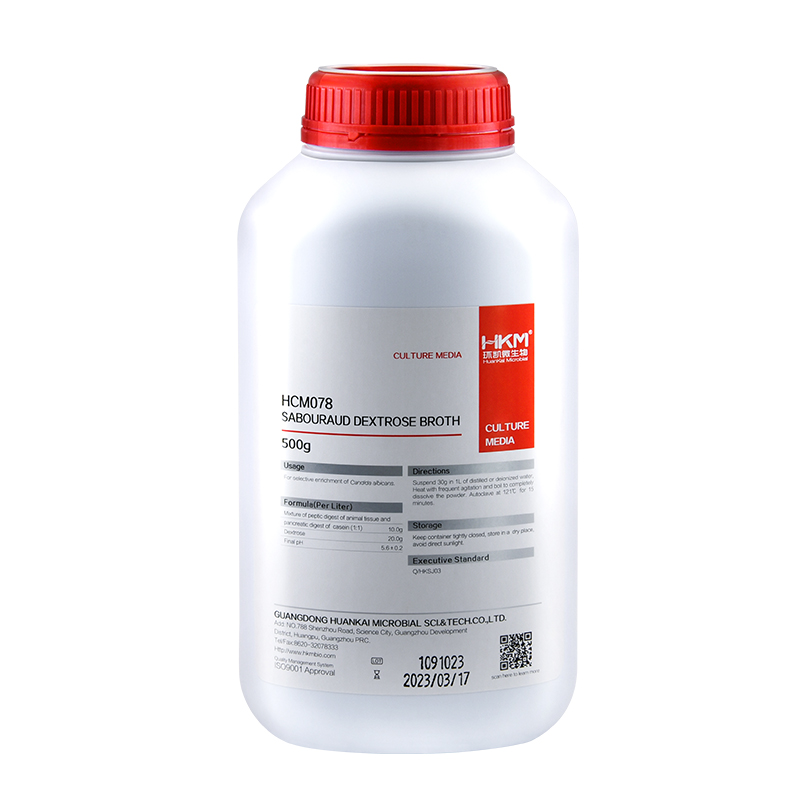
For cultivations of yeasts , moulds and acidophilic bacteria.
Principle:
Peptone and yeast extract powder provides carbon and nitrogen sources and trace elements; lactose are fermentable sugars; sodium chloride maintains osmotic equilibrium; the 3rd bile salts and crystal violet inhibiting gram-positive bacteria, especially against Gram positive bacteria and fecal streptococci; neutral red as pH indicator.
Formulation(per liter):
Peptone 5g
Tryptone 5g
Glucose 20g
Final pH 5.7 ± 0.1
How to use:
1.Suspend 30g in 1 L of distilled water , stirring heated to boiling until completely dissolved, dispensing flask, 121 autoclave for 15min.
2.Diluted and treated samples.
Quality control:
Item
The name and number of strain
Growth
Colony Color
1
Aspergillus niger ATCC16404
Good
Spore surface growth
2
Candida albicans ATCC10231
Good
Cloudy broth
3
Escherichia coli ATCC25922
Inhibition
—
Storage: Keep container tightly closed, store in a cool, dry place, away from bright light. Storage period of 3 years.
Other Products
Galactomannan Assay Kit
Product Info
Document
Product Info
K-GALM
SKU: 700004289
100 Assays per kit
Content:
100 assays per kit
Shipping Temperature:
Ambient
Storage Temperature:
Short term stability: 2-8oC, Long term stability: See individual component labels
Stability:
> 2 years under recommended storage conditions
Analyte:
Galactomannan
Assay Format:
Spectrophotometer
Detection Method:
Absorbance
Wavelength (nm):
340
Signal Response:
Increase
Limit of Detection:
1 g/100 g
Total Assay Time:
~ 90 min
Application examples:
Seeds, milling fractions and food ingredients.
Method recognition:
Novel method
The Galactomannon test kit is suitable for the measurement and analysis of Galactomannan in food and plant products.
Food and beverage samples such as milk or milk based products, wine, fruit juices, paper (and cardboard), waste treatment samples and other materials (e.g. biological cultures etc.).
This product has been discontinued.
The hydrogen peroxide Assay Kit provides a simple robust method for the measurement of hydrogen peroxide. This kit utilizes a highly sensitive Megaplex Red probe which in the presence of horseradish peroxidase (HRP), allows for the measurement of H2O2 in a sample. Upon oxidation of the probe by HRP, a coloured product (resorufin) is formed that can be measured in fluorescence mode using excitation in the range 530-560 nm and emission at ~ 590 nm or colourimetrically at 570 nm. The excitation and emission maxima of Megaplex Red are 571 nm and 585 nm respectively.
Fluorometric/UV method for the determination of H2O2 content in a variety of samples.
Advantages
Simple format
Very competitive price (cost per test)
Ability to run in fluorescence or absorbance mode
User friendly – Detailed protocol provided for the creation of calibration curve and the calculation of concentration in fluorescence mode. Single point standard for quicker and simpler analysis in absorbance mode.
Mega-Calc™ software tool is available from our website for hassle-free raw data processing
Suitable for manual, microplate and auto-analyser formats
All reagents stable for > 2 years
Document
The hydrogen peroxide Assay Kit provides a simple robust method for the measurement of hydrogen peroxide. This kit utilizes a highly sensitive Megaplex Red probe which in the presence of horseradish peroxidase (HRP), allows for the measurement of H2O2 in a sample. Upon oxidation of the probe by HRP, a coloured product (resorufin) is formed that can be measured in fluorescence mode using excitation in the range 530-560 nm and emission at ~ 590 nm or colourimetrically at 570 nm. The excitation and emission maxima of Megaplex Red are 571 nm and 585 nm respectively.
Programmed Death 1 (PD-1) is a member of the CD28/CTLA-4 family of T-cell regulators, expressed as a co-receptor on the surface of activated T-cells, B-cells, and macrophages. New studies have suggested that the PD-1/PD-L1 signaling pathway may be linked to anti-tumor immunity, as PD-L1 has been shown to induce apoptosis of activated T cells or inhibit activity of cytotoxic T cells. In comparison to CD10 and Bcl-6, PD-1 is expressed by fewer B cells and has therefore been considered a more specific and useful diagnostic marker for angioimmunoblastic T-cell lymphoma. Therapies targeted toward the PD-1 receptor have shown remarkable clinical responses in patients with various types of cancer, including non–small-cell lung cancer, melanoma, and renal-cell cancer.