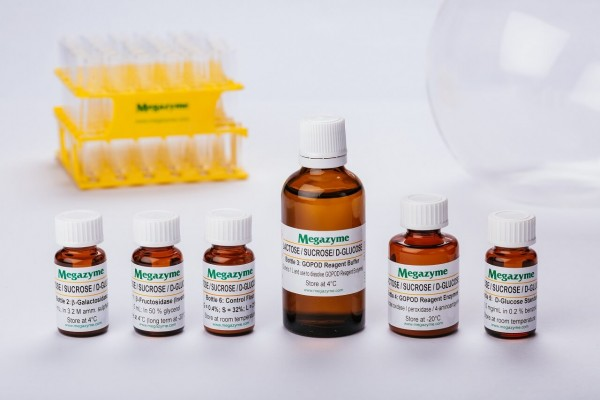
The Lactose/Sucrose/D-Glucose assay kit is suitable for the measurement and analysis of sucrose, lactose and D-glucose in flour mixtures and other materials.
Detail
K-LACSU
100 assays of each per kit
Content:
100 assays of each per kit
Shipping Temperature:
Ambient
Storage Temperature:
Short term stability: 2-8oC, Long term stability: See individual component labels
Stability:
> 2 years under recommended storage conditions
Analyte:
D-Glucose, Lactose, Sucrose
Assay Format:
Spectrophotometer
Detection Method:
Absorbance
Wavelength (nm):
510
Signal Response:
Increase
Limit of Detection:
100 mg/L
Reaction Time (min):
~ 60 min
Application examples:
Flours, beverages, dairy products, milk, foodstuffs containing milk, cosmetics, pharmaceuticals and other materials (e.g. biological cultures, samples, etc.).
The Lactose/Sucrose/D-Glucose assay kit is suitable for the measurement and analysis of sucrose, lactose and D-glucose in flour mixtures and other materials.
All reagents stable for > 12 months after preparation
Simple format
Very specific
Rapid reaction
Mega-Calc™ software tool is available from our website for hassle-free raw data processing
Standard included
Other Products
6-Formyl-2-pyridine-PEG4-DBCO
Product Info
Document
Product Info
6-Formyl-2-pyridine-PEG4-DBCO is a bifunctional PEG linker featuring an aldehyde and a DBCO function. DBCO is a strained cyclooctyne which reacts with azide groups on target molecules while the aldehyde group is a versatile electrophile that is reactive towards amines, hydroxylamines, and hydrazines.
Document
6-Formyl-2-pyridine-PEG4-DBCO is a bifunctional PEG linker featuring an aldehyde and a DBCO function. DBCO is a strained cyclooctyne which reacts with azide groups on target molecules while the aldehyde group is a versatile electrophile that is reactive towards amines, hydroxylamines, and hydrazines.
Short term stability: 2-8oC, Long term stability: See individual component labels
Stability:
> 2 years under recommended storage conditions
Analyte:
Acetic Acid
Assay Format:
Spectrophotometer, Microplate
Detection Method:
Absorbance
Wavelength (nm):
340
Signal Response:
Decrease
Linear Range:
0.3 to 25 µg of acetic acid per assay
Limit of Detection:
0.254 mg/L
Reaction Time (min):
~ 4 min
Application examples:
Wine, beer, fruit and fruit juices, soft drinks, vinegar, vegetables, pickles, dairy products (e.g. cheese), meat, fish, bread, bakery products (and baking agents), ketchup, soy sauce, mayonnaise, dressings, paper (and cardboard), tea, pharmaceuticals (e.g. infusion solutions), feed and other materials (e.g. biological cultures, samples, etc.).
Method recognition:
Improved method
The Acetic Acid (Acetate Kinase Manual Format) test kit is suitable for the measurement and analysis of acetic acid in food and beverages.
This rapid and reliable manual acetic acid kit is simple to perform (only two absorbance readings required), and because a true end-point is measured, does not involve complicated calculations like other kits. This product is very stable both during storage and use (> 2 years), has extended linearity (compared to ACS based kits), contains PVP to prevent tannin inhibition, and is performed at a relatively low pH (7.4), thus minimising ester hydrolysis related interference. This method is suitable for the measurement of acetic acid/acetate in foods, beverages and other materials.
Note for Content: The number of manual tests per kit can be doubled if all volumes are halved. This can be readily accommodated using the MegaQuantTM Wave Spectrophotometer (D-MQWAVE).
View all of our acetic acid and other organic acid assay kits.
Document
The Acetic Acid (Acetate Kinase Manual Format) test kit is suitable for the measurement and analysis of acetic acid in food and beverages.
This rapid and reliable manual acetic acid kit is simple to perform (only two absorbance readings required), and because a true end-point is measured, does not involve complicated calculations like other kits. This product is very stable both during storage and use (> 2 years), has extended linearity (compared to ACS based kits), contains PVP to prevent tannin inhibition, and is performed at a relatively low pH (7.4), thus minimising ester hydrolysis related interference. This method is suitable for the measurement of acetic acid/acetate in foods, beverages and other materials.
Short term stability: 2-8oC, Long term stability: See individual component labels
Stability:
> 2 years under recommended storage conditions
Analyte:
Pullulanase/Limit-Dextrinase
Assay Format:
Spectrophotometer
Detection Method:
Absorbance
Wavelength (nm):
400
Signal Response:
Increase
Limit of Detection:
0.18 U/mL for pullulanase preparations (50-fold dilution) 0.01 U/g for limit dextrinase in milled malt
Reproducibility (%):
~ 3%
Total Assay Time:
~ 10 min (Pullanase), ~ 30 min (Limit-Dextrinase)
Application examples:
Assay of microbial pullulanase preparations. Measurement of limit-dextrinase in malt extracts.
Method recognition:
Novel method
PullG6 assay for the measurement of pullulanase employs a water soluble defined substrate, namely 4,6-O-benzylidene-4-nitrophenyl-63-α-D-maltotriosyl-maltotriose (BPNPG3G3), coupled with the ancillary enzymes α-glucosidase and β-glucosidase. Upon hydrolysis of the substrate at the 1,6-α-linkage by pullulanase or limit-dextrinase, the released 4-nitrophenyl-β-maltotrioside is immediately hydrolysed to glucose and 4-nitrophenol by the concerted action of the α-glucosidase and β-glucosidase enzymes in the reagent mixture. The reaction is terminated and phenolate ions are developed by addition of dilute alkali. The absorbance is read at 400 nm and the value obtained correlates directly with pullulanase activity.