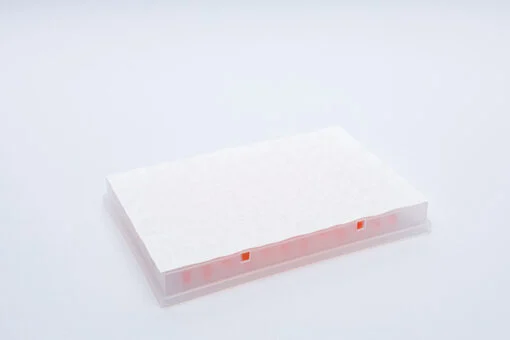
Peelable heat sealing film which is made using gas permeable grid lacquer paper. This seal is suitable for insect studies and seed storage.
Detail
Overview
Peelable heat sealing film which is made using gas permeable grid lacquer paper. This seal is suitable for insect studies and seed storage.
Heat sealing is a quick and cost effective method of plate sealing
Our Gas PermASeal II Heat Seal is a paper with a grid lacquer coating which is porous and gas permeable
The Gas PermeASeal II Heat Seal is compatible with polypropylene, polyethylene, polystyrene and cyclic olefin copolymer (COC) plates
The seal can be removed by peeling, or it can be pierced with a pipette tip manually or using a liquid handling robot
The Seal has a temperature range from -20°C to 80°C
It can be used for insect and seed storage, as it enables gas exchange, whilst providing an inert surface with no adhesive to interfere with the well contents
This seal is available as sheets, for use with manual and semi-automated sealers, such as our HeatASeal 500 Sealing Machine
Also available in roll format compatible with specified automated heat sealers, such as our Wasp or Chameleon XT
Other Products
BKV TaqMan PCR Detection Kits
Product Info
Document
Product Info
Overview
Detection kits for the BKV
Available in TaqMan format for analysis
The BK virus is a member of the polyomavirus family. BK viral infections are typically asymptomatic in healthy individuals, however very mild symptoms may appear including mild respiratory infections and fever. Once an individual has been infected the virus disseminates to the kidneys and the urinary tract where it remains for the lifetime of the individual. Infections with BK virus in immunocompromised or immunosupressed patients are much more severe and may involve renal dysfunction. In fact, in kidney transplant patients the immunosupressive drugs required for the transplant may allow the virus to replicate within the graft, resulting in a disease called BK virus nephropathy (BKVN). It is thought that 1-10% of renal transplant patients progress to BK virus nephropathy (BKVN) and up to 80% of these patients are reported to have lost their grafts. The onset of nephritis can occur as early as several days post-transplant to as late as 5 years. The mode of transmission of the virus is not clear, however it has been suggested that BKV may be transmitted through respiratory fluids or urine, since infected individuals periodically excrete virus in the urine. This virus can be diagnosed by BKV blood & urine testing, in addition to carrying out a biopsy in the kidneys. PCR techniques are now widely used to identify the virus.
BKV TaqMan PCR Kit, 100 reactions
Ready to use format, including Master Mix for the target and PCR control to monitor for PCR inhibition and validate the quality
Specific Primer and Probe mix for the pathogen/virus/viroid of interest
Primer and Probe mix
Positive and negative control to confirm the integrity of the kit reagents
BKV TaqMan PCR Probe/Primer Set and Controls, 100 reactions
Specific Primer/Probe mix and Positive Control for the pathogen/virus/viroid of interest
Nuclease-free water
Can be used together with Norgen’s PCR Master Mix (#28007) or customer supplied master mix
For research use only and NOT intended for in vitro diagnostics.
Storage Conditions and Product Stability All kit components can be stored for 2 years after the date of production without showing any reduction in performance.
All kit components should be stored at -20°C upon arrival.
This product is suitable for rapid extraction of DNA from tissue, cells, blood, saliva, swabs, blood spots, semen and other clinical samples. DNA can be used directly for PCR, quantitative PCR, Southern Blot, test of virus DNA and so on.
Details
Specifications
Features
Specifications
Main Functions
Isolation total DNA from blood, buffy coat, tissue and other samples
Applications
Second generation sequencing, PCR, real time PCR, etc.
Purification method
Polydisperse magnetic beads
Purification technology
Magnetic beads technology
Process method
Manual or automatic
Sample type
Anticoagulant blood, concentrated blood, buffy coat, lymphocytes and cultured cells
This product is based on the purification method of high binding magnetic particles. The sample is lysed and digested under the action of lysate and protease. DNA is released into the lysate. After adding magnetic particles and binding solution, DNA will be adsorbed on the surface of magnetic particles, and impurities such as proteins will be removed without adsorption. The adsorbed particles were washed with washing solution to remove proteins and impurities, washed with ethanol to remove salts, and finally DNA was eluted by Elution Buffer.
Advantages
High purity – OD 260 / 280 : 1.7- 1.9, OD 260 / 230 : 1.5 – 2.0
Economy – less than 50% of the price of Qiagen and other imported products
High yield – most optimal process, ensuring the recovery up to 90%
Strong processing ability – samples including animal blood, cultured cells, animal tissues, etc.
Proteinase K, RNase A, MagPure Particles should be stored at 2-8°C upon arrival. However, short-term storage (up to 24 weeks) at room temperature (15-25°C) does not affect their performance. The remaining kit components can be stored at room temperature (15-25°C) and are stable for at least 18 months under these conditions.
Experiment Data
Document
This product is suitable for rapid extraction of DNA from tissue, cells, blood, saliva, swabs, blood spots, semen and other clinical samples. DNA can be used directly for PCR, quantitative PCR, Southern Blot, test of virus DNA and so on.
RPA/MIRA is used for DNA and RNA nucleic acid templates isothermal amplification , and can be used in the field of molecular detection of viruses, pathogenic bacteria, tissues, cells, etc.
MIRA VS PCR ,MIRA Advantages:
Low and constant temperature, low requirements on instruments
20mins
Only one pair of primers is needed
Fluorescence detection by probe method is also available
High specificity
PCR :Need to control temperature,90 minutes
LAMP:Design three pairs of primers,60minutes,Low specificity
Document
RPA/MIRA is used for DNA and RNA nucleic acid templates isothermal amplification , and can be used in the field of molecular detection of viruses, pathogenic bacteria, tissues, cells, etc.