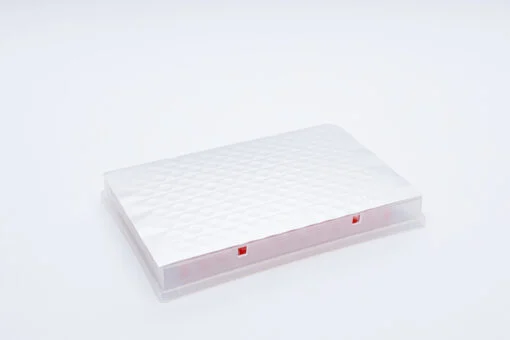
Heavy duty heat sealing foil which is peelable; suitable for long term storage and transportation.
Detail
Overview
Heavy duty heat sealing foil which is peelable; suitable for long term storage and transportation.
Heat sealing offers a 100% effective method of plate sealing, for complete seal integrity, as well as being quick and cost effective
Our ThermASeal Heat Seal is a heavy duty laminate foil seal suitable for providing a very strong, but peelable seal
The seal is compatible with polypropylene plates to provide a high degree of sample protection
It demonstrates very good solvent resistance and can be used for very low temperature compound storage, in DMSO and organic solvents, and long term room temperature storage such that it is recommended as suitable for sample transportation
The seal can be pierced only by using a blade
The seal is available as sheets, for use with manual and semi-automated sealers, such as our HeatASeal 500 Sealing Machine
Also available in multiple roll formats compatible with specified automated heat sealers, such as our Wasp or Chameleon XT
Other Products
C13113 HiPure cfDNA Column Set
Product Info
Document
Product Info
Introduction
Magen’s HiPure columns are prepared by high quality glass fiber filter membrane as raw materials through membrane cutting, membrane release, ring release, ring pressing, gland, weighing and other processes. HiPure nucleic acid adsorption columns have the characteristics of long-term stability and high binding capacity. Experiments show that the highest binding capacity and binding efficiency of HiPure nucleic acid adsorption columns are basically unchanged when stored at room temperature for 4 years.
The series of nucleic acid columns produced by Magen Biotech are based on carefully selected imported glass fiber membranes (GF/B, GF/D, GF/F). Columns production processes such as polypropylene injection molding materials, injection molding process, and downstream membrane packing and compression rings are strictly controlled. This is to ensure that the column has extremely high adsorption capacity and long-term stability. Compared with conventional products on the market, Magen’s columns are with varieties, and binding rate will not change when stored at room temperature for 4 years.
C13114 HiPure cfDNA Mini Column Set I (Centrifuge Method)
C13115 HiPure cfDNA Column Set Ⅱ (Vacuum Method)
Details
Specifications
Features
Specifications
Recommended application
Circulating or viral nucleic acid isolation from large volumes of cell free samples (1-5ml)
Preservation conditions
Room temperature
Stability
Up to 4 years
Filter membrane
High quality glass fiber filter GF/F, 4 layers (3 x GF/F, 1 x GF/B)
Membrane aperture
3 x 0.7μm, 1 x 1.0μm
Maximum binding yield of plasmid
30 μg
Maximum yield of alcohol mediated Binding
200 μg
Single liquid carrying capacity of column
800 μl
Minimum elution volume
30 μl
Withstand centrifugal force
16,000 x g
Centrifuge
Small high speed centrifuge (2ml)
Adsorption Mechanism
Based on the negatively charged DNA skeleton, it has a high affinity for positively charged glass fibers. In high salt and ethanol solutions, DNA/RNA binds to glass fiber and interacts with hydrophilic matrix on silica through hydrogen bond. DNA/RNA is tightly bound. All pollutants can be removed by washing solution. At high salt concentration, nucleic acids selectively bind to silica gel membrane, while other pollutants, mainly proteins, are removed by membrane washing.
Ordering information
CAT.No.
Product Name
Package
C13113
HiPure cfDNA Mini Column (3 x GF/F, 1 x GF/B)
100/Bag
C13114
HiPure cfDNA Mini Column (3 x GF/F, 1 x GF/B)with 50ml Centrifuge Tube, Extender Tube, Collection Tube, Collection Tube Ⅲ
100/Pack
C13115
HiPure cfDNA Mini Column (3 x GF/F, 1 x GF/B)with Collection Tubes, Extender Tube, Vac-Connector
100/Pack
C13301
Vac connector
100/Bag
C13302
Extender Tube
50/Bag
Purchase Guide
Item No.
Product Name
Membrane type/number of layers
Collection tubes
Plasmid DNA binding capacity (Physical adsorption)
Note: GF/B pore size is for 1.0μM glass fiber membrane; GF/F pore size is for 0.7μm glass fiber membrane.
Document
Magen’s HiPure columns are prepared by high quality glass fiber filter membrane as raw materials through membrane cutting, membrane release, ring release, ring pressing, gland, weighing and other processes. HiPure nucleic acid adsorption columns have the characteristics of long-term stability and high binding capacity. Experiments show that the highest binding capacity and binding efficiency of HiPure nucleic acid adsorption columns are basically unchanged when stored at room temperature for 4 years.
Propargyl-PEG10-NHS ester serves as a bifunctional PEG linker with a terminal propargyl that participates in click reactions with azide-bearing moieties and an NHS ester group that reacts readily and efficiently with amine-bearing molecules. The PEG10 units improve the water solubility of the molecule. Reagent grade, for research purpose. Please contact us for GMP-grade inquiries.
Document
Propargyl-PEG10-NHS ester serves as a bifunctional PEG linker with a terminal propargyl that participates in click reactions with azide-bearing moieties and an NHS ester group that reacts readily and efficiently with amine-bearing molecules. The PEG10 units improve the water solubility of the molecule. Reagent grade, for research purpose. Please contact us for GMP-grade inquiries.
Propargyl-PEG6-amine is a crosslinker with a hydrophilic PEG spacer which can increase the hydrophilicity of the molecule in aqueous environment. The amine group is reactive with carboxylic acids, activated NHS esters, carbonyls (ketone, aldehyde) etc. The propargyl group can react with azide-bearing compounds or biomolecules via copper catalyzed azide-alkyne Click Chemistry. Reagent grade, for research purpose. Please contact us for GMP-grade inquiries.
Document
Propargyl-PEG6-amine is a crosslinker with a hydrophilic PEG spacer which can increase the hydrophilicity of the molecule in aqueous environment. The amine group is reactive with carboxylic acids, activated NHS esters, carbonyls (ketone, aldehyde) etc. The propargyl group can react with azide-bearing compounds or biomolecules via copper catalyzed azide-alkyne Click Chemistry. Reagent grade, for research purpose. Please contact us for GMP-grade inquiries.