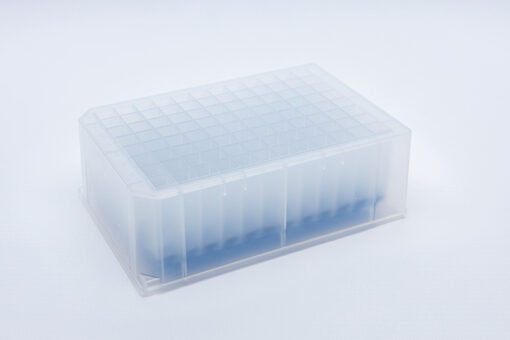
Virgin Polypropylene 96 Square Well plate with high uniformity from well to well.
Detail
Overview
Virgin Polypropylene 96 Square Well plate with high uniformity from well to well.
Working Volume of 2.0ml
Square well with ‘V’ bottom for maximum liquid extraction
High uniformity from well to well
Raised well rims for reliable closing with heat sealing.
Easy and reliable stacking
Good centrifugation stability up to 6,000 × g for faster protocols and improved sample quality
Other Products
R4150 HiPure Plant RNA Plus Kit
Product Info
Document
Product Info
Introduction
This product is suitable for extracting total RNA from 50-150mg conventional plantor fungal samples as well as samples rich in polyphenolic and polysaccharides. This kit is based on silica gel column purification technology, and the extraction process does not require the use of toxic phenol chloroform extraction. The entire extraction process only takes 20-30 minutes. This kit adopts DNA filtration technology, which can efficiently filter and remove DNA. The obtained RNA can be directly used for experiments such as RT-PCR, Northern Blot, poly A+ purification, nucleic acid protection, and in vitro translation.
Details
Kit Contents
Contents
R415002
D415003
Purification Times
50 Preps
250 Preps
HiPure RNA Mini Columns
50
250
gDNA Filter Columns
50
250
2ml Collection Tubes
100
500
TCEP (1M)
0.29 g
5 x 0.29 g
Buffer EP
1.0 ml
5.0 ml
Buffer PSL
50 ml
250 ml
Buffer RW1
50 ml
250 ml
Buffer RW2*
20 ml
2 x 50 ml
RNase Free Water
10 ml
30 ml
Storage and Stability
Except TCEP, the kit components can be stored dry at room temperature (15–25°C) and are stable for at least 18 months under these conditions. After receiving the product, it is recommended to store TCEP (dry powder) at -20-8°C. At low temperatures, Buffer PSL may form precipitates, dissolve it completely by 55°C water bath.
Purchase Guide
1. When dealing with woody or uncommon samples, R4150 is recommended first. R4150 contains two polysaccharide/polyphenol lysis buffer, which is the most universal product.
2. R4151 is recommended for handling common economic crop samples for the first time. Strong lysis solution can be used to process easy-extraction samples. The amount of corn or rice leaves samples can reach up to 300mg.
3. R4165 adopts CTAB/chloroform method, which can also handle a large number of difficult-to-extraction plants, but requires contact with chloroform substitutes, which is less safe than other kits. This kit uses DNase Ⅰ to remove DNA, which is also a good choice for extracting polysaccharide/polyphenol-rich plant samples.
4. R4014 is recommended for fruit/starch plant samples, which uses improved trizol pre-treatment, single column operation and is more economical.
Document
This product is suitable for extracting total RNA from 50-150mg conventional plantor fungal samples as well as samples rich in polyphenolic and polysaccharides. This kit is based on silica gel column purification technology, and the extraction process does not require the use of toxic phenol chloroform extraction. The entire extraction process only takes 20-30 minutes. This kit adopts DNA filtration technology, which can efficiently filter and remove DNA. The obtained RNA can be directly used for experiments such as RT-PCR, Northern Blot, poly A+ purification, nucleic acid protection, and in vitro translation.
Salmonella enterica Quantified Bacterial DNA Standard
Product Info
Document
Product Info
Overview
Quantified standard to be used as a positive control or PCR quantification standard
Vigorously quantified using multiple methods
Salmonella enterica has emerged as a significant foodborne pathogen that poses a serious public health problem. The symptoms of salmonellosis may include diarrhea, fever, vomiting, and abdominal cramps with elderly, new-born, and immunocompromised individuals the most susceptible. S. enterica is a facultatively anaerobic Gram-negative bacterium that could survive low temperatures and freezing. The majority of the 1.3 billion annual cases of Salmonella-caused human gastroenteritis result from ingestion of contaminated food products, such as raw or undercooked meat, seafood, and eggs, as well as raw or unpasteurized milk and dairy products. Salmonella infections are also contracted following consumption of fresh fruits or vegetables that have been contaminated by infected fertilizer.
Norgen’s Salmonella enterica Quantified Bacterial DNA Standard is prepared from cultured bacteria using Norgen’s sample preparation technology. The purified DNA is quantified vigorously using multiple methods including spectrophotometry, gel densitometry and real-time PCR. It is intended to be used as a positive control or PCR quantification standard for Salmonella enterica.
Upon receipt, store Norgen’s Salmonella enterica Quantified Bacterial DNA Standard at -20oC or lower. Avoid multiple freeze-thaw cycles. If needed, prepare smaller working aliquots and store at -20oC or lower.
Nucleic acid testing (NAT) is the method of choice for detection and quantification of a wide range of micro organisms. Primerdesign manufactures and supplies high quality quantitative real-time PCR kits for the detection and simultaneous quantification of numerous significant pathogens . A copy number standard curve is provided for quantification and an the internal extraction template (DNA or RNA), controls for the quality of the nucleic acid extraction and eliminates false negative results.
The kit is designed with the broadest possible detection profile to ensure that all clinically relevant strains and subtypes are detected. Target sequences are selected by working with data from key opinion leaders in the field. Multiple sequence alignments and unprecedented real-time PCR expertise in design and validation ensure the best possible kit. Details of the target and priming specificity are included in the individual handbooks above.
Packaged, optimised and ready to use. Expect Better Data.
Document
Exceptional value for money Rapid detection of all clinically relevant subtypes Positive copy number standard curve for quantification Highly specific detection profile High priming efficiency Broad dynamic detection range (>6 logs) Sensitive to < 100 copies of target
Accurate controls to confirm findings
150 reactions