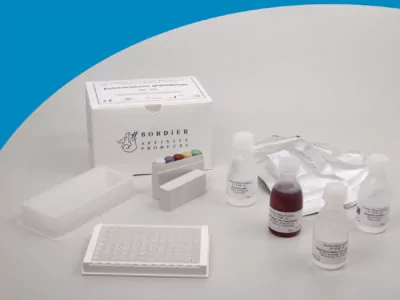
This ELISA kit is intended for the quantitative detection of IgG antibodies against Echinococcus granulosus (and Echinococcus multilocularis) in human serum.
This product is manufactured by Bordier Affinity Products in Switzerland and distributed in Germany exclusively by Milenia Biotec.
Detail
Name of Product
Echinococcus granulosus – IgG ELISA
Catalog Number
AF 9350
Short Info
This ELISA kit is intended for the quantitative detection of IgG antibodies against Echinococcus granulosus (and Echinococcus multilocularis) in human serum.
This product is manufactured by Bordier Affinity Products in Switzerland and distributed in Germany exclusively by Milenia Biotec.
Method/Platform
ELISA in microplate format
Range/Assay Sensivity
pNPP, λ=405 nm
Test Principle
Specific antibodies in the sample bind to Echinococcus granulosus Antigens sensitized on microtiter plates. The presence of parasite specific antibodies is detected with a Protein A – alkaline phosphatase conjugate.
Q-PAGE™ TGN (Tris-Glycine Novel) Precast Gels are ready-to-use acrylamide gels for SDS-PAGE running in Tris-Glycine buffer system. With unique formula, Q-PAGE™ TGN Precast Gels perform enhanced speed, better separation, and longer shelf life as compared with conventional Laemmli Tris-HCl gels. The protein migration patterns in Q-PAGE™ TGN series, however, are similar with typical Laemmli Tris-HCl gels, and thus Q-PAGE™ TGN Precast Gels are compatible to traditional SDS-PAGE and subsequent analyses.
Q-PAGE™ TGN Precast Gels are available in gradient (4 to 15%) and fixed (10%) concentrations of polyacrylamide in 12- and 15-well formats. Two available cassette sizes, Mini (10 x 8.3 cm) and Midi (10 x 10 cm), are compatible with most popular protein electrophoresis systems. Q-PAGE™ Mini (QP4XXX) Gels are suitable for Bio-Rad® and other systems. Q-PAGE™ Midi (QP5XXX) Gels are suitable for Invitrogen® XCell SureLock® Mini-Cell, Invitrogen® Mini Gel Tank, Hoefer SE260, and other systems.
Key Features
User-friendly gel cassette:
Numbered and framed wells for sample loading
Labeled warning sign and green tape as reminder
Enhanced gel performance:
Enhanced gel electrophoresis speed
Better band separation
Stable for shipping at ambient temperature
Easy compatibility:
Available as homogeneous and adjusted gradient gels for a wide range of protein separation.
Compatible with most popular protein electrophoresis systems
Storage and stability
Store Q-PAGE™ Precast Gels at 4°C for periods up to 12 months.
Do not freeze Q-PAGE™ Precast Gels. Remove tape and comb before electrophoresis.
Keep Q-PAGE™ Precast Gels flat during storage.
Document
Q-PAGE™ TGN (Tris-Glycine Novel) Precast Gels are ready-to-use acrylamide gels for SDS-PAGE running in Tris-Glycine buffer system. With unique formula, Q-PAGE™ TGN Precast Gels perform enhanced speed, better separation, and longer shelf life as compared with conventional Laemmli Tris-HCl gels. The protein migration patterns in Q-PAGE™ TGN series, however, are similar with typical Laemmli Tris-HCl gels, and thus Q-PAGE™ TGN Precast Gels are compatible to traditional SDS-PAGE and subsequent analyses.
Q-PAGE™ TGN Precast Gels are available in gradient (4 to 15%) and fixed (10%) concentrations of polyacrylamide in 12- and 15-well formats. Two available cassette sizes, Mini (10 x 8.3 cm) and Midi (10 x 10 cm), are compatible with most popular protein electrophoresis systems. Q-PAGE™ Mini (QP4XXX) Gels are suitable for Bio-Rad® and other systems. Q-PAGE™ Midi (QP5XXX) Gels are suitable for Invitrogen® XCell SureLock® Mini-Cell, Invitrogen® Mini Gel Tank, Hoefer SE260, and other systems.
MagZol Reagent is a reagent system for the isolation of total RNA from cells and tissues. The reagent, a single-phase solution consisting of phenol and guanidine isothiocyanate, is modification of the single-step RNA isolation method developed by Chomczynski and Sacchi. The sample is homogenized and lysed in MagZol Reagent which maintains the integrity of the RNA, while disrupting and denaturing endogenous RNases and other cellular components. Extraction of the lysate with chloroform further denatures proteins and separates the mixture into an organic and an aqueous phase. RNA remains exclusively in the aqueous phase, and is subsequently recovered by isopropanol.
This method is suitable for small quantities of tissue (<100mg) and cells (<5 X10⁶), and large quantities of tissue (up to 1g) and cells (<108), of human, animal, plant, or bacterial origin. The simplicity of the MagZol Reagent method allows simultaneous processing of a large number of samples. The entire procedure can be completed in one hour. Total RNA prepared in this manner can be used for Northern blot analysis, dot blot hybridization, poly(A) + selection, in vitro translation, RNase protection assay, and molecular cloning. For use in amplification by thermal cycling, treatment of the isolated RNA with RNase-free DNase I is recommended when the two amplimers lie within a single exon.
Details
Specifications
Features
Specifications
Main Functions
Extract RNA from liquid samples by salting out method
Applications
RT-PCR, Northern hybridization, poly (a) enrichment, etc.
Purification technology
Acid phenol guanidine isothiocyanate
Process method
Manual (centrifugation)
Sample type
Various liquid samples
Sample amount
Flexible
Elution volume
Variation with sample size
Time per run
Variation with sample size
Advantages
Flexible – sample amount can be adjusted according to the demand
Cost performance -the most economical nucleic acid extraction technology
Storage and Stability
MagZol Reagent should be stored at 2-8°C upon arrival and is stable for at least 24 months under the condition. However, short-term storage (up to 12 weeks) at room temperature (15-25°C) does not affect its performance.
Document
MagZol Reagent is a reagent system for the isolation of total RNA from cells and tissues. The reagent, a single-phase solution consisting of phenol and guanidine isothiocyanate, is modification of the single-step RNA isolation method developed by Chomczynski and Sacchi. The sample is homogenized and lysed in MagZol Reagent which maintains the integrity of the RNA, while disrupting and denaturing endogenous RNases and other cellular components. Extraction of the lysate with chloroform further denatures proteins and separates the mixture into an organic and an aqueous phase. RNA remains exclusively in the aqueous phase, and is subsequently recovered by isopropanol.