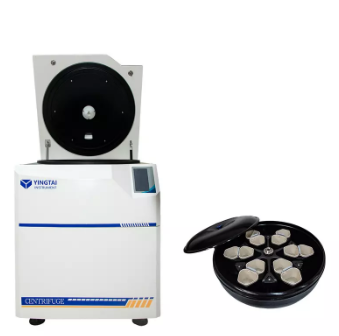
CDL7M touch screen with special programs for blood bag separation, can get good performance for platelet, red cell, all parts separation of blood. 6x2x1000ml bucket suitable for blood bag separation. Also with automatical lid lock open and close function, also wind shield can open along with door open. Model: CDL7M
Brand: Yingtai
Code: CDL7M blood bank centrifug
Detail
Features
1. Brushless frequency motor, in great torque, free maintenance, no power pollution, quick in speed up and down.
2. 7” LCD Touch screen display which indicates the program, rotor No, speed, time, RCF and temperature.
3. CFC-free refrigerant, pre-cooling function ,double cycle cooling, cold and hot alternating easily, free environment pollution and precise in temperature control.
4. Microprocessor control , 100 programs in store, 10 kinds of acceleration and deceleration for your choice.
5. Over speed and imbalance protection.
6. Speed, RCF, time, temperature can be edited during running.
7. High quality steel centrifuge body , stainless steel chamber, built-in stainless steel explosion-proof protect sleeve, 3 tiers protection, safe and reliable.
8. Automatic door open & close, as well as anti-pinch function (Optional).
CDL7M Technical Parameter:
Max. Speed
7000rpm
Max. RCF
11650×g
Max. Capacity
6×2400ml (12*500ml blood bag)
Time Range
1~99h59min59s
RPM/RCF Convert
Yes
Noise (dB)
≤ 65
Temperature
-20 ~ 40℃
Acc/Dec
10 Kinds
Speed Accuracy
±20r/min
Temperature Accuracy
±1℃
Voltage(V/Hz)
AC 220V/380V 50HZ/60HZ
Size (W x D x Hmm)
940×890×1000mm
Net Weight(Kg)
570KG
Certificates
CE,ISO & Calibration report are available
Special rotor for blood bag separation
Order No.
Rotor No.
Max Speed (rpm)
Max Volume(ml)
Max. RCF(×g)
05202
Swing Rotor
4000
6×2x1000ml
5210
Other Products
PROBESURE™ MULTIPLEX MASTER MIX
Product Info
Document
Product Info
ABOUT
ProbeSure Multiplex Master Mix is an enhanced version of ProbeSure Master Mix, formulated to enable users to analyse up to four targets in one reaction well. For example, two bi-allelic SNPs or one reference gene and a further three genes of interest.
Users will require a plate reader capable of reading FAM, HEX, ATTO 550, ATTO 647N and ATTO 633 (the wavelengths of each of these can be found in our ProbeSure Multiplex Master Mix User Guide). ProbeSure Multiplex Master Mix is supplied at 2x concentration for convenience and is supplied with the ATTO 633 normalising dye at either high level (500 nM final concentration), low level (25 nM final concentration) or without ATTO 633.
Simultaneous isolation of both host RNA and microbial RNA (universal protocol)
Isolate full diversity of RNA from large RNA down to small and microRNAs
Eliminates PCR inhibitors including humic acids
High quality RNA for sensitive downstream application
Purification is based on spin column chromatography that uses Norgen’s proprietary resin separation matrix
This kit provides a convenient and rapid method to purify total RNA from small amounts of stool samples. All types of stool samples can be processed with this kit, including animal fecal samples, manure and samples collected using Norgen’s Stool Nucleic Acid Collection and Preservation Tubes (Cat. 45660). The kit removes all traces of humic acids using rapid and simple spin column procedures. Bead tubes are also provided for effective homogenization of stool. The kit purifies all sizes of RNA, from large mRNA and ribosomal RNA down to microRNA and small interfering RNA. Both host and microbial RNA is recovered. The protocol does not rely on the use of phenol or chloroform, thereby providing a user friendly procedure and allowing high-throughput analysis. The purified RNA is of the highest integrity, and can be used in a number of downstream applications including real time PCR and reverse transcription PCR for gene expression analysis. The procedure can be completed in approximately 30 minutes for 10 samples.
Free Download
Extracting Biological Insights from Stool
Tips and tricks for isolating high yield and quality DNA, RNA, miRNA and EV’s from fecal samplesDownload for Free
200 mg (fresh/frozen stool) or 400 μL (preserved stool)
Type of Stool Processed
Preserved, fresh, and frozen stool from humans and animals
Maximum Column Binding Capacity
50 μg
Maximum Column Loading Volume
600 μL
Time to Complete 10 Purifications
30 minutes
Storage Conditions and Product Stability All solutions should be kept tightly sealed and stored at room temperature. This kit is stable for 2 years after the date of shipment.
Isolate all sizes of circulating and exosomal RNA, including microRNA
Versatile plasma/serum input ranges
No phenol extractions
No carrier RNA
Bind and elute all RNA irrespective of size or GC content, without bias
Concentrate circulating RNA and exosomal RNA into a flexible elution volume
High quality, purified RNA is suitable for a variety of downstream applications, including Small RNA Sequencing. Find out more information on Norgen’s NGS services
Compatible with Streck Cell-Free RNA BCT® Tubes
Purification is based on spin column chromatography that uses Norgen’s proprietary resin separation matrix
These kits provide a fast, reliable and convenient method to purify and concentrate high quality, high purity and inhibitor-free cell-free circulating and exosomal RNA using a convenient spin column method. These kits can purify RNA from fresh or frozen serum or plasma samples prepared from blood collected on either EDTA or Citrate. Plasma samples prepared from blood collected on heparin should not be used, as heparin can significantly interfere with many downstream applications such as RT-PCR. The purified plasma/serum RNA is fully compatible with all downstream applications including PCR, qPCR, methylation-sensitive reverse transcription qPCR, reverse transcription PCR, Northern blotting, RNase protection and primer extension, expression array assays, and NGS.
Background
Plasma/Serum cell-free circulating RNA or exosomal RNA has the potential to provide biomarkers for certain cancers and disease states. Exosomes are 40 – 150 nm membrane vesicles, which are secreted by most cell types. Exosomes can be found in saliva, blood, urine, amniotic fluid and malignant ascitic fluids, among other biological fluids. Evidence has been accumulating recently that these vesicles act as cellular messengers, conveying information to distant cells and tissues within the body. These exosomes may play a functional role in mediating adaptive immune responses to infectious agents and tumours, tissue repair, neural communication and transfer of pathogenic proteins. For this reason exosomal RNAs may serve as biomarkers for various diseases including cancer. As the RNA molecules encapsulated within exosomes are protected from degradation by RNAses they can be efficiently recovered from biological fluids, such as plasma or serum.
Plasma/Serum RNA Purification Mini Kit
This kit can purify RNA from fresh or frozen serum or plasma samples prepared from blood collected on either EDTA or Citrate, from volumes ranging from 50 µL to 200 µL. The purified plasma/serum RNA is eluted in a flexible final volume of 10 µL to 25 µL.
Plasma/Serum RNA Purification Midi Kit
This utilizes a two column method, and can purify RNA from fresh or frozen serum or plasma samples prepared from blood collected on either EDTA or Citrate, from volumes ranging from 250 µL to 1.5 mL. The first column will handle the large volume input of bodily fluids that is followed by a concentration on a mini column for a final elution of 50 µL to 100 µL.
Plasma/Serum RNA Purification Maxi Kit
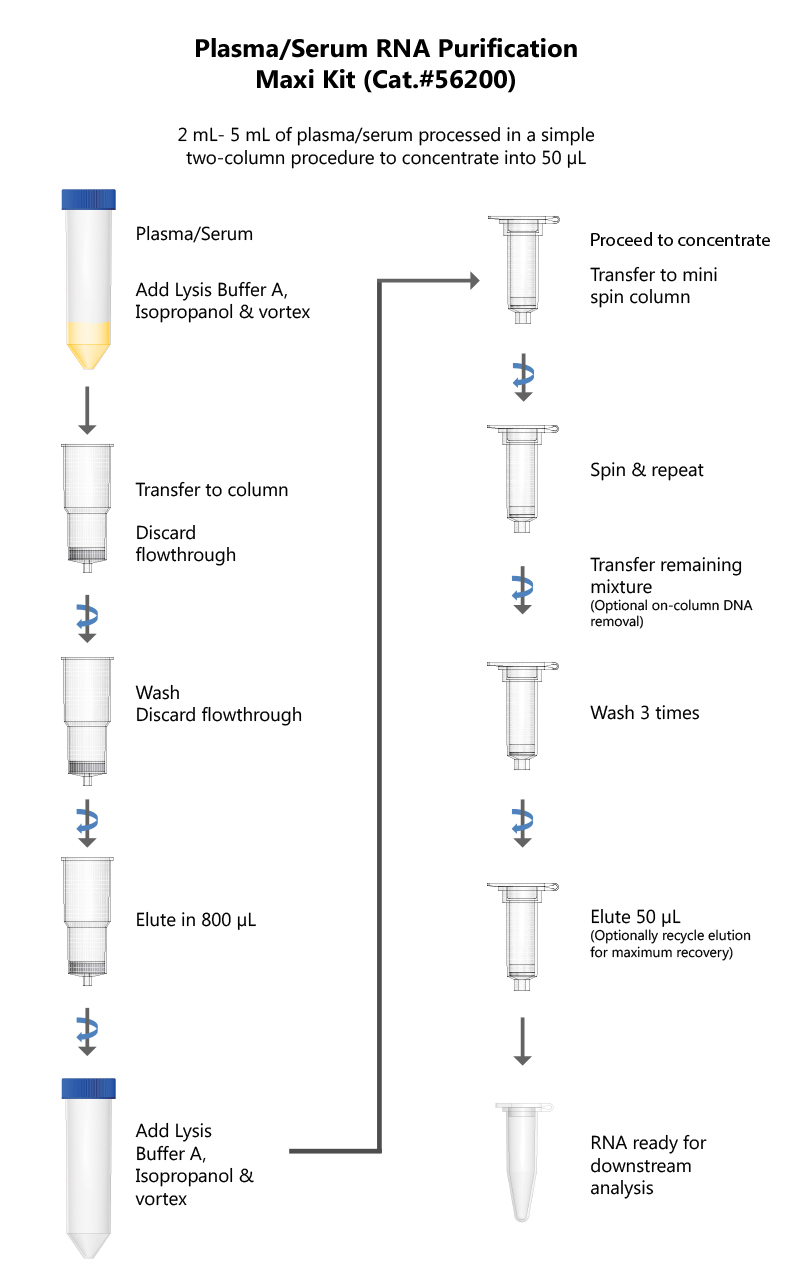
This kit can purify RNA from fresh or frozen serum or plasma samples prepared from blood collected on either EDTA or Citrate, from volumes ranging from 2 mL to 5 mL. The first column will handle the large volume input of bodily fluids that is followed by a concentration on a mini column for a final elution of 50 µL to 100 µL.
All sizes, including miRNA and small RNA (<200 nt)
Elution Volume
50-100 μL
Time to Complete 10 Purifications
35-40 minutes
Average Yields*
Variable depending on specimen
*Please check page 7 of the Product Insert for Average Plasma/Serum Yields and Common RNA Quantification Methods.
This kit is suitable for the isolation of RNA from fresh or frozen serum or plasma prepared from blood collected on either EDTA or Citrate. Plasma samples prepared from blood collected on heparin should not be used as heparin can significantly interfere with many downstream applications such as RT-PCR.
Storage Conditions and Product Stability All solutions should be kept tightly sealed and stored at room temperature. This kit is stable for 2 years after the date of shipment. It is recommended to warm Lysis Buffer A for 20 minutes at 60°C if any salt precipitation is observed.