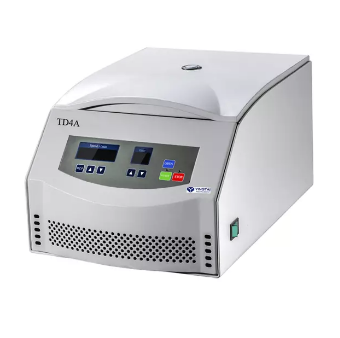
1. TD4A centrifuge is of microprocessor control, less noisily, it is widely used to qualitative analysis of blood serum, plasma and urea in the fields of hospital, blood center, laboratory and biochemistry.
2. Brushless motor, free maintenance, no powder pollution, quick in speed up and down.
3. The flexible axle driven system which drive the rotor directly, smooth in operation and small vibration.
4. There are many rotors for your choice, suitable for different specifications meet customers’ different requirements of separation.
5. Micro computer control system, LED display the RCF,time and speed.
6 .Electric lid lock, compact design, super speed and imbalance protection.
TD4A Technical Parameter:
Max. Speed
4000rpm
Max. RCF
2250×g
Max. Capacity
6×50ml
Time Range
0~99min
RPM/RCF Convert
Yes
Noise (dB)
≤ 45
Temperature
Normal
Acc/Dec
10 Kinds
Speed Accuracy
±10r/min
Voltage(V/Hz)
AC 220V/110V 50HZ/60HZ
Size (W x D x Hmm)
485×320×255mm
Net Weight/Gross Weight(Kg)
18KG/21KG
Certificates
CE,ISO & Calibration report are available
Matched Rotors for TD4A
Order No
Rotors
Max speed r/min
Volume(ml)
Max RCF(g)
No31601
Angle Rotor
4000
12×10ml Vacuum tube
2150
12×7ml Vacuum tube adapter
12×5ml Vacuum tube adapter
No31605
Angle rotor
4000
30×7/5ml
2250
No31604
Angle rotor
4000
18×10ml
2250
No31607
Angle rotor
4000
24x10ml
2200
No31602
Angle rotor
4000
12×15ml/7ml/5ml
2150
No31603
Angle rotor
4000
12×20ml
2220
No31606
Angle rotor
4000
6x50ml
2100
Other Products
RNA Clean-Up and Concentration Kits
Product Info
Document
Product Info
Overview
Clean-up & concentrate total RNA (including miRNA) in minutes
Clean-up & concentrate RNA from TRIzol®, TRI Reagent®, etc
Clean-up RNA from contaminants including enzymes, primers, nucleotides
Rapid spin-column protocol, elute in 20 µL
96-well format for high throughput processing & Micro-Elute spin column formats for 8 µL are available
Purified RNA is suitable for a variety of downstream applications, including Small RNA Sequencing. Find out more information on Norgen’s NGS services
Purification is based on spin column chromatography that uses Norgen’s proprietary resin separation matrix
These kits are designed to clean-up and concentrate RNA (including miRNA) from TRIzol® and TRI Reagent®, enzymatic reactions, in vitro transcription, labelling reactions, etc. These are robust kits for all clean-up and concentration purposes for up to 35 µg of RNA in solution. The purified RNA is of the highest purity and integrity, and can be used in a number of downstream applications. These kits purify all sizes of RNA, from large mRNA and ribosomal RNA down to miRNA, siRNA and lncRNA.
RNA Clean-Up and Concentration Kit (Spin Column)
Norgen’s RNA Clean-Up and Concentration Kit provides a rapid method for the purification, cleanup and concentration of up to 35 μg of RNA isolated using different methods including phenol/guanidine-based protocols, and from various upstream enzymatic reactions such as DNase treatment and labeling. The kit elutes RNA in 20 µL. Complete 10 purifications in 20 minutes.
RNA Clean-Up and Concentration 96-Well Kit (High Throughput)
Norgen’s RNA Clean-Up and Concentration 96-Well Kit provides a rapid method for the purification, cleanup and concentration of up to 50 μg of RNA isolated using different methods including phenol/guanidine-based protocols, and from various upstream enzymatic reactions such as DNase treatment and labeling. The kit elutes RNA in 75 µL. Complete 10 purifications in 30 minutes.
RNA Clean-Up and Concentration Micro-Elute Kit (Micro-Elute)
Norgen’s RNA Clean-Up and Concentration Micro-Elution Kit provides a rapid method for the purification, cleanup and concentration of up to 10 μg of RNA isolated using different methods including phenol/guanidine-based protocols, and from various upstream enzymatic reactions such as DNase treatment, labeling and in vitro transcription. This kit is made for eluting RNA in smaller volumes of 8 µL for all types of downstream applications, for the highest concentration of RNA sample. Complete 10 purifications in 20 minutes.
Storage Conditions and Product Stability All solutions should be kept tightly sealed and stored at room temperature. This kit is stable for 2 years after the date of shipment.
Brevetoxins (PbTx) are a class of cyclic polyether compounds produced by certain algae such as Karenia brevis. K. brevis can produce Brevetoxins in large quantities during an algae bloom which then pose a major health threat and are important to monitor and mitigate. Brevetoxins are the causative agent of Neurotoxic Shellfish Poisoning (NSP).
FDA and EPA safety levels in regulations and guidance – 0.8 mg/kg for clams, mussels, oysters, and whole and roe-on scallops, fresh, frozen, or canned. – National Shellfish Sanitation Program Guide for the Control of Molluscan Shellfish.
Efficient depletion of bovine exosomes from Fetal Bovine Serum
Deplete exosome-sized vesicles from versatile FBS volumes
No protease treatment required
No time-consuming ultracentrifugation
No precipitation reagents required
No overnight incubation required
Exosome depletion confirmed by reduction of bovine miRNAs below detectable levels
The depleted FBS provides the same cellular growth rates as the standard FBS
Purification is based on Norgen’s proprietary Silicon Carbide resin matrix
Norgen’s FBS Exosome Depletion Kits provides a quick and easy protocol for the depletion of bovine exosomes from FBS prior to using it as a growth supplement in your culture medium. The FBS recovered from the depletion process is exosome-depleted and does not contain any quantifiable bovine miRNAs. Moreover, the exosome-depleted FBS will support the growth of your cells of interest similar to the non-depleted FBS. Norgen’s kits allow for the processing of different FBS volumes. The depletion is based on Norgen’s proprietary resin. These kits provide a clear advantage over other available kits in that they do not require ultracentrifugation, any special instrumentation, precipitation reagents or any protease treatments. More importantly, the depletion process is an inexpensive method for exosome depletion from FBS, as compared to the expensive current ready-to-use exosome-depleted media available on the market.
Background
Most culture medium used for the growth and propagation of cells in culture require the addition of fetal bovine serum (FBS) as a growth supplement to media. FBS is obtained from bovine (cow) serum, and therefore contains large quantities of bovine exosome vesicles. These exosomes may interfere with some types of studies, or may lead to unreliable results when studying the exosomes shed from your cells of interest in normal culture conditions. Therefore, the use of exosome-depleted FBS is highly recommended for many types of studies.
Up to 140 mL (FBS Exosome Depletion Kit I (Slurry Format) Up to 280 mL (FBS Exosome Depletion Kit II (Slurry Format)
Depletion
Deplete exosome-sized vesicle
Bovine miRNA
No detectable bovine miRNA
Time to Complete 6 Purifications
40 minutes
Storage Conditions and Product Stability All buffers should be kept tightly sealed and stored at room temperature. This kit is stable for 2 years after the date of shipment.