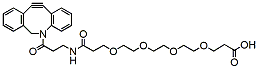
DBCO-NHCO-PEG4-acid is an analog of DBCO-Acid with a hydrophilic PEG spacer arm, which improves water solubility. This reagent is a non-activated building block with enhanced solubility in aqueous media and can thus be used to derivatize amine-containing molecule through a stable amide bond. DBCO is commonly used for copper-free Click Chemistry reactions. Reagent grade, for research purpose. Please contact us for GMP-grade inquiries.
Detail
DBCO-NHCO-PEG4-acid is an analog of DBCO-Acid with a hydrophilic PEG spacer arm, which improves water solubility. This reagent is a non-activated building block with enhanced solubility in aqueous media and can thus be used to derivatize amine-containing molecule through a stable amide bond. DBCO is commonly used for copper-free Click Chemistry reactions. Reagent grade, for research purpose. Please contact us for GMP-grade inquiries.
Other Products
D3181 HiPure Circulating Nucleic acid Mini Kit
Product Info
Document
Product Info
Introduction
Free-circulating nucleic acids, such as tumor-specific extracellular DNA fragments and mRNAs in the blood or fetal nucleic acids in maternal blood, are present in serum or plasma usually as short fragments, <1000bp (DNA). HiPure Circulating DNA Mini Kit enables efficient purification of these circulating nucleic acids from human plasma, serum, or urine. Samples can be fresh or frozen (provided that they have not been frozen and thawed more than once).
Details
Specifications
Features
Specifications
Main Functions
Isolation circulating DNA from 1ml plasma, serum, body fluids
Applications
qPCR, liquid or solid chip analysis, hybridization and SNP detection, etc.
Purification method
Mini spin column
Purification technology
Silica technology
Process method
Manual (centrifugation or vacuum)
Sample type
Serum, plasma and other cell-free fluid samples
Sample amount
1ml
Elution volume
≥30μl
Time per run
≤50 minutes
Liquid carrying volume per column
800µl
Binding yield of column
100µg
Principle
This product is based on silica gel purification. The sample is lysed and digested with lysate and protease, DNA is released into the lysate. Transfer to an adsorption plate and filter column. Nucleic acid is adsorbed on the membrane, while protein is not adsorbed and is removed with filtration. After washing proteins and other impurities, nucleic acid was finally eluted with low-salt buffer (10 Mm Tris,pH 8.0).
Advantages
High yield – most optimal process, free DNA (>50bp) can be obtained to the maximum extent
High concentration – low elution volume, ensuring high nucleic acid concentration
High purity – low alcohol binding method, completely removing inhibitor and protein pollution
High recovery – DNA can be recovered at the level of PG by silica gel column purification
Kit Contents
Contents
D318102
D318103
Purification Times
50 Preps
250 Preps
Buffer ACL
50 ml
250 ml
Buffer ACB*
60 ml
300 ml
Buffer DCW1*
22 ml
88 ml
Buffer DCW2*
10 ml
50 ml
Proteinase K
120 mg
540 mg
Protease Dissolve Buffer
10 ml
30 ml
Carrier RNA
110 μg
310 μg
Nuclease Free Water
10 ml
30 ml
HiPure CFDNA Mini Columns
50
250
2 ml Collection Tubes
100
500
Storage and Stability
Proteinase K and carrier RNA should be stored at 2–8°C upon arrival. However, short-term storage(up to 12 weeks) at room temperature (15–25°C) does not affect their performance. The remainingkit components can be stored dry at room temperature (15–25°C) and are stable for at least 18 months under these conditions.The entire kit can be stored at 2–8°C, but in this case buffers shouldbe redissolved before use. Make sure that all buffers are at room temperature when used.
Document
Free-circulating nucleic acids, such as tumor-specific extracellular DNA fragments and mRNAs in the blood or fetal nucleic acids in maternal blood, are present in serum or plasma usually as short fragments,
Q-PAGE™ Bis-Tris Precast Gel is a high-performance and easy to use precast polyacrylamide gel for electrophoresis in Bis-Tris buffer system (MOPS or MES). The optimized gel formula allows Q-PAGE™ Bis-Tris Precast Gel to show improved resolution, accurate results, and an extended shelf-life over conventional Laemmli Tris-HCl gels.
Q-PAGE™ Bis-Tris Precast Gels are available in gradient (4 to 12%) and fixed (8% and 12%) concentrations of polyacrylamide in 12-and 15-well formats. Two available cassette sizes, Mini (10 x 8.3 cm) and Midi (10 x 10 cm), are compatible with most popular protein electrophoresis systems. Q-PAGE™ Mini (QP2XXX) Gels are suitable for Bio-Rad® and other systems. Q-PAGE™ Midi (QP3XXX) Gels are suitable for Invitrogen® XCell SureLock® Mini-Cell, Invitrogen® Mini Gel Tank, Hoefer SE260, and other systems.
Key Features
User-friendly gel cassette:
Numbered and framed wells for sample loading
With cassette opener for easy use
Enhanced gel performance:
Enhanced band sharpness
Better resolution of small proteins
Stable for shipping at ambient temperature
Easy compatibility:
Available as homogeneous and adjusted gradient gels for a wide range of protein separation.
Compatible with most popular protein electrophoresis systems
Storage and stability
Store Q-PAGE™ Precast Gels at 4°C for periods up to 12 months.
Do not freeze Q-PAGE™ Precast Gels Remove tape and comb before electrophoresis.
Keep Q-PAGE™ Precast Gels flat during storage.
Document
Q-PAGE™ Bis-Tris Precast Gel is a high-performance and easy to use precast polyacrylamide gel for electrophoresis in Bis-Tris buffer system (MOPS or MES). The optimized gel formula allows Q-PAGE™ Bis-Tris Precast Gel to show improved resolution, accurate results, and an extended shelf-life over conventional Laemmli Tris-HCl gels.
Q-PAGE™ Bis-Tris Precast Gels are available in gradient (4 to 12%) and fixed (8% and 12%) concentrations of polyacrylamide in 12-and 15-well formats. Two available cassette sizes, Mini (10 x 8.3 cm) and Midi (10 x 10 cm), are compatible with most popular protein electrophoresis systems. Q-PAGE™ Mini (QP2XXX) Gels are suitable for Bio-Rad® and other systems. Q-PAGE™ Midi (QP3XXX) Gels are suitable for Invitrogen® XCell SureLock® Mini-Cell, Invitrogen® Mini Gel Tank, Hoefer SE260, and other systems.
N-(Amino-PEG4)-N-bis(PEG4-propargyl) HCl salt is a trifunctional linker with two terminal alkynes and a primary amine. The terminal alkynes can be linked to azides using copper click chemistry while the primary amine is reactive towards carboxylic acids, NHS esters, ketones and aldehydes to form a variety of stable bonds.
Document
N-(Amino-PEG4)-N-bis(PEG4-propargyl) HCl salt is a trifunctional linker with two terminal alkynes and a primary amine. The terminal alkynes can be linked to azides using copper click chemistry while the primary amine is reactive towards carboxylic acids, NHS esters, ketones and aldehydes to form a variety of stable bonds.