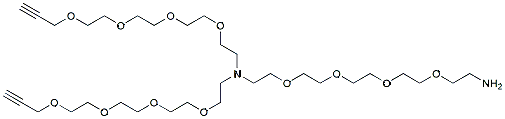
N-(Amino-PEG4)-N-bis(PEG4-propargyl) HCl salt is a trifunctional linker with two terminal alkynes and a primary amine. The terminal alkynes can be linked to azides using copper click chemistry while the primary amine is reactive towards carboxylic acids, NHS esters, ketones and aldehydes to form a variety of stable bonds.
Detail
N-(Amino-PEG4)-N-bis(PEG4-propargyl) HCl salt is a trifunctional linker with two terminal alkynes and a primary amine. The terminal alkynes can be linked to azides using copper click chemistry while the primary amine is reactive towards carboxylic acids, NHS esters, ketones and aldehydes to form a variety of stable bonds.
Other Products
D3148 HiPure Microbiome DNA Kit
Product Info
Document
Product Info
Introduction
This product provides an easy-to-use workflow for selective isolation of bacterial DNA from samples that are intrinsically rich in host DNA, such as body fluids or swabs. The method is specific for the identification of intact bacteria so it prevents false results due to nucleic acids from dead bacteria. The Kit allows isolation of enriched bacterial DNA suitable for a variety of applications, including qPCR and whole metagenome or 16S rRNA gene sequencing.
Details
Specifications
Features
Specifications
Main Functions
Isolation gDNA from biological sample and remove host DNA
Applications
PCR, southern blot and enzyme digestion, etc.
Purification method
Mini spin column
Purification technology
Silica technology
Process method
Manual (centrifugation or vacuum)
Sample type
Culture medium, swab, parasitic blood, tissue, sputum, etc.
This product is based on silica Column purification. This product efficiently depletes human and animal host DNA and yields enriched bacterial DNA. An optimized combination of mechanical and chemical lysis allows efficient disruption of bacterial cells. Target DNA is adsorbed on the membrane, while protein is not adsorbed and is removed with filtration. After washing proteins and other impurities, nucleic acid was finally eluted with low-salt buffer (10mm Tris, pH9.0, 0.5mm EDTA).
Advantages
High concentration – the host DNA is digested by dnase, without contamination of host DNA
High recovery – DNA can be recovered at the level of PG
Good repeatability – silica technology can obtain ideal results every time
Wide applicability – it can be used in blood, tissue, intestinal contents and other samples
Kit Contents
Contents
D314802
D314803
Purification Times
50 Preps
250 Preps
Hipure DNA Mini Columns I
50
2 x 125
2ml Collection Tubes
50
2 x 125
2ml beads Tubes
50
250
Buffer DRB
15 ml
60 ml
Buffer ES
6 ml
30 ml
Reagent DX
0.5 ml
1 ml
Buffer DL
30 ml
120 ml
Buffer GW1
22 ml
110 ml
Buffer GW2
12 ml
50 ml
DNase I (Powder)
6 mg
30 mg
Proteinase K
24 mg
120 mg
Protease Dissolve Buffer
5 ml
15 ml
Buffer AE
15 ml
60 ml
Storage and Stability
DNase I and Proteinase K should be stored at 2–8°C upon arrival. However, short-term storage (up to 12 weeks) at room temperature (15–25°C) does not affect their performance. The remaining kit components can be stored dry at room temperature (15–25°C) and are stable for at least 18 months under these conditions. The entire kit can be stored at 2–8°C, but in this case buffers should be redissolved before use. Make sure that all buffers are at room temperature when used.
Document
This product provides an easy-to-use workflow for selective isolation of bacterial DNA from samples that are intrinsically rich in host DNA, such as body fluids or swabs. The method is specific for the identification of intact bacteria so it prevents false results due to nucleic acids from dead bacteria. The Kit allows isolation of enriched bacterial DNA suitable for a variety of applications, including qPCR and whole metagenome or 16S rRNA gene sequencing.
Propargyl-PEG7-NHS ester contains a propargyl group and an NHS ester. As an amine reactive reagent, this product can be used for derivatizing peptides, antibodies, amine coated surfaces etc. In the presence of copper catalyst, propargyl group reacts with azide to yield a stable triazole linkage. The PEG units help increase the hydrophilicity of the reagent. Reagent grade, for research purpose. Please contact us for GMP-grade inquiries.
Document
Propargyl-PEG7-NHS ester contains a propargyl group and an NHS ester. As an amine reactive reagent, this product can be used for derivatizing peptides, antibodies, amine coated surfaces etc. In the presence of copper catalyst, propargyl group reacts with azide to yield a stable triazole linkage. The PEG units help increase the hydrophilicity of the reagent. Reagent grade, for research purpose. Please contact us for GMP-grade inquiries.
Cerillo’s Canopy Wireless Accessory Package includes the Canopy wireless device which enables wireless plate reader monitoring. It also comes with a companion software for retrieving, analyzing and communicating results from your Alto/Stratus microplate reader.
Document
Cerillo’s Canopy Wireless Accessory Package includes the Canopy wireless device which enables wireless plate reader monitoring. It also comes with a companion software for retrieving, analyzing and communicating results from your Alto/Stratus microplate reader.