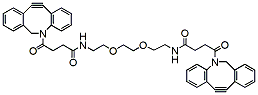
DBCO-PEG2-DBCO is a PEG linker containing two terminal DBCO groups. The DBCO groups is commonly used for copper-free Click Chemistry reactions due to its strain promoted high energy. The hydrophilic PEG chain allows for increased water solubility. T Reagent grade, for research purpose. Please contact us for GMP-grade inquiries.
Detail
DBCO-PEG2-DBCO is a PEG linker containing two terminal DBCO groups. The DBCO groups is commonly used for copper-free Click Chemistry reactions due to its strain promoted high energy. The hydrophilic PEG chain allows for increased water solubility. T Reagent grade, for research purpose. Please contact us for GMP-grade inquiries.
Other Products
1 Layer Cell Factory Double Wide Mouth
Product Info
Document
Product Info
1 Layer Cell Factory Double Wide Mouth
Huayi Cell Factory is a robust and easy-to-use cell culture platform for applications in the production of human and animal vaccines, therapeutic proteins, cell therapy, and gene therapy.
To address the needs of your workflow, We have three kinds of mouth, which is available on most cell culture products to ensure consistent performance from lot to lot and from format to format.
The product assembled with ultrasonic welded technology
Versatile port design facilitates both pouring and aseptic filling techniques
Gamma radiation sterilization
the cell culture surface area
of one 10-layer Cell Factory unit is equivalent to the area
of 36 T-175 flasks
Double Wide Mouth
Document
Huayi Cell Factory is a robust and easy-to-use cell culture platform for applications in the production of human and animal vaccines, therapeutic proteins, cell therapy, and gene therapy.
To address the needs of your workflow, We have three kinds of mouth, which is available on most cell culture products to ensure consistent performance from lot to lot and from format to format.
N-(Propargyl-PEG4-carbonyl)-N-bis(PEG1-methyl ester) is a crosslinker that can react with azide compounds or biomolecules via copper catalyzed Click Chemistry to form a stable triazole linkage. The methyl ester groups can be hydrolyzed, reduced, or substituted under different conditions. Reagent grade, for research purpose. Please contact us for GMP-grade inquiries.
Document
N-(Propargyl-PEG4-carbonyl)-N-bis(PEG1-methyl ester) is a crosslinker that can react with azide compounds or biomolecules via copper catalyzed Click Chemistry to form a stable triazole linkage. The methyl ester groups can be hydrolyzed, reduced, or substituted under different conditions. Reagent grade, for research purpose. Please contact us for GMP-grade inquiries.
DBCO-Sulfo-Link-biotin is an anqueous soluble biotin reagent for introducing a biotin moiety to proteins and cell surfaces containing azide moiety through copper-free Click Chemistry. This biotin reagent is membrane-impermeable due to its negatively charged, water soluble sulfonate group. DBCO is commonly used for copper-free Click Chemistry reactions. Reagent grade, for research purpose. Please contact us for GMP-grade inquiries.
Document
DBCO-Sulfo-Link-biotin is an anqueous soluble biotin reagent for introducing a biotin moiety to proteins and cell surfaces containing azide moiety through copper-free Click Chemistry. This biotin reagent is membrane-impermeable due to its negatively charged, water soluble sulfonate group. DBCO is commonly used for copper-free Click Chemistry reactions. Reagent grade, for research purpose. Please contact us for GMP-grade inquiries.