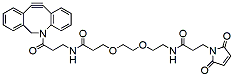
DBCO-PEG2-Maleimide is a PEG linker containing a DBCO moiety and a terminal primary maleimide group. The maleimide group will react with a thiol group to form a covalent bond, enabling the connection of biomolecule with a thiol. DBCO is commonly used for copper-free Click Chemistry reactions. Reagent grade, for research purpose. Please contact us for GMP-grade inquiries.
Detail
DBCO-PEG2-Maleimide is a PEG linker containing a DBCO moiety and a terminal primary maleimide group. The maleimide group will react with a thiol group to form a covalent bond, enabling the connection of biomolecule with a thiol. DBCO is commonly used for copper-free Click Chemistry reactions. Reagent grade, for research purpose. Please contact us for GMP-grade inquiries.
The genesig® Real-Time PCR COVID-19 (CE) is CE-IVD marked and intended for in vitro diagnostic use in Europe.
PLEASE NOTE: This is a Professional Use Only product that requires a trained operator in a controlled laboratory environment. It is NOT a lateral flow or a Point of Care device designed to be used by the general public.
Document
Total workflow solution All reagents and components provided from start to finish Rapid protocol with fewer handling steps For use with dry swabs Viral inactivation; Preparation, Amplification, Diagnosis Total chemistry optimisation Low shipping costs with ambient shipping Includes our genesig® Real-Time PCR Coronavirus COVID-19 (CE IVD)
Milk samples are stable for 1 month at room temperature (or 1 week at 37°C) in the Preservation Solution
Fast and easy processing using a rapid spin-column format
DNA can be isolated and detected from as little as 100 µL of milk
Isolate high quality genomic DNA
Norgen’s Milk DNA Preservation and Isolation Kit is an all-in-one solution designed for 1) preservation of DNA in milk samples at ambient temperature; and 2) isolation of high quality DNA within a laboratory setting. The kit is provided with a Preservation Solution that allows for either immediate processing of milk samples, or allows for the storage of the milk samples for up to 1 month at room temperature prior to DNA isolation. Genomic DNA extracted from somatic cells and bacteria found in milk can be used in various applications. The isolated DNA can be used for the detection of biomarkers to diagnose a disease, follow the diseases progress or monitor the effects of a particular treatment. Milk DNA can also be used to diagnose particular types of infections. Milk DNA purified using Norgen’s kit is of the highest quality, and is compatible with a number of downstream applications including PCR, Southern Blot analysis, sequencing and microarray analysis.
Milk DNA Preservative
Norgen’s Milk DNA Preservation Solution is an aqueous storage buffer designed for rapid cellular lysis and subsequent preservation of DNA from fresh specimens. The preservative prevents the growth of Gram-negative and Gram-positive bacteria and fungi, and also inactivates viruses allowing the resulting non-infectious samples to be handled and shipped safely. In addition, the preservative eliminates the need to immediately process or freeze samples and allows the samples to be shipped to centralized testing facilities at ambient temperature. The components of the preservative allow samples to be stored for 1 month without any detectable DNA degradation.
Storage Conditions and Product Stability The Proteinase K should be stored at -20°C upon arrival and after reconstitution. All other solutions should be kept tightly sealed and stored at room temperature. This kit is stable for 2 years after the date of shipment.
Storage in Preservation Buffer 1) Storage at -20°C is recommended for archival samples and will provide optimal preservation. The preservation buffer will freeze at -20°C. Samples can be stored indefinitely at -70°C. 2) Samples can be stored at room temperature (25°C) for up to 1 month without significant loss of DNA quality. 3) DNA has also been successfully isolated from samples stored at 37°C 1 for one week.
Peelable heat sealing film which is made using gas permeable grid lacquer paper. This seal is suitable for insect studies and seed storage.
Heat sealing is a quick and cost effective method of plate sealing
Our Gas PermASeal II Heat Seal is a paper with a grid lacquer coating which is porous and gas permeable
The Gas PermeASeal II Heat Seal is compatible with polypropylene, polyethylene, polystyrene and cyclic olefin copolymer (COC) plates
The seal can be removed by peeling, or it can be pierced with a pipette tip manually or using a liquid handling robot
The Seal has a temperature range from -20°C to 80°C
It can be used for insect and seed storage, as it enables gas exchange, whilst providing an inert surface with no adhesive to interfere with the well contents
This seal is available as sheets, for use with manual and semi-automated sealers, such as our HeatASeal 500 Sealing Machine
Also available in roll format compatible with specified automated heat sealers, such as our Wasp or Chameleon XT
Document
Peelable heat sealing film which is made using gas permeable grid lacquer paper. This seal is suitable for insect studies and seed storage.