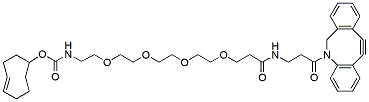
TCO-PEG4-DBCO is a heterobifunctional click chemistry reagent containing a TCO and a DBCO moiety. TCO group specifically and efficiently reacts with terrahydrazine at fast speed. DBCO is very reactive toward Azide through copper free click chemistry, the PEG spacer increases the aqueous solubility of the reagent. Reagent grade, for research purpose. Please contact us for GMP-grade inquiries.
Detail
TCO-PEG4-DBCO is a heterobifunctional click chemistry reagent containing a TCO and a DBCO moiety. TCO group specifically and efficiently reacts with terrahydrazine at fast speed. DBCO is very reactive toward Azide through copper free click chemistry, the PEG spacer increases the aqueous solubility of the reagent. Reagent grade, for research purpose. Please contact us for GMP-grade inquiries.
Other Products
N-(Propargyl-PEG2)-PEG3-t-butyl ester
Product Info
Document
Product Info
N-(Propargyl-PEG2)-PEG3-t-butyl ester is a branched PEG linker with an alkyne group and a t-butyl ester. The alkyne group reacts with azide-bearing compound in coppper catalyzed azide-alkyne Click Chemistry reaction. The amino group is reactive with carboxylic acids, activated NHS esters, and carbonyls. Reagent grade, for research purpose. Please contact us for GMP-grade inquiries.
Document
N-(Propargyl-PEG2)-PEG3-t-butyl ester is a branched PEG linker with an alkyne group and a t-butyl ester. The alkyne group reacts with azide-bearing compound in coppper catalyzed azide-alkyne Click Chemistry reaction. The amino group is reactive with carboxylic acids, activated NHS esters, and carbonyls. Reagent grade, for research purpose. Please contact us for GMP-grade inquiries.
Sulfo DBCO-Amine can be used to derivatize carboxyl-containing molecules or activated esters (e.g. The NHS ester) with DBCO moiety through a stable amide bond. The low mass weight will add minimal spacer to modified molecules and the hydrophilic sulfonated spacer arm will greatly improve water solubility of DBCO derivatized molecules. DBCO is commonly used for copper-free Click Chemistry reactions. Reagent grade, for research purpose. Please contact us for GMP-grade inquiries.
Document
Sulfo DBCO-Amine can be used to derivatize carboxyl-containing molecules or activated esters (e.g. The NHS ester) with DBCO moiety through a stable amide bond. The low mass weight will add minimal spacer to modified molecules and the hydrophilic sulfonated spacer arm will greatly improve water solubility of DBCO derivatized molecules. DBCO is commonly used for copper-free Click Chemistry reactions. Reagent grade, for research purpose. Please contact us for GMP-grade inquiries.
The 23S ribosomal RNA (rRNA) is a crucial component of the bacterial/archean ribosome. The 23S rRNA is a 2,904-nucleotide long component of the large subunit (50S) of the ribosome. Compared to 16S rRNA genes, 23S rRNA genes have greater sequence variations due to unique insertions, deletions, and length. Attogene’s 23s PCR kit is designed for identification of specific strains of bacterial/archean using the ribosomal RNA gene region for use in Phylogenetic studies of bacterial diversity from environmental DNA samples such as water. For example, a sample of algae is obtained and washed to extract a clean algal genomic DNA (gDNA) sample. A reaction mixture is assembled from primers, master mix, and gDNA samples as required. The qPCR machine of choice is set up and loaded as needed and the mixture undergoes PCR amplification. The Primer mix provided exploits the Taq polymerase to amplify the gene region of interest.
Document
This kit is sufficient for 150 reactions: For characterizing cyanobacteria in environmental samples Use in combination with Attogene Algae DNA isolation kit Universal 23s PCR primers Perfect for Environmental DNA (eDNA) Characterization