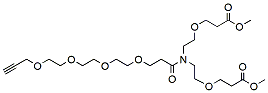
N-(Propargyl-PEG4-carbonyl)-N-bis(PEG1-methyl ester) is a crosslinker that can react with azide compounds or biomolecules via copper catalyzed Click Chemistry to form a stable triazole linkage. The methyl ester groups can be hydrolyzed, reduced, or substituted under different conditions. Reagent grade, for research purpose. Please contact us for GMP-grade inquiries.
Detail
N-(Propargyl-PEG4-carbonyl)-N-bis(PEG1-methyl ester) is a crosslinker that can react with azide compounds or biomolecules via copper catalyzed Click Chemistry to form a stable triazole linkage. The methyl ester groups can be hydrolyzed, reduced, or substituted under different conditions. Reagent grade, for research purpose. Please contact us for GMP-grade inquiries.
Actin is part of the cytoskeletal system of all cell types. Smooth Muscle Actin is found in myofibroblasts and myoepithelium, but not in cardiac and skeletal muscles. Labelling of smooth muscle actin in concert with muscle specific actin staining can allow for differentiation between rhabdomyosarcoma and leiomyosarcoma, as Muscle specific actin is found in rhabdomyoblasts, while smooth muscle actin is found in leiomyosarcomas.
One cDNA Synthesis, Multiple microRNAs and microRNA-targets analyzed
Time Savings
Cost Efficient
High Sensitivity and Yield
Robust Enzyme
Available in 12 or 50 reaction size
Norgen’s microScript microRNA cDNA Synthesis Kit is an all-in-one, ready-to-use product for the reverse transcription of microRNA from either Total RNA preparations or enriched microRNA preparations. The kit contains the 2x Reaction Mix and the microScript microRNA Enzyme Mix. The kit utilizes Norgen’s microScript Reverse Transcriptase, a mutant version of Moloney Murine Leukemia Virus (M-MuLV) Reverse Transcriptase. It has reduced RNase H activity and increased thermal stability.
The workflow of Norgen’s microScript microRNA cDNA Synthesis Kit involves a simple, single-tube set-up by the mixing of 2x Reaction Mix, Enzyme Mix and the RNA template. The reaction can then be carried out in a thermocycler. A poly (A) tail is first added to the RNA template, followed by cDNA synthesis using an adapter primer. In addition to the ease-of-use, the single-tube set-up provides superb consistency and sensitivity. The cDNA could be used in a PCR or qPCR amplification using a Universal PCR Reverse Primer and the forward primer that contains the sequence of the microRNA of interest. A single cDNA preparation could be used for PCR amplification of a number of different microRNAs. In addition, the cDNA preparation could be used for PCR or qPCR detection (using gene-specific forward and reverse primers) of mRNA or large RNA if total RNA preparation was the starting template. This could allow for parallel evaluation of expression level of microRNAs and microRNA-targets.
This product provides fast and easy methods for purification of total DNA for reliable PCR and southern blotting. Total DNA can be purified from bacterial culture, body fluids, food and fermentation.
Details
Specifications
Features
Specifications
Main Functions
Isolation bacterial DNA from cultures, food and other samples
Applications
PCR, southern blot and enzyme digestion, etc.
Purification method
Mini spin column
Purification technology
Silica technology
Process method
Manual (centrifugation or vacuum)
Sample type
Culture medium, swab, parasitic blood, tissue,sputum, etc.
Sample amount
Bacterial culture medium: 0.5-2 mlTissue samples: 50-100 mg Whole blood / cell suspension: 0.5-1 ml Viscous secretion: 0.1-1 g
Elution volume
≥30μl
Time per run
≤40 minutes
Liquid carrying volume per column
800μl
Binding yield of column
100μg
Principle
This product is based on silica Column purification. The sample is lysed and digested with lysate and protease, DNA is released into the lysate. Transfer to an adsorption column. Nucleic acid is adsorbed on the membrane, while proteinis not adsorbed and is removed with filtration. After washing proteins and other impurities, Nucleic acid was finally eluted with low-salt buffer (10mmTris, pH9.0, 0.5mm EDTA). This product carries 0.1-0.2mm acid glass beads, which can improve the wall-breaking effect of lysozyme resistant bacteria, the success rate and DNA yield through physical bead grinding.
Advantages
Fast – several samples can be extracted in 40 minutes (after digestion)
High purity – purified DNA can be directly used in various downstream applications
Good repeatability – silica technology can obtain ideal results every time
High recovery – DNA can be recovered at the level of PG
Broad spectrum – it can deal with a variety of bacteria, including Gram-positive bacteria that are difficult to disrupt
Sufficient components – this kit has carried lysozyme, protease K, RNase A and glass beads
Kit Contents
Contents
D314602
D314603
Purification Times
50 Preps
250 Preps
Hipure DNA Mini Columns I
50
2 x 125
2ml Collection Tubes
50
2 x 125
Glass Beads (0.1~0.2mm)
20 g
100 g
Buffer P1
20 ml
100 ml
Buffer DL
15 ml
80 ml
Buffer GW1
22 ml
88 ml
Buffer GW2
12 ml
50 ml
Lysozyme
60 mg
300 mg
Proteinase K
24 mg
120 mg
Protease Dissolve Buffer
5 ml
15 ml
Buffer AE
15 ml
60 ml
Storage and Stability
Lysozyme and Proteinase K should be stored at 2-8°C upon arrival. However, short-term storage (up to 12 weeks) at room temperature (15-25°C) does not affect their performance. The remaining kit components can be stored dry at room temperature (15-25°C) and are stable for at least 18 months under these conditions.
Document
This product provides fast and easy methods for purification of total DNA for reliable PCR and southern blotting. Total DNA can be purified from bacterial culture, body fluids, food and fermentation.