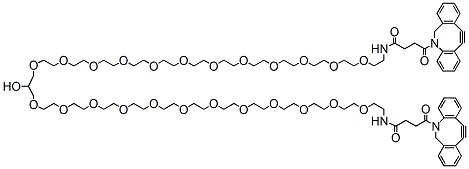
Propane-1,3-(PEG12-DBCO),2-alcohol is a PEG linker containing two DBCO moieties and a terminal primary hydroxyl group. The hydroxyl can react with a variety of functional groups and the hydrophilic PEG spacer arm can provide better solubility to labeled molecules. DBCO is commonly used for copper-free Click Chemistry reactions. Reagent grade, for research use only.
Detail
Propane-1,3-(PEG12-DBCO),2-alcohol is a PEG linker containing two DBCO moieties and a terminal primary hydroxyl group. The hydroxyl can react with a variety of functional groups and the hydrophilic PEG spacer arm can provide better solubility to labeled molecules. DBCO is commonly used for copper-free Click Chemistry reactions. Reagent grade, for research use only.
Other Products
【RC1000】EzRNA™ RNA Capping System, 50 RXN
Product Info
Document
Product Info
Description
The EzRNA™ RNA Capping System is a user-friendly product for post-transcriptional RNA modification. Both Vaccinia Capping Enzyme and 2’-O-Methyltransferase are included in the package, which are able to perform in a single reaction. The Vaccinia Capping Enzyme attach 7-methylguanylate cap (m7Gppp, Cap-0) to the 5′ end of RNA to form m7Gppp5’N-RNA (Cap-0 RNA). The 2′-O-methyltransferase utilizes Cap-0 RNA as a substrate, employing S-adenosine methionine (SAM) as a methyl donor to methylate 2′ -OH of the first nucleotide at the 5′ end of Cap-0 RNA, resulting in the formation of Cap-1 RNA.
Features
2’-O-Methyltransferase included for Cap-1 RNA
High capping efficiency
High stability
RNase inhibitor is included to enhance the stability of capping reaction
Application
Generation of 5’Cap-0 (m7Gppp) and Cap-1 (m7GpppNm-) RNA by enzymatic reaction
mRNA synthesis for in vitro translation
Gene expression studies
mRNA vaccine development and therapeutics
Storage
-20°C for 24 months
Document
The EzRNA™ RNA Capping System is a user-friendly product for post-transcriptional RNA modification. Both Vaccinia Capping Enzyme and 2’-O-Methyltransferase are included in the package, which are able to perform in a single reaction. The Vaccinia Capping Enzyme attach 7-methylguanylate cap (m7Gppp, Cap-0) to the 5′ end of RNA to form m7Gppp5’N-RNA (Cap-0 RNA). The 2′-O-methyltransferase utilizes Cap-0 RNA as a substrate, employing S-adenosine methionine (SAM) as a methyl donor to methylate 2′ -OH of the first nucleotide at the 5′ end of Cap-0 RNA, resulting in the formation of Cap-1 RNA.
96-Well Universal Bar Magnetic Plate with Integrated Cushion base
Product Info
Document
Product Info
Permagen’s MSPU650R is identical to the product shown above, with the exception of the added integrated cushion base which helps aid in robot and consumable labware inconsistencies for precision pipetting
Features include solid aluminum alloy construction and hard coat anodized finish for years of trouble-free use, and compatible with any magnetic beads
Permagen’s MSPU650R is identical to the product shown above, with the exception of the added integrated cushion base which helps aid in robot and consumable labware inconsistencies for precision pipetting
Sputum Liquification Buffer (Cat. 28289) can be purchased separately
This kit constitutes an all-in-one system for the rapid isolation of DNA from sputum samples. It allows for the isolation of bacterial or eukaryotic DNA from the sputum samples using spin-column chromatography based on Norgen’s proprietary resin. The kit includes all the reagents needed to process sputum DNA. The protocol can be completed in 30 minutes. Purified DNA is of the highest quality and free from inhibitors, and can be used in sensitive downstream applications including PCR and qPCR.
Background
A sputum specimen is the name given to the mucus which is expectorated from the lower airways. High quality sputum samples should contain very little saliva, as this may contaminate the sputum sample with oral bacteria. Sputum samples are typically evaluated to look for infections such as Moraxella catarrhalis, Mycobacterium tuberculosis, Streptococcus pneumoniae ;and Haemophilus influenza. Other pathogens can be detected in sputum as well, including HIV. In addition, sputum samples are useful in the detection of lung cancer or to evaluate chronic inflammation.
* Average DNA yield will vary depending on the health status of the donor
Storage Conditions and Product Stability All solutions should be kept tightly sealed and stored at room temperature. This kit is stable for 2 years after the date of shipment.
Norgen’s Sputum DNA Isolation Kit contains ready-to-use Proteinase K, which is dissolved in a specially prepared storage buffer. The buffered Proteinase K is stable for up to 2 years after the date of shipment when stored at room temperature.