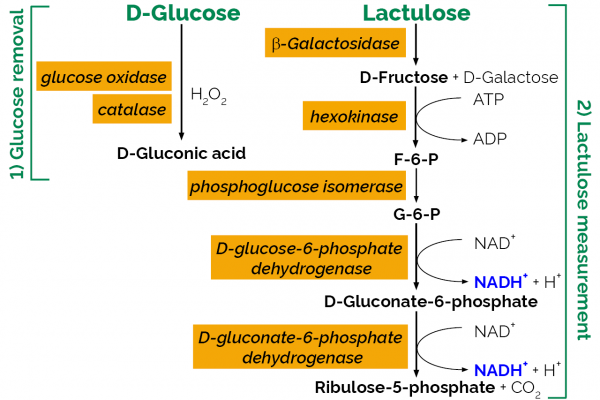
The Lactulose Assay Kit is suitable for the specific, rapid and sensitive measurement and analysis of lactulose in milk and milk-based samples. Reagents included in this kit may also be prepared for use in the procedure described by ISO Method 11285:2004.
Detail
Lactulose Assay Kit
Content:
50 assays per kit
Shipping Temperature:
Ambient
Storage Temperature:
Short term stability: 2-8oC, Long term stability: See individual component labels
Stability:
> 2 years under recommended storage conditions
Analyte:
Lactulose
Assay Format:
Spectrophotometer
Detection Method:
Absorbance
Wavelength (nm):
340
Signal Response:
Increase
Linear Range:
0.65 to 65 µg of lactulose per “Enzymatic Determination Reaction
Limit of Detection:
4.8 mg/L
Reaction Time (min):
~ 120 min
Application examples:
Milk, dairy products and foods containing milk.
Method recognition:
Novel method
The Lactulose Assay Kit is suitable for the specific, rapid and sensitive measurement and analysis of lactulose in milk and milk-based samples. Reagents included in this kit may also be prepared for use in the procedure described by ISO Method 11285:2004.
Twice the sensitivity of traditional hexokinase based lactulose methods
Very cost effective
All reagents stable for > 2 years after preparation
Mega-Calc™ software tool is available from our website for hassle-free raw data processing
Standard included
Other Products
IVD3182 HiPure Circulating DNA Kit
Product Info
Document
Product Info
Introduction
Free-circulating nucleic acids, such as tumor-specific extracellular DNA fragments and mRNAs in the blood or fetal nucleic acids in maternal blood, are present in serum or plasma usually as short fragments, <1000bp (DNA). HiPure Circulating DNA Midi Kit enables efficient purification of these circulating nucleic acids from human plasma, serum, or urine. The extracted products can be used for clinical in vitro detection.
Details
Specifications
Features
Specifications
Main Functions
Isolation circulating DNA from 1-5ml plasma, serum, body fluids using vacuum protocol
Applications
qPCR, liquid or solid chip analysis, hybridization and SNP detection, etc.
Purification method
Mini spin column
Purification technology
Silica technology
Process method
Manual (vacuum)
Sample type
Serum, plasma and other cell-free fluid samples
Sample amount
1-5ml
Elution volume
≥50μl
Time per run
≤60 minutes
Liquid carrying volume per column
4ml
Binding yield of column
1mg
Principle
This product is based on silica Column purification. The sample is lysed and digested with lysate and protease, DNA is released into the lysate. Transfer to an adsorption column. Nucleic acid is adsorbed on the membrane, while protein is not adsorbed and is removed with filtration. After washing proteins and other impurities, Nucleic acid was finally eluted with low-salt buffer.
Advantages
High yield – most optimal process, free DNA (>50bp) can be obtained to the maximum extent
High concentration – low elution volume, ensuring high nucleic acid concentration
High purity – low alcohol binding method, completely removing inhibitor and protein pollution
High recovery – DNA can be recovered at thelevel of PG by silica gel column purification
Kit Contents
Contents
IVD3182
Purification Times
50
Buffer ACL
250 ml
Buffer ACB*
300 ml
Buffer DCW1*
22 ml
Buffer DCW2*
10 ml
Proteinase K
540 mg
Protease Dissolve Buffer
30 ml
Carrier RNA
110 μg
Nuclease Free Water
20 ml
HiPure CFDNA Mini Columns
50
2 ml Collection Tubes
100
Extender Tube
50
Vac-Connector
50
Storage and Stability
Proteinase K, Carrier RNA should be stored at 2-8°C upon arrival. However, short-term storage (up to 12 weeks) at room temperature (15-25°C) does not affect their performance. The remaining kit components can be stored dry at room temperature (15-25°C) and are stable for at least 18 months under these conditions. The entire kit can be stored at 2-8°C, but in this case buffers should be redissolved before use. Make sure that all buffers are at room temperature when used.
Experiment Data
Document
Free-circulating nucleic acids, such as tumor-specific extracellular DNA fragments and mRNAs in the blood or fetal nucleic acids in maternal blood, are present in serum or plasma usually as short fragments,
TCO-PEG12-DBCO is a long chain PEGreagent containing a TCO and a DBCO moiety. TCO group specifically and efficiently reacts with terrahydrazine under mild condition. DBCO is very reactive toward Azide through click chemistry, the PEG spacer increases the aqueous solubility of the reagent. Reagent grade, for research purpose. Please contact us for GMP-grade inquiries.
Document
TCO-PEG12-DBCO is a long chain PEGreagent containing a TCO and a DBCO moiety. TCO group specifically and efficiently reacts with terrahydrazine under mild condition. DBCO is very reactive toward Azide through click chemistry, the PEG spacer increases the aqueous solubility of the reagent. Reagent grade, for research purpose. Please contact us for GMP-grade inquiries.
The kit provides rapid, simple, and reliable components for the labeling proteins with biotin for use in lateral flow procedures. Kit enables the biotinylation of antibody or proteins to be used with the Universal Lateral Flow Kits (AU2034, AU2037 or AUAU2044 in addition to Streptavidin Colloidal (AU2017) gold or Streptavidin CdZnS Quantum Dots (AU2043).
Document
Attogene’s Protein Biotinylation kit provides the user with reagents for labeling proteins Desalting columns for purifying the labeled molecule Convenient and easy to interpret instructions on how to carry out the labeling process. Made by Attogene in the USA