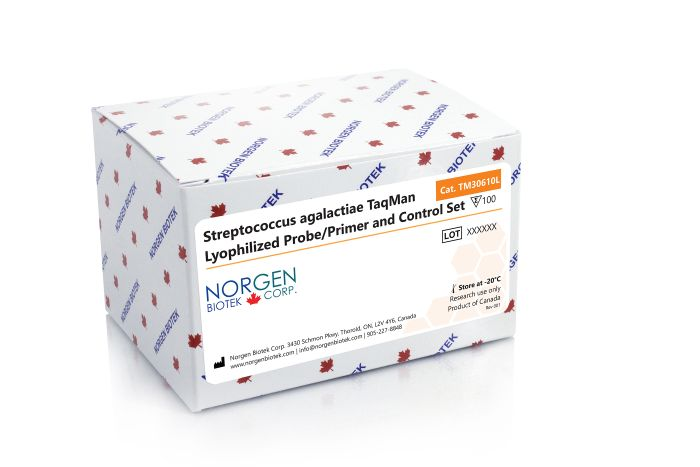
Lyophilized format designed for room temperature shipping
Available in TaqMan format for analysis
Norgen’s Streptococcus agalactiae TaqMan PCR Lyophilized Kit is designed for the detection of Streptococcus agalactiae specific DNA in a real-time PCR based on the use of TaqMan® technology. The lyophilized format is designed to ship the kit at ambient temperature.
Norgen’s Streptococcus agalactiae TaqMan Lyophilized Probe/Primer and Control Set is designed for the detection of Streptococcus agalactiae specific DNA in a real-time PCR based on the use of TaqMan® technology. The lyophilized format is designed to ship the kit at ambient temperature.
All kit components should be stored at -20°C upon arrival.
Once reconstituted, repeated thawing and freezing (>2 times) of the Master Mix and Positive Control should be avoided, as this may affect the performance of the assay. If the reagents are to be used only intermittently, they should be frozen in aliquots.
All kit components can be stored for 2 years after the date of production without showing any reduction in performance.
Component
Cat. TM30650L (100 preps)
Cat. TM30610L (100 preps)
MDx TaqMan 2X PCR Master Mix (Lyo)
4 x 350 μL
–
Streptococcus agalactiae Primer & Probe Mix (Lyo)
280 μL
280 μL
Streptococcus agalactiae Positive Control (Lyo)
150 μL
150 μL
Nuclease-Free Water (Negative Control)
3 x 1.25 mL
1 x 1.25 mL
Product Insert
1
1
Other Products
Okadaic Acid (DSP) ELISA Kit
Product Info
Document
Product Info
Competitive ELISA for the quantitative analysis of Okadaic Acid (DSP)
Format: 96-well microtiter plate (12 test strips of 8 wells)
Okadaic acid is a potent neurotoxin and phosphatase inhibitor from dinoflagellate black sponges that are associated with seafood poisonings.
Okadaic Acid (OA) is a one of the diarrhetic shellfish poisons (DSP) produced by dinoflagellate genera Dinophysis and Prorocentrum. There are several chemically different toxins associated with DSP.
They are lipophilic and polyether compounds and can be divided into three main groups:
Acidic toxins
Neutral toxins
Other toxins 2 Contamination of shellfish with OA has been associated with harmful algae blooms throughout the world.
In humans, DSP causes dose-dependent symptoms of diarrhea, nausea, and vomiting. The action levels established by the FDA for OA is 200ppb. The EU has established a level of 160 ppb of OA or its equivalent.
The Attogene Okadaic acid ELISA kit enables international and government regulatory agencies, food manufacturers and processors, as well as quality assurance organizations to detect OA in food, feed, fish, and environmental samples of concern.
Okadaic acid is the causative agent of Diarrhetic Shellfish Poisoning (DSP).
FDA and EPA Safety Levels in Regulations and Guidance – 0.16 mg/kg for Clams, mussels, oysters, and whole and roe-on scallops, fresh, frozen, or canned. – National Shellfish Sanitation Program Guide for the Control of Molluscan Shellfish.
Document
Competitive ELISA for the quantitative analysis of Okadaic Acid (DSP) Format: 96-well microtiter plate (12 test strips of 8 wells) Okadaic acid is a potent neurotoxin and phosphatase inhibitor from dinoflagellate black sponges that are associated with seafood poisonings.
Plasma/Serum Exosome and Free-Circulating RNA Isolation Kits
Product Info
Document
Product Info
Overview
Isolate all sizes of RNA, including microRNA, irrespective of size or GC content, without bias.
Versatile sample input ranges
Isolate all sizes of free-circulating RNA, including microRNA
The purified exosomal RNA is free from any circulating RNA-binding proteins
No phenol extractions, Proteinase K treatment, nor carrier RNA
No time-consuming ultracentrifugation, filtration nor special syringes are required
No precipitation reagents, nor overnight incubation required
Concentrate isolated exosomal RNA and are free-circulating RNA into a flexible elution volume ranging from 50 µL to 100 µL
Purification is based on spin column chromatography that uses Norgen’s proprietary resin separation matrix
These kits provide a fast, reliable and convenient method to sequentially isolate and concentrate exosomal RNA as well as Free-Circulating RNA from different plasma/serum sample volumes. The purification is based on spin column chromatography that employs Norgen’s proprietary resin. These kits are designed to isolate all sizes of RNA, including microRNA as well as all sizes of the free-circulating protein-bound RNA, including microRNA. These kits provide a clear advantage over other available kits in that they do not require any special instrumentation, protein precipitation reagents, extension tubes, phenol/chloroform or protease treatments. Moreover, these kits allow the user to elute into a flexible elution volume ranging from 50 µL to 100 µL. The RNA isolated from the purified exosomes is free from any protein-bound circulating RNA and is of the highest integrity. Moreover, the free-circulating, protein-bound, RNA is free from any exosomal RNA. The purified RNA can be used in a number of downstream applications including real time PCR, reverse transcription PCR, Northern blotting, RNase protection and primer extension, and expression array assays.
Plasma/Serum Exosome and Free-Circulating RNA Isolation Mini Kit
For sample volumes ranging from 50 µL to 1 mL.
Plasma/Serum Exosome and Free-Circulating RNA Isolation Midi Kit
For sample volumes ranging from 1 mL to 4 mL.
Plasma/Serum Exosome and Free-Circulating RNA Isolation Maxi Kit
All sizes, including miRNA and small RNA (< 200 nt)
Elution Volume
50 – 100 µL
Time to Complete 10 Purifications
40 – 45 minutes
Average Yields*
Variable depending on specimen
*Please check page 5 of the product insert for the average yields and the common RNA quantification methods
Storage Conditions and Product Stability All solutions should be kept tightly sealed and stored at room temperature. This kit is stable for 2 years after the date of shipment. It is recommended to warm Lysis Buffer A for 20 minutes at 60°C if any salt precipitation is observed.
Important Note This kit is suitable for the purification of exosomes from fresh or frozen serum or plasma prepared from blood collected on either EDTA or Citrate. Plasma samples prepared from blood collected on heparin should not be used as heparin can significantly interfere with many downstream applications such as RT-PCR.
Short term stability: 2-8oC, Long term stability: See individual component labels
Stability:
> 2 years under recommended storage conditions
Analyte:
Amylopectin, Amylose
Assay Format:
Spectrophotometer
Detection Method:
Absorbance
Wavelength (nm):
510
Signal Response:
Increase
Limit of Detection:
Amylose 5-95% of total starch content
Total Assay Time:
~ 120 min
Application examples:
Cereal starches, flours, pure starches and foods.
Method recognition:
Novel method
The Amylose/Amylopectin test kit is suitable for the measurement and analysis of amylose/amylopectin ratio and content in cereal starches and flours. Based on a Con A precipitation procedure.
All reagents stable for > 12 months after preparation
Only enzymatic kit available
Accurate and reliable amylose / amylopectin ratio determination
Simple format
Standard included
Document
The Amylose/Amylopectin test kit is suitable for the measurement and analysis of amylose/amylopectin ratio and content in cereal starches and flours. Based on a Con A precipitation procedure.