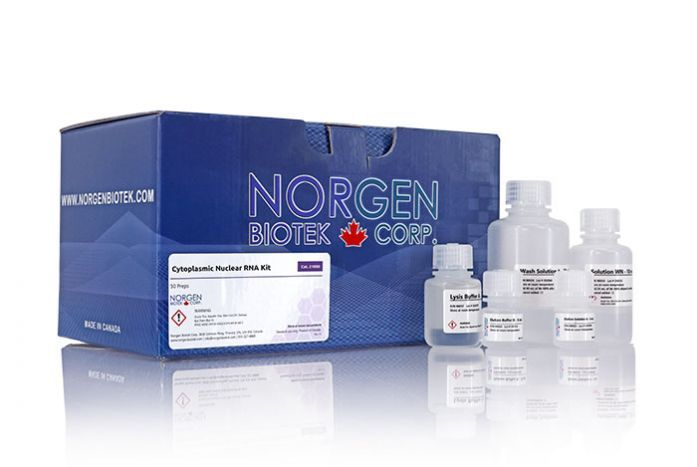
Excellent separation and purification of cytoplasmic and nuclear RNA
Convenient and fast spin column format
High quality and yield of RNA
Isolate full diversity of RNA (including microRNA) without phenol
Purified RNA is ready for any application including RT-PCR, qRT-PCR, RNA-Seq, arrays and more
Cytoplasmic RNA is free of DNA and ready for direct use in RT-PCR/qRT-PCR
Purification is based on spin column chromatography that uses Norgen’s proprietary resin separation matrix
This kit provides a rapid method for the isolation and purification of both cytoplasmic and nuclear RNA from cultured animal cells and small tissue samples. The kit can be used to isolate all sizes of RNA from the cytoplasmic and nuclear RNA fractions, including all small RNA species without any requirement for phenol. Included in the kit are sufficient reagents to perform either 50 cytoplasmic RNA preparations or 25 cytoplasmic and 25 nuclear RNA preparations. Ten samples can be processed in approximately 45 minutes. This kit is also available in a 100 prep size.
Background
In certain circumstances it is desirable to be able to isolate fractionated RNA as opposed to total RNA. For example, it may be preferable to isolate only mature, cytoplasmic RNA for some studies on expression profiling. Alternatively it may be desirable to isolate nuclear RNA in order to investigate and study pre-processed (non-spliced) RNA. Furthermore, this kit can be used to isolate RNA for downstream applications where it is necessary to avoid DNA contamination, since the cytoplasmic fraction has been shown to be free of all traces of genomic DNA.
RNA Yield HeLa (1 x 10⁶) – Cytoplasmic RNA HeLa (1 x 10⁶) – Nuclear RNA
15 µg ≤ 3.5 µg
Storage Conditions and Product Stability All solutions should be kept tightly sealed and stored at room temperature. This kit is stable for 2 years after the date of shipment.
Component
Cat. 21000 (50 preps)
Cat. 37400 (100 preps)
Lysis Buffer J
20 mL
2 x 20 mL
Buffer SK
40 mL
2 x 40 mL
Wash Solution A
38 mL
2 x 38 mL
Elution Buffer E
6 mL
2 x 6 mL
Mini Spin Columns
50
100
Collection Tubes
50
100
Elution Tubes (1.7 mL)
50
100
Product Insert
1
1
Other Products
D3141 HiPure Stool DNA Kit
Product Info
Document
Product Info
Introduction
With the development of molecular biology, stool, a new non-invasive sample, has been widely used in the research of animal molecular genetics, population ecology, behavioral ecology and some intestinal disease diagnosis. Stool samples includes gut microbial DNA, food residue sample DNA, and alimentary tract exfoliated cell DNA.
The primary problem encountered when using stool sample for molecular biology research is the low content of exfoliated cells in the digestive tract and a certain degree of degradation of genetic material in stool. Another issue in molecular scatology research based on PCR is the presence of a large number of inhibitors in stool that can affect Taq enzyme activity, leading to downstream detection inactivation. These inhibitors include polysaccharides, plant polysaccharides, bile acids, bile salts, bile pigments, digestive juices, mucus, etc. Therefore, selecting appropriate extraction methods to obtain high-quality DNA is the key to successful downstream detection of stool DNA.
At present, the pretreatment methods used in the laboratory, such as phenol/chloroform extraction, cetyltrimethyl bromide (CTAB) lysis, and guanidine isothiocyanate lysis, lack universality in different species, and the success rate of extracting DNA for PCR amplification is also very low. The HiPure Stool DNA Kit provided by Magen Company has opened up a new approach for DNA extraction from stool samples with good universality, high cost-effectiveness, high yield and purification. The reagent kit adopts a unique solution system and inhibitory factor adsorbent, which can efficiently remove various impurities in stool samples. The purified DNA can be directly used for PCR, quantitative PCR and other applications.
This product allows rapid and reliable isolation of high-quality genomic DNA from various stool samples. Up to 100 mg soil samples can be processed in 60 minute. The system combines the reversible nucleic acid binding properties of HiPure matrix with the speed and versatility of spin column technology to eliminate PCR inhibiting compounds such as humic acid from soil samples. Purified DNA is suitable for PCR, restriction digestion, and next-generation sequencing. There are no organic extractions thus reducing plastic waste and hands-on time to allow multiple samples to be processed in parallel.
Details
Specifications
Features
Specifications
Main Functions
Isolation total DNA from 50-100mg stool samples
Applications
PCR, Southern Blot, enzyme digestion and NGS, etc.
Purification method
Mini spin column
Purification technology
Silica technology
Process method
Manual (centrifugation or vacuum)
Sample type
Stool
Sample amount
50-100mg
Yield
3-15μg
Elution volume
≥30μl
Time per run
≤60 minutes
Liquid carrying volume per column
750μl
Binding yield of column
100μg
Principle
Stool sample is homogenized and then treated in a specially formulated buffer containing detergent to lyse bacteria, yeast, and fungal samples. Humic acid, proteins, polysaccharides, and other contaminants are removed using our proprietary Absorber Solution. Binding conditions are then adjusted and the sample is applied to a DNA Mini Column. Two rapid wash steps remove trace contaminants and pure DNA is eluted in low ionic strength buffer. Purified DNA can be directly used in downstream applications without the need for further purification.
Advantages
High purity – unique adsorbent can completely remove inhibitory factors
High concentration – maximum extraction of total DNA from stool samples
High recovery – DNA can be recovered at the level of PG
Good repeatability – silica technology can obtain ideal results every time
Kit Contents
Contents
D314102
D314103
Purification Times
50 Preps
250 Preps
HiPure DNA Mini Columns II
50
250
2ml Collection Tubes
50
250
2ml Bead Tubes
50
250
Proteinase K
24 mg
120 mg
Protease Dissolve Buffer
1.8 ml
10 ml
Buffer SPL
40 ml
200 ml
Buffer PCI
40 ml
200 ml
Buffer AL
20 ml
80 ml
Buffer GW1
22 ml
88 ml
Buffer GW2
20 ml
2 x 50 ml
Buffer AE
15 ml
30 ml
Storage and Stability
Proteinase K and Buffer PCI should be stored at 2-8°C upon arrival. However, short-term storage (up to 12 weeks) at room temperature (15-25°C) does not affect their performance. The remaining kit components can be stored at room temperature (15-25°C) and are stable for at least 18 months under these conditions. The entire kit can be stored at 2–8°C, but in this case buffers should be redissolved before use. Make sure that all buffers are at room temperature when used.
Document
With the development of molecular biology, stool, a new non-invasive sample, has been widely used in the research of animal molecular genetics, population ecology, behavioral ecology and some intestinal disease diagnosis. Stool samples includes gut microbial DNA, food residue sample DNA, and alimentary tract exfoliated cell DNA.
The primary problem encountered when using stool sample for molecular biology research is the low content of exfoliated cells in the digestive tract and a certain degree of degradation of genetic material in stool. Another issue in molecular scatology research based on PCR is the presence of a large number of inhibitors in stool that can affect Taq enzyme activity, leading to downstream detection inactivation. These inhibitors include polysaccharides, plant polysaccharides, bile acids, bile salts, bile pigments, digestive juices, mucus, etc. Therefore, selecting appropriate extraction methods to obtain high-quality DNA is the key to successful downstream detection of stool DNA.
At present, the pretreatment methods used in the laboratory, such as phenol/chloroform extraction, cetyltrimethyl bromide (CTAB) lysis, and guanidine isothiocyanate lysis, lack universality in different species, and the success rate of extracting DNA for PCR amplification is also very low. The HiPure Stool DNA Kit provided by Magen Company has opened up a new approach for DNA extraction from stool samples with good universality, high cost-effectiveness, high yield and purification. The reagent kit adopts a unique solution system and inhibitory factor adsorbent, which can efficiently remove various impurities in stool samples. The purified DNA can be directly used for PCR, quantitative PCR and other applications.
This product allows rapid and reliable isolation of high-quality genomic DNA from various stool samples. Up to 100 mg soil samples can be processed in 60 minute. The system combines the reversible nucleic acid binding properties of HiPure matrix with the speed and versatility of spin column technology to eliminate PCR inhibiting compounds such as humic acid from soil samples. Purified DNA is suitable for PCR, restriction digestion, and next-generation sequencing. There are no organic extractions thus reducing plastic waste and hands-on time to allow multiple samples to be processed in parallel.
This product is suitable for extracting total viral nucleic acid from cell-free/low-content cell biological samples such as body fluids, serums, plasma, soaking solutions, tissue homogenate supernatant, and culture supernatant. The Purified DNA/RNA is used for RT-PCR and PCR detection.
Details
Specifications
Features
Specifications
Main Functions
Extract viral DNA/RNA from 200μl cell-free samples by magnetic beads
Applications
RT-PCR,PCR,NGS
Products
Viral DNA / RNA
Purification method
Polydisperse magnetic beads
Purification technology
Magnetic beads technology
Process method
Manual or automatic
Sample type
cell-free/low-content cell biological samples such as body fluids, serums, plasma, tissue homogenate supernatant
Sample amount
200μl
Adaptive instrument
Nucleic acid extractor, pipetting workstation
Principle
This product is based on the purification method of high binding magnetic particles. The sample is lysed and digested under the action of lysate and Protease. DNA/RNA is released into the lysate. After adding magnetic particles and binding solution, DNA/RNA will be adsorbed on the surface of magnetic particles, and impurities such as proteins will be removed without adsorption. The adsorbed particles were washed with washing solution to remove proteins and impurities, washed with ethanol to remove salts, and finally DNA/RNA was eluted by Nuclease Free Water.
Advantages
Fast – several samples can be extracted in 40 minutes by column method
High quality – high purity total RNA / DNA can be directly used in various sensitive downstream applications
Safe – no phenol chloroform extraction required
Sensitive – DNA/RNA can be recovered at the level of PG
Kit Contents
Contents
IVD5412
Purification Times
200 Preps
MagPure Particles N
5 ml
PK/Carrier RNA
50 mg
Protease Dissolve Buffer Blue
5 ml
Buffer MLB*
120 ml
Buffer MW1*
53 ml
RNase Free Water
30 ml
Storage and Stability
This kit is shipped and stored at room temperature and is valid for 12 months.
Experiment Data
Document
This product is suitable for extracting total viral nucleic acid from cell-free/low-content cell biological samples such as body fluids, serums, plasma, soaking solutions, tissue homogenate supernatant, and culture supernatant. The Purified DNA/RNA is used for RT-PCR and PCR detection.
Huayi Cell Factory is a robust and easy-to-use cell culture platform for applications in the production of human and animal vaccines, therapeutic proteins, cell therapy, and gene therapy.
To address the needs of your workflow, We have three kinds of mouth, which is available on most cell culture products to ensure consistent performance from lot to lot and from format to format.
The product assembled with ultrasonic welded technology
Versatile port design facilitates both pouring and aseptic filling techniques
Gamma radiation sterilization
the cell culture surface area
of one 10-layer Cell Factory unit is equivalent to the area
of 36 T-175 flasks
Document
Huayi Cell Factory is a robust and easy-to-use cell culture platform for applications in the production of human and animal vaccines, therapeutic proteins, cell therapy, and gene therapy.
To address the needs of your workflow, We have three kinds of mouth, which is available on most cell culture products to ensure consistent performance from lot to lot and from format to format.