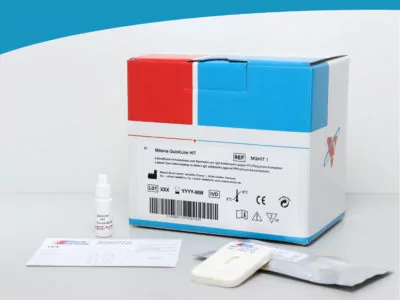
Lateral Flow Assay designed for the detection of IgG antibodies against PF4/polyanion-complexes in human citrated plasma or Serum
Detail
20 tests
Name of Product
HIT – Heparin-Induced Thrombocytopenia Test (20)
Catalog Number
MQHIT 1
Short Info
Lateral Flow Assay designed for the detection of IgG antibodies against PF4/polyanion-complexes in human citrated plasma or Serum
This product is only available in Germany!
Method/Platform
lateral flow, immunoassay
Range/Assay Sensivity
Test Principle
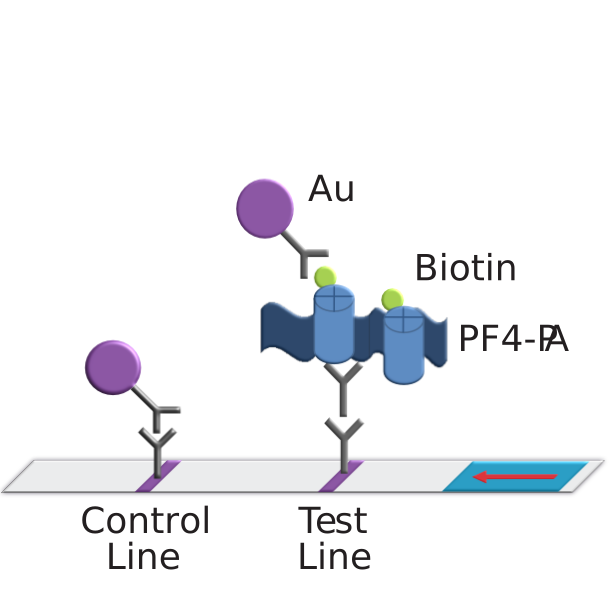
IgG antibodies are resposible for the heparin induced thrombocytopenia.
Immobilized anti-human IgG on the membrane of the test unit binds patients IgG-antibodies which are previously captured by the PF4/polyanion-complex which is detected by intensely colored gold nanoparticles.
The presence of PF4/polyanion-complex becomes visible at a colored test line. The surplus of gold particles continues to migrate through the membrane and is captured at the control line by specific antibodies.
Other Products
FBS Exosome Depletion Kits
Product Info
Document
Product Info
Overview
Efficient depletion of bovine exosomes from Fetal Bovine Serum
Deplete exosome-sized vesicles from versatile FBS volumes
No protease treatment required
No time-consuming ultracentrifugation
No precipitation reagents required
No overnight incubation required
Exosome depletion confirmed by reduction of bovine miRNAs below detectable levels
The depleted FBS provides the same cellular growth rates as the standard FBS
Purification is based on Norgen’s proprietary Silicon Carbide resin matrix
Norgen’s FBS Exosome Depletion Kits provides a quick and easy protocol for the depletion of bovine exosomes from FBS prior to using it as a growth supplement in your culture medium. The FBS recovered from the depletion process is exosome-depleted and does not contain any quantifiable bovine miRNAs. Moreover, the exosome-depleted FBS will support the growth of your cells of interest similar to the non-depleted FBS. Norgen’s kits allow for the processing of different FBS volumes. The depletion is based on Norgen’s proprietary resin. These kits provide a clear advantage over other available kits in that they do not require ultracentrifugation, any special instrumentation, precipitation reagents or any protease treatments. More importantly, the depletion process is an inexpensive method for exosome depletion from FBS, as compared to the expensive current ready-to-use exosome-depleted media available on the market.
Background
Most culture medium used for the growth and propagation of cells in culture require the addition of fetal bovine serum (FBS) as a growth supplement to media. FBS is obtained from bovine (cow) serum, and therefore contains large quantities of bovine exosome vesicles. These exosomes may interfere with some types of studies, or may lead to unreliable results when studying the exosomes shed from your cells of interest in normal culture conditions. Therefore, the use of exosome-depleted FBS is highly recommended for many types of studies.
Up to 140 mL (FBS Exosome Depletion Kit I (Slurry Format) Up to 280 mL (FBS Exosome Depletion Kit II (Slurry Format)
Depletion
Deplete exosome-sized vesicle
Bovine miRNA
No detectable bovine miRNA
Time to Complete 6 Purifications
40 minutes
Storage Conditions and Product Stability All buffers should be kept tightly sealed and stored at room temperature. This kit is stable for 2 years after the date of shipment.
[NS1001] FluoroVue™ Nucleic Acid Gel Stain (10,000X), 500 μl x 5
Product Info
Document
Product Info
Description
FluoroVue™ Nucleic Acid Gel Stain (10,000X) is specially designed for in-gel use and is a safer replacement for conventional Ethidium bromide (EtBr), which poses a significant health and safety hazard to its users. It is a fluorescent stain which offers highly sensitive detection of double-stranded or single-stranded DNA and RNA in a convenient manner. FluoroVue™ Nucleic Acid Gel Stain offers high sensitivity that is several times greater than EtBr.
FluoroVue™ Nucleic Acid Gel Stain is compatible with both conventional UV gel-illumination systems as well as harmless long wavelength blue light illumination systems, like B-BOX™. When bound to nucleic acids, FluoroVue™ Nucleic Acid Gel Stain has a fluorescent excitation maximum of 250 and 482 nm, and an emission maximum of 509 nm. Therefore, it can replace EtBr without the need of changing existing lab imaging systems.
Features:
Excellent for in-gel staining
Sensitivity: 0.14 ng (DNA) or 1 ng (total RNA)
A safer alternative to EtBr
Compatibility: suitable to blue or UV light
Increased cloning efficiency (blue light)
Storage
Protected from light 4°C for 12 months -20°C for 24 months
Document
FluoroVue™ Nucleic Acid Gel Stain (10,000X) is specially designed for in-gel use and is a safer replacement for conventional Ethidium bromide (EtBr), which poses a significant health and safety hazard to its users. It is a fluorescent stain which offers highly sensitive detection of double-stranded or single-stranded DNA and RNA in a convenient manner. FluoroVue™ Nucleic Acid Gel Stain offers high sensitivity that is several times greater than EtBr.
FluoroVue™ Nucleic Acid Gel Stain is compatible with both conventional UV gel-illumination systems as well as harmless long wavelength blue light illumination systems, like B-BOX™. When bound to nucleic acids, FluoroVue™ Nucleic Acid Gel Stain has a fluorescent excitation maximum of 250 and 482 nm, and an emission maximum of 509 nm. Therefore, it can replace EtBr without the need of changing existing lab imaging systems.