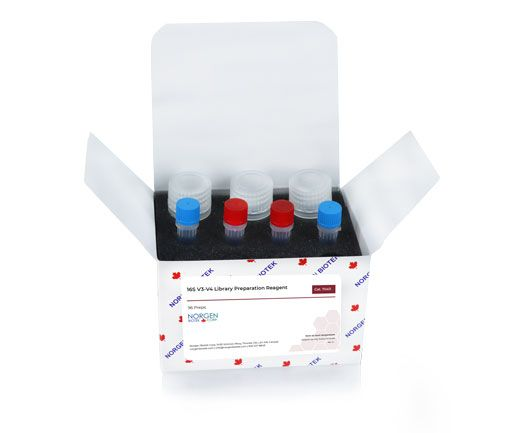
The ITS1 Library Preparation Kit for Illumina consists of the reagents and components required for library preparation of the fungal target ITS1 libraries to be used for next-generation sequencing on Illumina platforms. All molecular reagents including primers, enzyme mixes, indexes, and buffers are provided. Instructions for PCR clean up with the AMPure XPMagneticBeads(supplied by customer) are also included for rapid purification of nucleic acid products generated at two steps of the workflow. The library prep workflow could be used for purified DNA inputs from different sources including stool, soil, water, saliva, plant, urine, skin swab, vaginal swab, cheek swab, nasal/swab, plasma/serum, tongue swab, gum swab, and others.
The ITS1 Library Preparation Kit for Illumina has a streamlined procedure that reduces the handling time such that the library prep procedure can be completed in approximately 4 hours (see diagram below). Input DNA is first subjected to targeted PCR to amplify the ITS1 region of the fungal DNA.The post-PCR reaction is then cleaned up using AMPure XPbeads. Dual index primers are then added using a limited-cycle PCR. The indexed amplicons flanked by 5′ and 3′ barcoded adaptors are then cleaned using AMPure XPbeads. The libraries are then ready for quantification, pooling and sequencing.
Storage Conditions and Product Stability Norgen’s ITS1 Library Prep Kit for Illumina is shipped as one kit box (for the 24 prep kit) or two sub-component kits (for the 96 prep kit). All kits should be stored at -20°C upon arrival.
All kit components will remain stable for at least 1 year when stored at the specified storage conditions.
Other Products
Solid Phase Adsorption Toxin Tracking (SPATT) Bag Set
Product Info
Document
Product Info
Set of three Solid Phase Adsorption Toxin Tracking (SPATT) Bags
Solid Phase Adsorption Toxin Tracking (SPATT) is a biomimetic in-situ water monitoring tool that falls under an expanding umbrella of passive samplers. It serves to warn researchers of toxin-producing harmful algal bloom (HAB) developments early on. It has been popularized through its affordability, ease of use, and its ability to capture ephemeral events in marine, brackish, and freshwater environments. Its uptake of contaminants has been shown to be more similar than other sampling methods to that of aquatic species like bivalves, mussels, and clams. It provides an average bioavailable fraction of a toxin over deployment time that can be used to determine an overall toxin risk to organisms. The sampling period typically depends on the bioactivity at a site, ranging from 24 hours to 4 weeks in most cases.
A SPATT passively absorbs and desorbs extracellular compounds over its stretch of time at a sampling site; in an organism, a toxin would go through biochemical detoxification processes. Passive samplers have a higher sensitivity for more compounds and provide improved stability and preservation of these compounds within the resin. SPATT devices capture less commonly detected cyanotoxins (e.g. cylindrospermopsin) at lower concentrations than that of a grab sample (collected at one point in time). Grab samples are limited in scope and sensitivity, and underrepresent toxins like microcystin-LR, which is picked up very reliably through SPATT technology.
Uses HP20 that is widely applicable for many toxins.
Used to capture:
Cyanotoxin (e.g. microcystin and cylindrospermopsin)
Saxitoxin & derivatives (GNTXs, C-toxins), and other paralytic shellfish toxins (PSTs)
DBCO-amine TFA salt is a simple building block containing a DBCO moiety and an amine group. Amine is very reactive with NHS ester. DBCO is commonly used for copper-free Click Chemistry reactions.
Document
DBCO-amine TFA salt is a simple building block containing a DBCO moiety and an amine group. Amine is very reactive with NHS ester. DBCO is commonly used for copper-free Click Chemistry reactions.
Blood samples contain rich DNA, including mitochondrial DNA, genomic DNA, circulating DNA (mostly released into blood after tumor cell apoptosis) in white blood cells, as well as parasitic viral or microbial DNA. These DNA are important parameters in clinical testing or diagnosis, which are also valuable materials for medical research. There are three main issues with extracting DNA from blood samples:
1. The sample is highly infectious, posing great harm to operators and the environment.
2. The source of DNA is complex and aportion of the nucleic acid, such as viral DNA or free DNA, may be lost during the operation, leading to downstream detection failure;
3. Blood sample contains a large amount of impurities and inhibitory factors.
Currently there are many methods available for extracting DNA from whole blood samples, such as phenol chloroform extraction, salting out method, etc. However, these methods require pre-treatment of blood sample, which removes red blood cells and isolate white blood cells in the first step. Due to the requirement that it cannot inactivate or kill pathogens during the process of removing red blood cells, the waste liquid (red blood cell lysate) and consumables may be contaminated by pathogens and become infectious, posing a danger to the entire laboratory environment and operators. In addition, during the process of removing red blood cells, useful nucleic acid information such as viruses, microorganisms, or circulating DNA is also lost, leading to experiment or detection failures.
The HiPure Blood DNA Kits series provided by Magen Company uses silica gel column purification technology, which can directly lyse whole blood samples without the need for white blood cell separation. Whole blood samples are directly mixed with lysates and proteases, resulting in the inactivation of pathogens, greatly reducing the infectivity, environmental pollution, and the chance of operators being infected. Due to the direct lysis and digestion of samples, except lymphocyte DNA, other circulating DNA as well as DNA from viruses and microorganisms, can also be recovered.
This product provides fast and easy methods for purification of total DNA for reliable PCR and Southern blotting. Total DNA (e.g., genomic, viral, mitochondrial) can be purified from tissue, whole blood, plasma, serum, buffy coat, bone marrow, other body fluids, lymphocytes, cultured cells.
Details
Specifications
Features
Specifications
Main Functions
Isolation total DNA from blood, tissue, culture cells, swab, blood spots using 96 plate
Applications
PCR, southern bolt and virus detection, etc
Purification method
96 well plate
Purification technology
Silica technology
Process method
Manual (centrifugation or vacuum)
Sample type
Blood, serum, plasma, milk, saliva, and other liquid samples and cultured cells
Sample amount
Elution volume
Time per run
Liquid carrying volume per column
Binding yield of column
Principle
This product is based on silica column purification. The sample is lysed and digested with lysate and protease, DNA is released into the lysate. Transfer to an adsorption column. Nucleic acid is adsorbed on the membrane, while protein is not adsorbed and is removed with filtration. After washing proteins and other impurities, Nucleic acid was finally eluted with low-salt buffer (10mm Tris, pH9.0, 0.5mm EDTA).
Advantages
High quality DNA – meet a variety of downstream applications, including PCR, qPCR, enzyme digestion, hybridization, etc.
High throughput – 96 samples can be processed simultaneously
Kit Contents
Contents
D311701
D311702
Purification Times
1 x 96
4 x 96
HiPure gDNA Plate
1
4
96 well Plate (2.2ml)
1
4
1.6ml Collection Plate
1
4
0.5ml Collection Plate
1
4
Silicon Seal Tape
1
4
Seal Film
5
25
Buffer ATL
30 ml
100 ml
Buffer AL
30 ml
100 ml
Buffer DW1
60 ml
250 ml
Buffer GW2
50 ml
2 x 100 ml
Proteinase K
50 ml
200 ml
Protease Dissolve Buffer
5 ml
15 ml
Buffer AE
30 ml
120 ml
Storage and Stability
Proteinase K should be stored at 2-8°C upon arrival. However, short-term storage (up to 12 weeks) at room temperature (15-25°C) does not affect their performance. The remaining kit components can be stored at room temperature (15-25°C) and are stable for at least 18 months under these conditions.
Blood samples contain rich DNA, including mitochondrial DNA, genomic DNA, circulating DNA (mostly released into blood after tumor cell apoptosis) in white blood cells, as well as parasitic viral or microbial DNA. These DNA are important parameters in clinical testing or diagnosis, which are also valuable materials for medical research. There are three main issues with extracting DNA from blood samples: