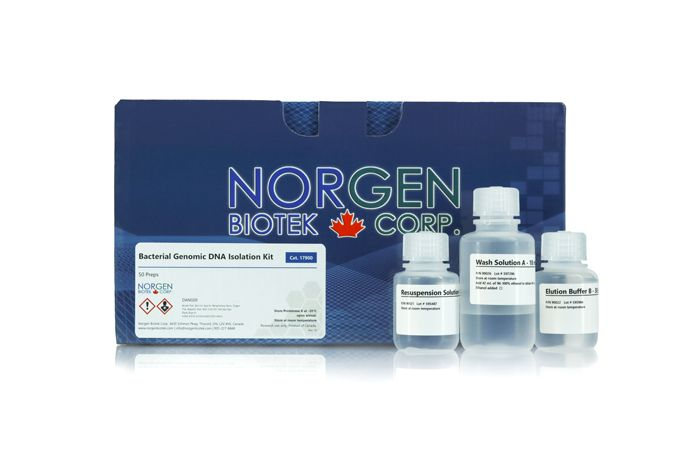
Isolate genomic DNA from all types of bacteria (both Gram-positive and Gram-negative)
Rapid and convenient spin column protocol
96-well format available for high throughput
High yield, high quality DNA for sensitive downstream applications including sequencing, PCR, qPCR and more
This kit is designed for the rapid spin column preparation of genomic DNA from 2 x 10⁹ viable bacterial cells (between 0.5 and 1.0 mL of culture). This kit can be used for both Gram-negative and Gram-positive bacteria including Escherichia coli and Bacillus cereus. Purified genomic DNA is of an excellent quality and yield, and is fully compatible with restriction enzyme digestions, sequencing, PCR, qPCR and more. Also available in 96-well format for high throughput applications.
* Yield will vary depending on the type of sample processed
Storage Conditions and Product Stability All solutions should be kept tightly sealed and stored at room temperature. This kit is stable for 1 year after the date of shipment. The kit contains a ready-to-use Proteinase K, which is dissolved in a specially prepared storage buffer. The buffered Proteinase K is stable for up to 1 year after the date of shipment when stored at room temperature.
Component
Cat. 17900 (50 preps)
Cat. 17950 (192 preps)
Resuspension Solution A
20 mL
60 mL
Lysis Buffer P
18 mL
60 mL
Solution BX
28 mL
110 mL
Wash Solution A
18 mL
2 x 38 mL
Elution Buffer B
30 mL
2 x 30 mL
Proteinase K
12 mg
50 mg
Spin Columns
50
–
96-Well Plate
–
2
Adhesive Tape
–
4
Collection Plate
–
2
Collection Tubes
50
–
Elution Tubes (1.7 mL)
50
–
Elution Plate
–
2
Product Insert
1
1
Other Products
IVD3182 HiPure Circulating DNA Kit
Product Info
Document
Product Info
Introduction
Free-circulating nucleic acids, such as tumor-specific extracellular DNA fragments and mRNAs in the blood or fetal nucleic acids in maternal blood, are present in serum or plasma usually as short fragments, <1000bp (DNA). HiPure Circulating DNA Midi Kit enables efficient purification of these circulating nucleic acids from human plasma, serum, or urine. The extracted products can be used for clinical in vitro detection.
Details
Specifications
Features
Specifications
Main Functions
Isolation circulating DNA from 1-5ml plasma, serum, body fluids using vacuum protocol
Applications
qPCR, liquid or solid chip analysis, hybridization and SNP detection, etc.
Purification method
Mini spin column
Purification technology
Silica technology
Process method
Manual (vacuum)
Sample type
Serum, plasma and other cell-free fluid samples
Sample amount
1-5ml
Elution volume
≥50μl
Time per run
≤60 minutes
Liquid carrying volume per column
4ml
Binding yield of column
1mg
Principle
This product is based on silica Column purification. The sample is lysed and digested with lysate and protease, DNA is released into the lysate. Transfer to an adsorption column. Nucleic acid is adsorbed on the membrane, while protein is not adsorbed and is removed with filtration. After washing proteins and other impurities, Nucleic acid was finally eluted with low-salt buffer.
Advantages
High yield – most optimal process, free DNA (>50bp) can be obtained to the maximum extent
High concentration – low elution volume, ensuring high nucleic acid concentration
High purity – low alcohol binding method, completely removing inhibitor and protein pollution
High recovery – DNA can be recovered at thelevel of PG by silica gel column purification
Kit Contents
Contents
IVD3182
Purification Times
50
Buffer ACL
250 ml
Buffer ACB*
300 ml
Buffer DCW1*
22 ml
Buffer DCW2*
10 ml
Proteinase K
540 mg
Protease Dissolve Buffer
30 ml
Carrier RNA
110 μg
Nuclease Free Water
20 ml
HiPure CFDNA Mini Columns
50
2 ml Collection Tubes
100
Extender Tube
50
Vac-Connector
50
Storage and Stability
Proteinase K, Carrier RNA should be stored at 2-8°C upon arrival. However, short-term storage (up to 12 weeks) at room temperature (15-25°C) does not affect their performance. The remaining kit components can be stored dry at room temperature (15-25°C) and are stable for at least 18 months under these conditions. The entire kit can be stored at 2-8°C, but in this case buffers should be redissolved before use. Make sure that all buffers are at room temperature when used.
Experiment Data
Document
Free-circulating nucleic acids, such as tumor-specific extracellular DNA fragments and mRNAs in the blood or fetal nucleic acids in maternal blood, are present in serum or plasma usually as short fragments,
The dsDNA Quantification Broad Range Kit and dsDNA Quantification High Sensitivity Kit are developed for double stranded DNA quantification using microplate readers. The DNA Quantification BR kit includes BR Dye, BR Dilution Buffer, and BR DNA Standards. The DNA Quantification HS kit includes HS Dye, HS Dilution Buffer, and HS DNA Standards. Simply dilute the Dye with the Dilution Buffer, add DNA sample, then read the concentration using microplate reader. The BR assay is accurate in the linear range from 4 to 1000 ng and the HS assay is accurate in the linear range from 0.2 to 100 ng. Both kits are highly selective for double-stranded DNA over RNA.
The Quantification Kits have several advantages over traditional DNA quantitation such as sensitivity, stability, and tolerance of contaminants.
Both kits reduce the cost of DNA quantification by 60% as compared to other brands.
Selectivity and sensitivity of the kits
Save 60% of the costs.
The performance of the kit is nearly identical to that of Thermo Fisher’s kit (figure below).
Comparison of BioDynami dsDNA Quantification Broad Range Kit with Thermo Fisher kit.
Comparison of BioDynami dsDNA Quantification High Sensitivity Kit with Thermo Fisher kit.
Common contaminants such as salts, free nucleotides, solvents, detergents, RNA, single stranded DNA, or protein are well tolerated in the assay (Table 1).
Collagen is a fundamental component of the extracellular matrix, and the predominant protein in animals, constituting around 30% of total protein mass. A glycoprotein, it is well known for its triple helical structure. This is formed from three polypeptide α-chains with Gly-X-Y repeating residues (Gly for Glycine, X for proline, and Y for hydroxyproline).
Types of Collagen
Over 28 types of collagens have been identified, with Type I collagen being the most abundant. It’s prevalent in ligaments, tendons, skin, and bone tissue. Its mature, insoluble form grants it remarkable strength, making it vital for the mobility of organisms. Collagen also has biochemical functions, influencing cell growth, proliferation, and differentiation.
This version of the kit is designed to detect and measure INSOLUBLE forms of collagen. Chose our Sircol 2.0 collagen kit if you need to analyse SOLUBLE collagen.
Applications of Collagen
Collagen, with its diverse properties, finds utility in various industries. It plays a role in medicine for wound healing and has an expanding role in tissue engineering and cell culture for biomedical purposes. It’s gaining popularity in the cosmetic industry for skin rejuvenation and is used in chemical formulations and the food industry as a functional food supplement and additive.
How does the Sircol assay detect collagen?
Sircol dye reagent contains Sirius Red – a linear anionic dye with sulphonic acid side chain groups. Under assay conditions the Sircol dye binds the basic groups of soluble collagen molecules. Maximal binding occurs in collagens possessing intact triple helix organisation as the highly ordered Gly-X-Yn helical structure of tropocollagen further contributes to dye binding. This results in a high degree of dye-collagen specificity. Affinity is progressively reduced during heat denaturation 4ºC due to the unwinding of the triple helix and formation of random chains.
Overview of the Sircol assay process:
Step 1. Samples being assayed for insoluble collagen must first undergo a 2-3 hour pre-treatment with Sircol Fragmentation reagent. This converts insoluble collagen into water-soluble gelatin can then be assayed.
Step 2. Addition of Sircol Dye Reagent to these pre-treated insoluble collagen samples results in the formation of a denatured collagen-dye complex. This complex then precipitates during the dye incubation period and is subsequently isolated by centrifugation, followed by washing to remove unbound dye. The Denatured collagen-bound dye is then eluted and measured spectrophotometrically.
Step 3. The insoluble collagen content of unknown samples is quantified by comparison against a calibration curve prepared using a the denatured collagen standard supplied with the kit.
Assay range
100 – 1000 µg/ml
Limit of Detection
100µg/ml
Detection Method
Colorimetric Detection (556nm) (Endpoint)
Measurements per kit
110 in total (allows a maximum of 46 samples to be run in duplicate alongside a standard curve).
Suitable Samples
The assay can be used to assess the rate of production of newly laid down collagen fibres during periods of rapid growth, development, tissue repair, remodeling and wound healing. Sources of material includes tissues, bone and calcified tissue.
*Insoluble collagens must be converted into soluble form prior to assay. Instructions and regents are provided with the kit., depending on sample this will require prior salt/acid/acid-pepsin extraction.
**non-mammalian collagens may result in a reduced limit of detection. We recommend use of an assay standard matched to the species under assay.
Many customers have found that the straightforward sample processing and analysis of Sircol make it a good alternative to conventional hydroxyproline analysis.
Precautions
This kit is designed for research use only. Not for use in diagnostic procedures. Kit requires access to a centrifuge, water bath / heated block, as well as a spectrophotometer/colorimeter capable of absorbance detection at 556nm. Specific sample preparation protocols may require customer to provide further reagents, consult assay manual for further information.
Sircol Insoluble Collagen kit contents:
1. Sircol Dye Reagent (1x110ml)
2. Denatured Collagen Reference Standard (1x5ml, 1.0mg/ml)
3. Acid-Salt Wash Reagent (1x20ml)
4. Fragmentation Reagent (1x110ml)
5. Alkali Reagent (1x110ml)
6. 2ml screw-cap tubes for preparation of samples.
7. Assay kit manual
NB: Additional reagents may be required for sample preparation prior to assay. Consult manual or contact us for further details.
Document
As collagens mature, they become increasingly crosslinked and insoluble – characteristics necessary for key biophysical role that collagen plays in living organisms. Biocolor’s Sircol™ INSOLUBLE Collagen Kit is a dye-binding assay designed for accurate quantification and measurement such collagens. It is ideal for analyzing crosslinked / insoluble collagens from sources such as tissues, bone, and calcified tissue.