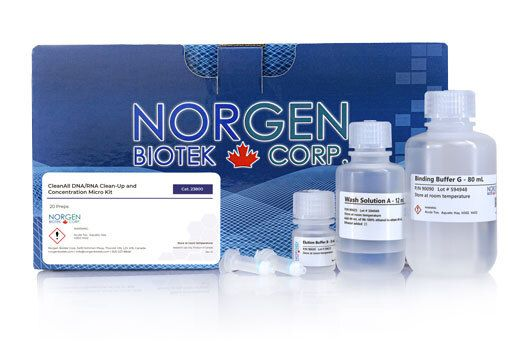
CleanAll DNA/RNA Clean-Up and Concentration Micro Kit
Facebook
X
Pinterest
Email
Detail
Overview
Can be used for the clean up of both RNA and DNA from enzymatic reactions, labeling etc.
Purifies all sizes of RNA, from large mRNA down to microRNA (miRNA)
Purifies all sizes of DNA, from small PCR products to plasmids to genomic DNA
Removes endotoxins for transfection of injection ready RNA or DNA
Rapid and efficient spin-column format (20 minutes)
Purification is based on spin column chromatography that uses Norgen’s proprietary resin separation matrix
Norgen’s CleanAll DNA/RNA Clean-Up and Concentration Micro Kit provides a rapid method for the purification, cleanup and concentration of RNA or DNA from different isolation methods or upstream applications. The kit can be used as an alternative to organic extraction and ethanol precipitation to clean up various enzymatic reactions.
The CleanAll Kit purifies RNA from phenol/guanidine-based protocols or from various upstream enzymatic reactions such as DNase treatment, labeling and in vitro transcription. Furthermore, endotoxins can be removed from previously purified RNA solutions.
The kit can be used to clean up DNA from digestions, ligations, PCR reactions, labeling reactions, DNA modification reactions and staining. The kit also provides a protocol for the rapid removal of endotoxins from previously purified DNA down to 0.1 EU/µg DNA or less.
Purify all sizes of RNA, from large mRNA and ribosomal RNA down to microRNA (miRNA) and small interfering RNA (siRNA).
Purify all sizes of DNA, from small PCR products, native or linearized plasmids, to genomic DNA. Using an alternative protocol, even oligonucleotides and smaller DNA fragments can be purified.
≥90% for RNA ≥90% for DNA 100 bp to 10 kbp ≥75% for DNA ≥ 10 kbp
* Applicable to smaller fragments or oligonucleotides with alternative protocol
Storage Conditions and Product Stability All solutions should be kept tightly sealed and stored at room temperature. This kit is stable for 2 years from the date of shipment.
Component
Cat. 23800 (50 preps)
Binding Buffer H
60 mL
Wash Solution K
27 mL
Elution Buffer L
15 mL
Micro Spin Columns
50
Collection Tubes
50
Elution Tubes (1.7 mL)
50
Product Insert
1
Other Products
C1410 MagPure Particles
Product Info
Document
Product Info
Introduction
Magnetic bead nucleic acid purification technology uses nano or micron superparamagnetic material as the matrix, generally black ferric oxide or yellowish brown ferricoxide as the magnetic material. The surface of bead is coated with appropriate functional groups, which can adsorb nucleic acid. Magnetic beads commonly used for nucleic acids, containing carboxyl groups, hydroxyl groups, or silicon groups. Silicon-based magnetic beads are the most common, and its principle of adsorbing nucleic acid is consistent with the classical glass milk purification technology or glass fiber filter membrane purification method. Magpure particle is a kind of polydisperse fast speed silica magnetic beads. The core is ferricoxide, accounting for 50%, and the surface coating is silica, accounting for 50%. The product can be used for plasmid extraction, gel DNA recovery, product purification, genomic DNA and RNA extraction, and viral nucleic acid extraction.
Details
Specifications
Features
Specifications
Concentration
100 mg/ml
Appearance
Suspension of black particles
Surface functional group
Si-OH, Silanol
Dispersibility
Polydisperse Amorphous
Particle size
1.5-5 μm
Preservation conditions
Room Temperature, valid for up to 2 years.It is recommended to store in 2-8°C to prevent microbial growth.
Magnetic response speed
15-30 seconds
Settling velocity
>5 minutes
High salt mediated binding
>2M guanidine isothiocyanate, DNA recovery up to 80%
Alcohol mediated binding
2M guanidine hydrochloride / isopropanol (30%), and the recovery of DNA / RNA was as high as 85%
PEG8000 mediated binding
The recovery of DNA/RNA was up to 85%
DNase/RNase
Not detected
DNA residue
<1 ppm
Recommended application
Plasmid extraction, gel DNA recovery, genomic DNA extraction and RNA extraction.
Principle
Highsalt mediated binding: in the solution containing 2-4M guanidine isothiocyanate, Magpure particles can selectively recover DNA molecules, and impurities such as protein polysaccharides are not adsorbed.
Alcohol mediated binding: in the solution containing guanidine salt and alcohol (>25%), Magpure particles can selectively recover DNA/RNA molecules, and proteins and other impurities are not adsorbed.
After biological samples are treated with digestive solution or lysis Buffer, DNA/RNA is released from cells, organelles and protein complexes (ribosomes and nucleosomes) into reagents. After Magpure particles and binding solution are added, DNA/RNA is adsorbed to the surface of Magpure particles to form DNA/RNA bead complex. Under the action of the magnetic field, the magnetic beads are separated and collected, and the impurities such as protein are removed with the waste liquid. After two or three steps of further cleaning, the DNA/RNA magnetic bead complex is resuspended in sterilized water or TE buffer, and the DNA/RNA falls off from the surface of the magnetic beads, so as to achieve the purpose of purification.
gDNA/RNA Isolation from Blood, Tissue, Plant, Swab, Spots, Stool, Soil and etc.Viral DNA/RNA IsolationAgarose Gel DNA Purification
DNA/RNA Isolation from low nucleic acid content samplesPlasmid IsolationDNA/RNA Clean Up
Circulating DNA IsolationViral Nucleic acid IsolationgDNA Isolation FFPE DNA/RNA Isolation
Plasmid extractiongel DNA recoverygenomicDNA/RNA extraction viral nucleic acid extractionCirculating DNA extraction
DNA/RNA Clean Up and concentrationDNA/RNA Isolation from low nucleic acid content samplesResearch immuno assays
The MagPure magnetic-particle technology combines the speed and efficiency of silica-based DNA purification with the convenient handling of magnetic particles. DNA binds to the silica surface of the magnetic particles in the presence of a chaotropic salt. DNA bound to the particles is then efficiently washed, considerably improving the purity of DNA. High-quality DNA is eluted. The automated purification procedure completely removes enzymes, nucleotides, and other contaminants and inhibitors. Purified DNA is suitable for direct use in downstream applications, such as sequencing and microarray analysis.
Document
Magnetic bead nucleic acid purification technology uses nano or micron superparamagnetic material as the matrix, generally black ferric oxide or yellowish brown ferricoxide as the magnetic material. The surface of bead is coated with appropriate functional groups, which can adsorb nucleic acid. Magnetic beads commonly used for nucleic acids, containing carboxyl groups, hydroxyl groups, or silicon groups. Silicon-based magnetic beads are the most common, and its principle of adsorbing nucleic acid is consistent with the classical glass milk purification technology or glass fiber filter membrane purification method. Magpure particle is a kind of polydisperse fast speed silica magnetic beads. The core is ferricoxide, accounting for 50%, and the surface coating is silica, accounting for 50%. The product can be used for plasmid extraction, gel DNA recovery, product purification, genomic DNA and RNA extraction, and viral nucleic acid extraction.
Flex Temperature Module Caddy and Calibration Adapter
Product Info
Document
Product Info
The Flex caddy allows the Temperature Module GEN2 to be installed on the Opentrons Flex deck and sit below the deck, enabling below-deck cable routing and labware placed on top of modules to remain closer to the deck surface. The calibration adapter is used to calibrate the location of the Temperature Module. Caddies and calibration adapters are specific to the type of module.
Note: This item does not include the Temperature Module. The module is available with or without the Flex Caddy and Calibration tool: Temperature Module GEN2
Document
The Flex caddy allows the Temperature Module GEN2 to be installed on the Opentrons Flex deck and sit below the deck, enabling below-deck cable routing and labware placed on top of modules to remain closer to the deck surface. The calibration adapter is used to calibrate the location of the Temperature Module. Caddies and calibration adapters are specific to the type of module.
Note: This item does not include the Temperature Module. The module is available with or without the Flex Caddy and Calibration tool: Temperature Module GEN2
The Heat&Run® gDNA removal kit removes contaminating gDNA from RNA prior to RT-qPCR.
The kit is based on the recombinant heat labile dsDNase, which is irreversibly inactivated at low temperatures (5 minutes at 58ºC or 15 minutes at 55ºC).
Reverse Transcription can be performed in the same tube, thereby minimizing pipetting steps and reducing hands-on time.
Protocol
The kit contains HL-dsDNase which efficiently removes gDNA from RNA preps before running RT-qPCR.
gDNA is removed, leaving RNA ready for reverse transcription in the same tube (Figure 1).
Heat-labile dsDNase can easily be inactivated.
This procedure minimizes pipetting steps and reduces hands-on time.
The Heat&Run kit is especially well suited for high throughput experiments.
The high activity of the HL-dsDNase at low temperature and its heat-lability makes it ideal to use in a combination with a heat activated RT enzyme. The contaminating genomic DNA is cleaved at ambient temperature and increasing the temperature over 50°C will inactivate the DNase and start the Reverse Transcriptase.
Do you require gDNA removal in applications other than RT-qPCR? Contact our support team for assistance in implementing dsDNase treatment in your workflow.
Kit Contents
10X reaction Buffer
HL-dsDNase (50 or 250 reactions)
Document
The Heat&Run® gDNA removal kit removes contaminating gDNA from RNA prior to RT-qPCR.
The kit is based on the recombinant heat labile dsDNase, which is irreversibly inactivated at low temperatures (5 minutes at 58ºC or 15 minutes at 55ºC).
Reverse Transcription can be performed in the same tube, thereby minimizing pipetting steps and reducing hands-on time.