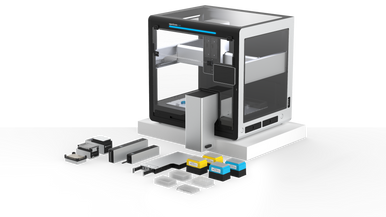
For scaling up and fully automating magnetic bead-based nucleic acid extraction
With the Flex Nucleic Acid Extraction Workstation, you can automate your NAE workflow at the scale you need to increase efficiency, reduce errors, and save hands-on time. Flex enables you to automate your nucleic acid isolation and purification workflows using any leading magnetic bead-based system on the market.
Optional add-ons can be purchased at a 10% discount when ordered with the Flex Nucleic Acid Extraction Workstation*
Detail
For scaling up and fully automating magnetic bead-based nucleic acid extraction
With the Flex Nucleic Acid Extraction Workstation, you can automate your NAE workflow at the scale you need to increase efficiency, reduce errors, and save hands-on time. Flex enables you to automate your nucleic acid isolation and purification workflows using any leading magnetic bead-based system on the market.
Optional add-ons can be purchased at a 10% discount when ordered with the Flex Nucleic Acid Extraction Workstation*
Other Products
Opentrons Flex 8-Channel Pipette
Product Info
Document
Product Info
Opentrons Flex 8-Channel pipettes enable highly accurate pipetting, optimized for automation.
Flex pipettes use air displacement technology to offer highly accurate pipetting with pipette volume ranges from 1 to 50 µL and 5 to 1000 μL. Smart sensors support automatic calibration, real-time positioning, and error detection. Choose the pipettes that fit your workflow — the gantry supports any two Flex 1-Channel or 8-Channel Pipettes — and swap them out yourself when your workflow changes.
Document
Opentrons Flex 8-Channel pipettes enable highly accurate pipetting, optimized for automation.
Flex pipettes use air displacement technology to offer highly accurate pipetting with pipette volume ranges from 1 to 50 µL and 5 to 1000 μL. Smart sensors support automatic calibration, real-time positioning, and error detection. Choose the pipettes that fit your workflow — the gantry supports any two Flex 1-Channel or 8-Channel Pipettes — and swap them out yourself when your workflow changes.
NGS Low Input DNA Library Prep Kit (illumina and MGI Platforms)
Product Info
Document
Product Info
The NGS Low Input DNA Library Prep Kit (illumina and MGI Platforms) was developed for construction of high quality NGS libraries with low input DNA amount from 1 ng to 400 ng. The kit allows scientist to study samples with limited DNA such as tumor samples, patient samples, and other specially collected samples (FACS sorting etc.). The kit has high library conversion efficiency with as little as 1 ng DNA input. The fast and simple 1.5-hour protocol makes libraries with even coverage and low GC-bias based our unique chemistry for DNA end-polishing and ligation.
The kit needs double strand DNA fragments (blunt and/or sticky) as input DNA for NGS library preparation, and is compatible with DNA fragments generated from both enzymatic approach (for example, BioDynami DNA fragmentation enzymes, Cat.# 40061 and Cat.# 40062) and mechanical approaches such as sonication and nebulization etc.
NGS Low Input DNA Library Prep Kit Workflow
Three index types are available for the NGS Low Input DNA Library Prep Kit of illumina platform:
Non-index (Cat.# 30022): Libraries do not have index.
Index (Cat.# 30024): Each of our index primers contains a unique barcode sequence with 6 bases that can be used to identify the low input DNA libraries. Library multiplexing up to 48 samples is possible. Index information can be downloaded here.
Unique dual index (Cat.# 30025): Library multiplexing up to 96 low input DNA libraries is possible with unique dual indexes with our Four-Base Difference Index System. The system allows us to make indexes for the libraries that have at least 4 bases different from each other in the 8-base barcode length. Our unique dual index primers can reduce sequencing errors such as de-multiplexing errors, amplification errors, mis-assignment of reads, index cross-contamination, and also index hopping. The kit includes 96 pre-mixed unique pairs of index primers. Index information can be downloaded here.
Indexes are available for the MGI platform kits (Cat.# 34024).
Kit advantages:
Fast protocol
The hands-on time is only 10 minutes
The total protocol time is around 1.5 hours
Simple procedure
Ready-to-use master mix makes it simple for reaction setup
Less reaction components
Less magnetic beads required for cleanup steps: Save the cost more than 50%
Low input DNA amount: Starts from 1 ng of DNA
Comparison of library conversion efficiency under the same NGS library preparation condition. Input DNA amounts are 1 ng and 10 ng, respectively. DNA was mechanical sheared with Covaris before library prep. BioDynami kit: NGS Low Input DNA Library Prep Kit (Cat. #30022).
Comparison of library yield under the same NGS library prep condition. Input DNA amounts are 1 ng, 10 ng, and 100 ng. DNA was mechanical sheared with Covaris before library prep. BioDynami kit (Cat. #30022). PCR cycle numbers were indicated.
Document
The NGS Low Input DNA Library Prep Kit (illumina and MGI Platforms) was developed for construction of high quality NGS libraries with low input DNA amount from 1 ng to 400 ng. The kit allows scientist to study samples with limited DNA such as tumor samples, patient samples, and other specially collected samples (FACS sorting etc.). The kit has high library conversion efficiency with as little as 1 ng DNA input. The fast and simple 1.5-hour protocol makes libraries with even coverage and low GC-bias based our unique chemistry for DNA end-polishing and ligation.
Lateral Flow Assay designed for the detection of IgG antibodies against PF4/polyanion-complexes in human citrated plasma or Serum
This product is only available in Germany!
Method/Platform
lateral flow, immunoassay
Range/Assay Sensivity
Test Principle
IgG antibodies are resposible for the heparin induced thrombocytopenia.
Immobilized anti-human IgG on the membrane of the test unit binds patients IgG-antibodies which are previously captured by the PF4/polyanion-complex which is detected by intensely colored gold nanoparticles.
The presence of PF4/polyanion-complex becomes visible at a colored test line. The surplus of gold particles continues to migrate through the membrane and is captured at the control line by specific antibodies.
Document
Lateral Flow Assay designed for the detection of IgG antibodies against PF4/polyanion-complexes in human citrated plasma or Serum