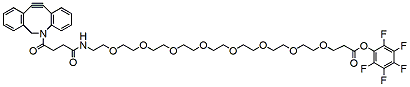
DBCO-PEG8-PFP ester is a PEG reagent comprising a DBCO group which can react with azides for copper-free Click Chemistry reactions. The PFP ester is an active ester which can be used to react with amine groups. PFP esters have been are stable compounds and are less susceptible to undergo hydrolysis. PEG8 linker increases the water solubility of a compound in aqueous media. Reagent grade, for research purpose. Please contact us for GMP-grade inquiries.
Detail
DBCO-PEG8-PFP ester is a PEG reagent comprising a DBCO group which can react with azides for copper-free Click Chemistry reactions. The PFP ester is an active ester which can be used to react with amine groups. PFP esters have been are stable compounds and are less susceptible to undergo hydrolysis. PEG8 linker increases the water solubility of a compound in aqueous media. Reagent grade, for research purpose. Please contact us for GMP-grade inquiries.
Other Products
LEAF SAMPLE COLLECTION KIT
Product Info
Document
Product Info
For simplified collection and shipment of leaf samples for our premium DNA Extraction and Genotyping Lab Services.
About
3CR Bio’s Leaf Sample Collection Kit – Your Gateway to High-Quality DNA Extraction and Genotyping Lab Services
The correct sampling and storage of leaf samples for DNA extraction have a significant impact on the final quality and quantity of the DNA extracted. Our simple, lightweight kits provide everything you need to sample and ship your leaf tissue from anywhere in the world, so it reaches us in top condition.
Use the 3CR Bioscience Leaf Sample Collection Kit to sample and prepare leaf tissue optimally when shipping to us for DNA extraction and Genotyping. Full instructions available in the Leaf Sample Collection User Guide.
Kit Contents
1 x 96-tube storage rack containing individual 2D-barcoded tubes sealed with a secure locking lid.
1 x Sponge pad to fit inside the lid of the storage rack for shipping.
1 x Sealed black plastic packet containing 2 x 10g sachets of desiccant.
1 x Large clear sealable plastic bag.
1 x Basic leaf cutting tool and leaf cutting mat (order separately)
or
1 x Advanced cutting tool (order separately)
Plate Map for recording sample IDs (image not shown, provided in paper and electronic form)
The Plant Kit is used in combination with our Lab Services. Visit the Lab Services page for more information about our DNA Extraction, Endpoint Genotyping, and GBTS services.
Here you can also:
View an interactive workflow infographic detailing our user-friendly ordering, shipping, processing, and data retrieval.
Access our online customer portal to register, submit projects. and review data.
Norgen’s Nuclease-Free Water is free of all DNases, RNases and nucleic acids and is suitable for all molecular biology applications requiring nuclease-free water including PCR, RT-PCR and real-time PCR. Our water is prepared without the use of DEPC, and is ready to use without further treatment.
IsoPol® BST+ is a heat-tolerant BST polymerase (large fragment) with enhanced strand-displacement activity. IsoPol® BST+ is active from 25 to 65°C. It is lacking 5’-3’- and 3’-5’-exonuclease activity.
Key features
IsoPol® BST+ lacks 5’-3’- and 3’-5’-exonuclease activity.
Inactivation – IsoPol® BST+ is completely inactivated after one minute incubation at 95°C
Enhanced strand displacement and processivity.
Increased salt tolerance.
IsoPol® BST+ Glycerol FREE
Is the popular choice f or isothermal applications such as LAMP and RT-LAMP at point-of-care diagnostics for its superior amplification performance and robustness. The enzyme is offered in a 1X storage buffer at a concentration < 300 U/µl
IsoPol® BST+ High Concentration Glycerol FREE
(IsoPol® BST+ HC Glycerol FREE) is used to ease the product development processes in sequencing technologies, solid phase amplification and several isothermal technologies. Same performance as IsoPol® BST+ (i.e., high processivity, relative SDA, and relative activity) with the only difference that it is offered in a 2X storage buffer at a concentration > 500 U/
Key features
High concentration
High purity
Lyophilisation and automation friendly
Figures
Properties
Document
These DNA polymerases are ideal for Isothermal Amplification
IsoPol® BST+ is a heat-tolerant BST polymerase (large fragment) with enhanced strand-displacement activity. IsoPol® BST+ is active from 25 to 65°C. It is lacking 5’-3’- and 3’-5’-exonuclease activity.