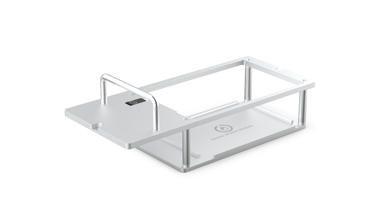
The Flex caddy allows the Heater-Shaker GEN1 to be installed on the Opentrons Flex deck and sit below the deck, enabling below-deck cable routing and labware placed on top of modules to remain closer to the deck surface. The calibration adapter is used to calibrate the location of the Heater-Shaker. Caddies and calibration adapters are specific to the type of module.
Note: This item does not include the Heater-Shaker. The module is available with or without the Flex Caddy and Calibration tool: Heater-Shaker Module GEN1
Detail
The Flex caddy allows the Heater-Shaker GEN1 to be installed on the Opentrons Flex deck and sit below the deck, enabling below-deck cable routing and labware placed on top of modules to remain closer to the deck surface. The calibration adapter is used to calibrate the location of the Heater-Shaker. Caddies and calibration adapters are specific to the type of module.
Note: This item does not include the Heater-Shaker. The module is available with or without the Flex Caddy and Calibration tool: Heater-Shaker Module GEN1
Nucleic acid testing (NAT) is the method of choice for detection and quantification of a wide range of micro organisms. Primerdesign manufactures and supplies high quality quantitative real-time PCR kits for the detection and simultaneous quantification of numerous significant pathogens . A copy number standard curve is provided for quantification and an the internal extraction template (DNA or RNA), controls for the quality of the nucleic acid extraction and eliminates false negative results.
The kit is designed with the broadest possible detection profile to ensure that all clinically relevant strains and subtypes are detected. Target sequences are selected by working with data from key opinion leaders in the field. Multiple sequence alignments and unprecedented real-time PCR expertise in design and validation ensure the best possible kit. Details of the target and priming specificity are included in the individual handbooks above.
Packaged, optimised and ready to use. Expect Better Data.
Document
Primer and probe mix (150 reactions) Reverse Transcription, target specific primers (RNA genome viruses only) Copy number standard curve (sufficient for multiple standard curves) Internal extraction control – Read through VIC channel* Endogenous control (150 tests) RNAse/DNAse free water *alternative fluorophores available on request
Nineteen discrete fragments ranging from 100 bp to 10000 bp
Higher intensity reference bands at 500 bp, 1000 bp and 5000 bp
The Norgen HighRangerPlus 100 bp DNA Ladder is prepared to ensure quality and batch-to-batch consistency. Our HighRangerPlus contains nineteen discrete fragments ranging from 100 bp to 10000 bp with higher intensity reference bands at 500 bp, 1000 bp and 5000 bp. This Ladder is ideal for size determination of digested DNA.
Contents: 1mL of premixed DNA ladder (0.5µg/10µL) in loading buffer (10mM EDTA, 10% glycerol, 0.015% bromophenol blue, and 0.17% SDS).
HighRanger Plus 100 bp DNA Ladder (Cat# 12000) – 100 loads
Ladder Properties:
Nineteen discrete fragments ranging from 100 bp to 10000 bp
Higher intensity bands at 500 bp, 1000 bp and 5000 bp for easy reference
Fragment
Size (bp)
Mass (ng)
1
10000
42
2
8000
33
3
6000
25
4
5000
42
5
4000
35
6
3000
27
7
2500
22
8
2000
18
9
1500
13
10
1000
40
11
900
28
12
800
25
13
700
34
14
600
19
15
500
44
16
400
13
17
300
18
18
200
13
19
100
10
Recommended Use: Mix thoroughly. For best results, load 10µL of DNA ladder per well. For precise mass determination with a densitometer, stain gel after electrophoresis using 0.5µg/mL ethidium bromide for 30-40 minutes. The table above shows the size and mass for each band based on 10µL ladder per well.
Storage: This kit is stable for 2 years after the date of shipment.
This ladder was standardized using 10µL of DNA per lane on a 0.8 cm thick, 13 x 15 cm, 1.0% agarose gel run in TAE buffer.
Bioprocessing with Salt Active Nucleases – High Salt Conditions
Product Info
Document
Product Info
Bioprocessing with Salt Active Nucleases – High Salt Conditions
OverView
For SAN HQ, SAN HQ ELISA Kit, and now SAN HQ GMP
SAN HQ GMP is biochemically identical to SAN HQ but produced under GMP conditions.
Applications
Purification of biologics from residual nucleic acids in biopharma manufacturing
Purification of recombinant proteins and enzymes for research and diagnostic use
Removal of unwanted nucleic acids contamination in molecular biology reagents in challenging conditions
Reduction of viscosity in biological samples during production and automation
Vaccine manufacturing and viral vector preparation
DNA removal in high-salt lysates
SAN HQ – Peak performance at high salt conditions
Salt Active Nuclease High Quality (SAN HQ) is a Bioprocessing Grade nuclease developed as the most efficient solution for removal of both single and double stranded DNA and RNA at high salt conditions.
This nonspecific endonuclease has peak activity at salt concentrations between 400 – 700 mM (Fig. 1)
Non-enveloped viruses like Adenoviruses and Adeno-Associated Viruses (AAV’s) are inherently more robust with two distinct advantages: 1) They exhibit higher tolerance to additives like salt and detergents and 2) their production often involves the lysis of host cells, allowing for harvesting non-secreted vectors.
For Adeno-Associated Viruses (AAVs), which are often harvested from crude cell lysate, the high salt tolerance of SAN HQ is particularly beneficial. Salt is typically added to such lysates to reduce viral aggregation, facilitating more effective nuclease action to digest residual DNA.
SAN HQ’s is engineered for optimum activity in these high salt environments ensuring that you achieve unparalleled DNA removal without compromising the integrity of these robust viral vectors.
Key Benefits
Optimized Residual DNA Removal: Ensures efficient degradation of residual DNA in high-salt conditions, meeting stringent quality requirements for biologics and vaccines.
Boosted AAV Vector Purification: Enhances the purification process for adeno-associated viral vectors in high-salt conditions, improving quality and yield.
Streamlined Workflow: Eliminates the need for desalting stages, simplifying the bioprocessing protocol and saving time and resources.
Enable High-Throughput Processes: Facilitates scale-up and automation by working effectively in high-salt environments, increasing operational throughput.
Potential Surge in Virus Yield: Operates under conditions that may boost the titer yield of AAV production, potentially enhancing overall viral yield.
Economized Enzyme Usage: Reduces the need for excess enzyme and additional process adjustments, resulting in significant cost savings.
Minimized Risk of Process Disruptions: Offers reliable performance in various high-salt bioprocessing conditions, reducing the likelihood of disruptions due to enzyme inhibition.
Reliability: Provides consistent enzyme activity in challenging high-salt conditions, adding a layer of predictability and dependability to your operations.
Broader Applicability: Versatile enough to be used in a wide range of viral vector systems, expanding your research and production capabilities.
Enhanced Viral Stability: High-salt levels stabilize viral vectors, and SAN HQ operates effectively in these conditions, maintaining high yield and quality.
Host Cell Lysis: Facilitates efficient lysis of host cells in high-salt conditions, optimizing the harvest of both secreted and non-secreted viral vectors.
Key Features
High purity (≥ 98%)
No protease detected
Supplied with extended product documentation
Compatible with SAN HQ ELISA
The Challenge in Removing Host Cell Chromatin Impurities
In bioprocessing, the primary role of a nuclease is to efficiently digest and fragment host-cell DNA into sufficiently small pieces, facilitating its removal during downstream processing. While most nucleases can effectively degrade naked DNA into tiny fragments under optimal conditions—as demonstrated by M-SAN HQ and SAN HQ, which can digest dsDNA into fragments smaller than 6 nt—the reality in bioprocessing is more complex. (See fig. 5)
The DNA targeted for removal often exists as chromatin, embedded in a complex matrix containing remnants of the lysed host cell as well as large amounts of the therapeutic product.The product may or may not have an affinity for the chromatin you aim to remove.
High salt is often applied to mitigate issues like aggregation. The real challenge lies in a nuclease’s ability to efficiently fragment chromatin under these more complicated, high-salt, conditions—not merely degrading naked DNA under ideal circumstances.
SAN HQ ELISA kit is developed for the detection and quantification of SAN HQ and SAN HQ GMP. The kit is designed as a classical sandwich ELISA, with two monoclonal antibodies specific towards SAN HQ nuclease (fig 6).
Features
Sensitive: 0.4 – 25.6 ng/ml
Precise: RSD ≤ 15%
Accurate: 100% ± 15%
Stability: 12 months when stored between +2°C to +8°C
Document
For SAN HQ, SAN HQ ELISA Kit, and now SAN HQ GMP
SAN HQ GMP is biochemically identical to SAN HQ but produced under GMP conditions.