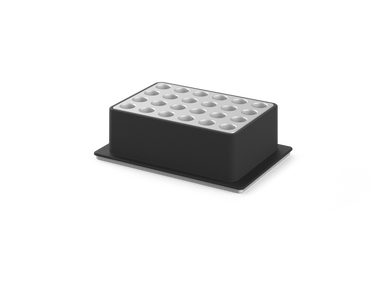
The Opentrons 24-well Aluminum Block can be placed directly on the OT-2/Opentrons Flex deck or on the Opentrons Temperature Module. This block acts as a 24 position rack to keep 2mL tubes, 1.5mL tubes, and the NEST 0.5mL tubes at constant temperature. The aluminum block holds temperatures between 4°C and 95°C when used with the Opentrons Temperature Module (GEN2).
Detail
The Opentrons 24-well Aluminum Block can be placed directly on the OT-2/Opentrons Flex deck or on the Opentrons Temperature Module. This block acts as a 24 position rack to keep 2mL tubes, 1.5mL tubes, and the NEST 0.5mL tubes at constant temperature. The aluminum block holds temperatures between 4°C and 95°C when used with the Opentrons Temperature Module (GEN2).
Other Products
Tube sealer
Product Info
Document
Product Info
Application
The blood bag tube sealer is a compact equipment to seal the blood bags, infusion bags, urine bags by high frequency sealing system. It is widely used in blood bank, hospital, biological industry, etc.
Features
No Hemolysis
With suction feet to avoid moving, can be used in blood collecting vehicle.
Technical Parameters
Model
HG-BTS1
Sealing time
2-4S
Sealing Type
Automatic
Diameter of tube
φ2-6mm(Tube thickness≤1.5mm)
Powe supply
220V 0.7A
Consumption
150W
External Size
310*190*150mm
Package Size
405*290*240mm
Net/Gross Weight
6/7kgs
Document
The blood bag tube sealer is a compact equipment to seal the blood bags, infusion bags, urine bags by high frequency sealing system. It is widely used in blood bank, hospital, biological industry, etc.
The Opentrons® 3-piece Aluminum Block Set is used with our Temperature Deck. The set comes with a 24-well, 96-well and flat bottom plate format block. These are used to keep your 2mL tubes, 1.5mL tubes, 96-well PCR plates, PCR strips and flat bottom plates at a constant temperature. These blocks holds temperatures between 4°C and 95°C when used with the Opentrons Temperature Module (GEN2).
Document
The Opentrons® 3-piece Aluminum Block Set is used with our Temperature Deck. The set comes with a 24-well, 96-well and flat bottom plate format block. These are used to keep your 2mL tubes, 1.5mL tubes, 96-well PCR plates, PCR strips and flat bottom plates at a constant temperature. These blocks holds temperatures between 4°C and 95°C when used with the Opentrons Temperature Module (GEN2).
Features of the sDNASEQ E.coli Residual DNA Quantitation kit include:
Simpler and Rapid
Only three steps will be need for Sample Preparation and All components of the Sample Preparation Kit can be stored at room temperature.
Only one Reagent for qPCR;
Only 1.5 hours will be needed for the whole test.
Accurate
Perfect amplification curve, good amplification efficiency and good precision.
Highly sensitive quantitation using proven TaqMan™ real-time qPCR technology.
Limit of Detection (LoD): 1 fg/μL; Limit of Quantification (LoQ):5 fg/μL.
The recovery rate of different concentration samples in the linear range is between 70% and 130%
Kit Performance
Fig 1. Only three steps will be need for Sample Preparation and only 20 minitutes will be taken for Sample Preparation.
Fig 2. Seven concentration samples of 5fg/μL, 10fg/μL, 20fg/μL, 30fg/μL, 300fg/μL, 3pg/μL, 30pg/μL, 300pg/μL were detected. CV of each concentration was < 30%, Regression coefficient associated with standard solutions was 0.99975, and amplification efficiency was 100.068%.
Fig 3. Four concentration samples of 5fg/μL, 10fg/μL, 20fg/μL, and 30fg/μL were detected, and 10 multiple holes were detected for each concentration. The detection values of 5fg/μL and above were CV <30%.
Fig 4. DNA recovery can be determined by including samples spiked with known DNA amounts which are prepared from the corresponding DNA standards. Typically, the range for this value varies from 70% to 130%.
Fig 5. Only one Reagent for qPCR MIX.
Document
Note: Price not include shipment & duty, contact us to get full quote. The resDNASEQ E.coli Residual DNA Quantitation kit is designed for the quantification of residual DNA from E. coli, in cell lines which are used for production of biopharmaceutical products. The resDNASEQ E.coli Residual DNA Quantitation kit use TaqManTM quantitative PCR to perform rapid, specifc quantitation of femtogram levels of residual host-cell or plasmid DNA. The kit was developed to meet the sensitivity requirements defined by WHO (10 ng E. coli DNA per therapeutic dose).