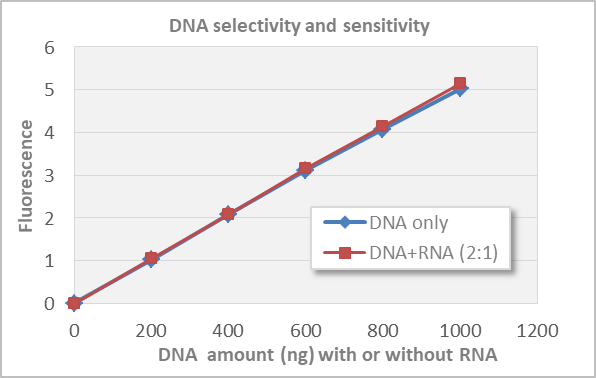
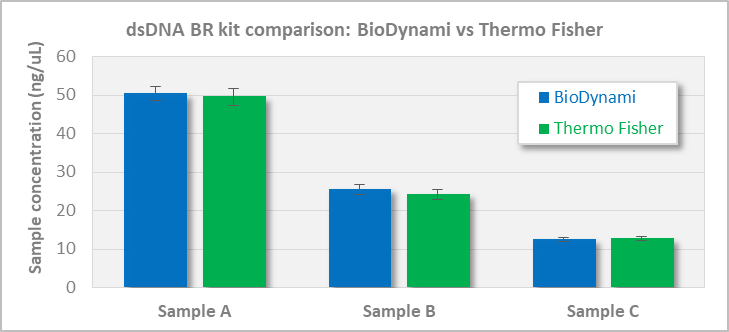
The kit includes BR Dye, BR Dilution Buffer, and two DNA Standards. The assay is accurate for DNA concentrations from 100 pg/µL to 1000 ng/µL, and is highly selective for double-stranded DNA over RNA.
Features
Kit was optimized for use with the Qubit® Fluorometer
Uses the Qubit® dsDNA Broad Range assay setting
Linear range is 2-1000 ng dsDNA
Great saving since the kit cuts the costs by 60%
DNA selectivity and sensitivity. A series of input DNA (200, 400, 600, 800, and 1000 ng) was used with or without RNA contamination.
Lyophilized format designed for room temperature shipping
Available in TaqMan format for analysis
Norgen’s Streptococcus agalactiae TaqMan PCR Lyophilized Kit is designed for the detection of Streptococcus agalactiae specific DNA in a real-time PCR based on the use of TaqMan® technology. The lyophilized format is designed to ship the kit at ambient temperature.
Norgen’s Streptococcus agalactiae TaqMan Lyophilized Probe/Primer and Control Set is designed for the detection of Streptococcus agalactiae specific DNA in a real-time PCR based on the use of TaqMan® technology. The lyophilized format is designed to ship the kit at ambient temperature.
All kit components should be stored at -20°C upon arrival.
Once reconstituted, repeated thawing and freezing (>2 times) of the Master Mix and Positive Control should be avoided, as this may affect the performance of the assay. If the reagents are to be used only intermittently, they should be frozen in aliquots.
Each kit is provided with 4 tubes of 2X PCR Master Mix and each tube is enough to run 25 reactions. It is not necessary to reconstitute all Master Mix tubes at once. The Master Mix tubes can be reconstituted as and when needed.
All kit components can be stored for 2 years after the date of production without showing any reduction in performance.
Accurate & Reliable Testing Solutions Diagnosis Nucleic Acid Detection White Spot Syndrome Virus
Product Description:
The Livestock Disease Kit is a reliable and easy-to-use test kit designed to detect the presence of diseases in livestock, such as cattle, sheep, goats, pigs and horses. The kit has been designed to detect diseases with high accuracy and sensitivity. Also it requires only a small sample volume of 50 μl, making it highly efficient and cost-effective. It is also suitable for a range of canine dog test kit applications, providing fast and accurate results.The reliable detection results make it a reliable and cost-effective solution for farmers and veterinarians looking to diagnose livestock diseases quickly and accurately.
Features:
Product Name: White spot syndrome virusisothermal detetction fluorescence kit
Target Species: Shrimp
Type: Fluorescence Kit
Storage Temperature: -20°C
Sample Type: Serum, Plasma, Whole Blood
Technical Parameters:
Product Name
White spot syndrome virus isothermal detetction fluorescence kit
Type
Fluorescence Kit
Sample Volume
50 μl
Sample Type
Serum, Plasma, Whole Blood
Storage Temperature
-20°C
Package Size
48 Tests/Kit
Target Disease
Livestock Disease
Target Species
Shrimp
Applications:
Amp-future bio Livestock Disease Kit is an innovative animal health care product designed to detect and diagnose livestock diseases. Developed by a Chinese research team, this kit is a simple and reliable solution to test and treat livestock diseases. With its detection limit of 0.1 ng/ml, users can obtain accurate results quickly and accurately. The test time takes from 5-20 minutes, and the kit typically contains 48 tests/kit. Furthermore, it is easy to store with its cold storage temperature of -20°C.
The Amp-future bio Livestock Disease Kit provides an innovative solution for animal health care. It is an essential product for veterinary professionals, pet owners, and animal health researchers to detect and diagnose livestock diseases. With its simple and reliable detection and diagnosis, this kit is a must-have for anyone who wants to ensure the health of their animals.
Support and Services:
Livestock Disease Kit Technical Support and Services
We provide technical support and services for our Livestock Disease Kit. We are committed to helping you get the most out of your product and ensuring your satisfaction with our products and services.
Our technical support staff is available to answer any questions you may have about the product.
We offer online tutorials and user guides to help you understand the product better.
We provide technical assistance to help troubleshoot any issues you may be having with the product.
We offer a warranty on our products.
If you have any questions or need technical support, please do not hesitate to contact us. We are here to help you make the most of your Livestock Disease Kit.
FAQ:
Q: What diseases can Livestock Disease Kit detect? A: Livestock Disease Kit can detect different infectious diseases, such as Foot and Mouth Disease, Bluetongue Disease, Bovine Viral Diarrhea.
Q: How does Livestock Disease Kit work? A: Livestock Disease Kit uses advanced MIRA technology to amplify the target DNA/RNA targent sequences , and detect the disease by analyzing the amplified sequences.
Q: How long does it take to get results from Livestock Disease Kit? A: Livestock Disease Kit can give a result within 5-20 mins.
Q: What type of sample is suitable for Livestock Disease Kit? A: Livestock Disease Kit is suitable for blood, serum, and tissue samples.
Q: Does Livestock Disease Kit require professional equipment? A: No, Livestock Disease Kit does not require any professional equipment,can use with our isothermal equipment or pcr machine
Document
The Livestock Disease Kit is a reliable and easy-to-use test kit designed to detect the presence of diseases in livestock, such as cattle, sheep, goats, pigs and horses. The kit has been designed to detect diseases with high accuracy and sensitivity. Also it requires only a small sample volume of 50 μl, making it highly efficient and cost-effective. It is also suitable for a range of canine dog test kit applications, providing fast and accurate results.The reliable detection results make it a reliable and cost-effective solution for farmers and veterinarians looking to diagnose livestock diseases quickly and accurately.
Extract high quality & quantity total RNA including miRNA
No phenol step required; isolate all RNA in one fraction
Bind & elute all RNA irrespective of size or GC content, without bias
Very sensitive & linear down to a few cells without the need for carrier RNA
Isolate from a wide variety of specimens
Purified RNA is suitable for a variety of downstream applications, including Small RNA Sequencing. Find out more information on Norgen’s NGS services
Available in a variety of formats to suit your needs
Purification is based on spin column chromatography that uses Norgen’s resin separation matrix
These kits are suitable for the isolation of total RNA from a range of samples including cells, bacteria, yeast, virus and bodily fluids including plasma/serum, blood, saliva, CSF and more. Extract high quality and purity RNA with excellent RIN values and A260/A280 suitable for downstream applications including qRT-PCR, RT-PCR, microarrays, NGS and more. These kits purify all sizes of RNA from large mRNA, lncRNA down to microRNA (miRNA) in the same fraction without the requirement of phenol. Isolate all RNA sequences at an equal rate irrespective of size. Moreover, when the RNA sequences are small (e.g. miRNA), the column binds small RNAs regardless of their GC content.
Total RNA Purification 96-Well Kit (High Throughput and High Throughput Deep Well)
This 96-well kit provides a rapid method for the high-throughput isolation and purification of total RNA in 30 minutes using vacuum manifold, plate centrifuge, or liquid handlers with vacuum capabilities. Total RNA can be isolated from a broad range of sample sources including cultured cells, tissues, blood, serum, plasma, bacteria, yeast, fungi, and viruses.
* for isolating total RNA from larger amounts of tissue, please use Norgen’s Animal Tissue RNA Purification Kit (Cat# 25700)
Storage Conditions and Product Stability All solutions should be kept tightly sealed and stored at room temperature. These kits are stable for 2 years after the date of shipment.