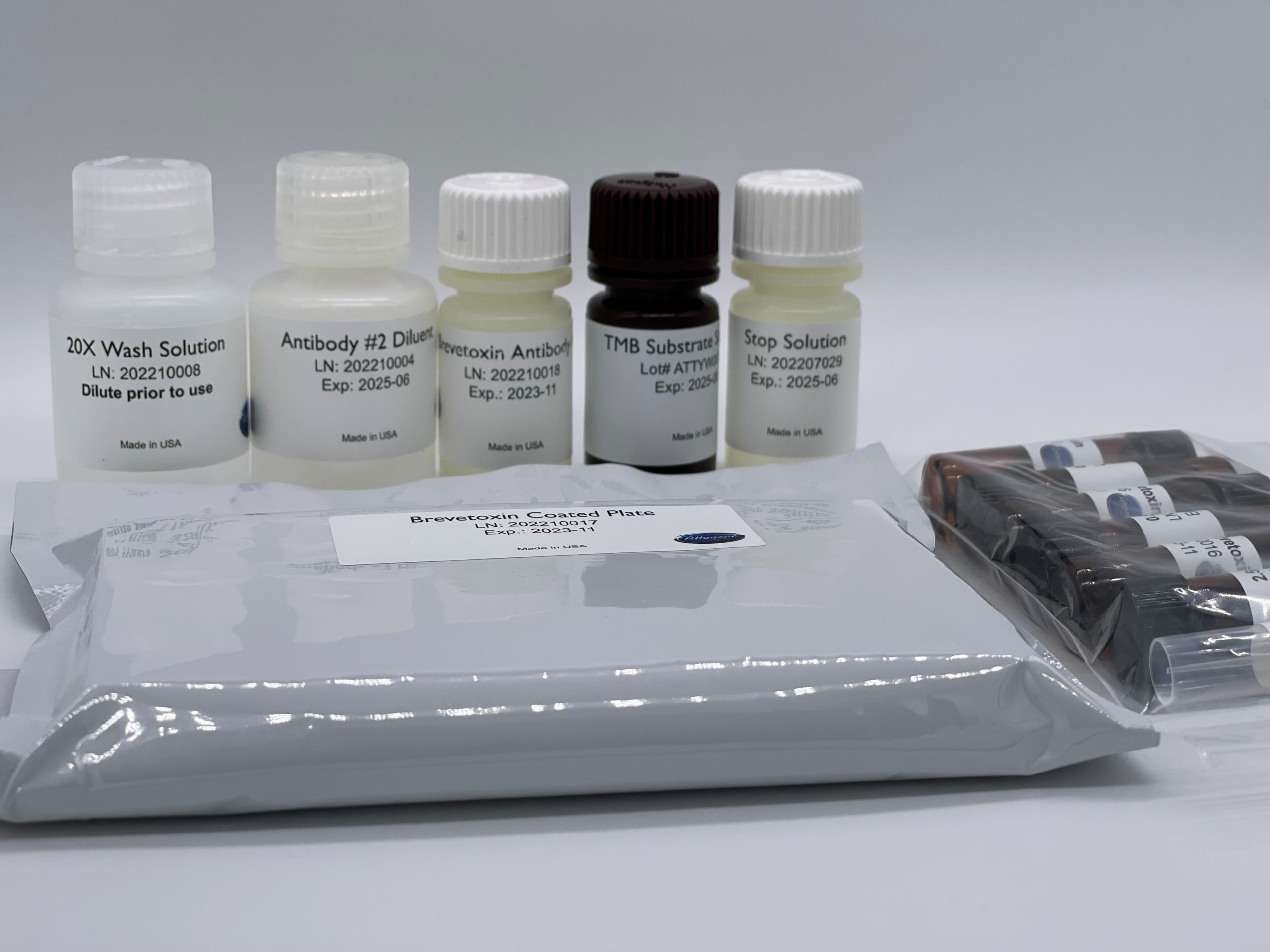
Brevetoxins (PbTx) are a class of cyclic polyether compounds produced by certain algae such as Karenia brevis. K. brevis can produce Brevetoxins in large quantities during an algae bloom which then pose a major health threat and are important to monitor and mitigate. Brevetoxins are the causative agent of Neurotoxic Shellfish Poisoning (NSP).
FDA and EPA safety levels in regulations and guidance – 0.8 mg/kg for clams, mussels, oysters, and whole and roe-on scallops, fresh, frozen, or canned. – National Shellfish Sanitation Program Guide for the Control of Molluscan Shellfish.
Salmonella spp. are members of the family Enterobacteriaceae. They are Gram-negative, facultatively anaerobic, flagellated, rod-shaped organisms. They are approximately 0.7 to 1.5 µm in diameter and 2 to 5 µm in length and responsible for a large number of cases of foodborne illness throughout the world. Salmonella have circular DNA genomes with a mean length of approximately 4530 kb, although this can vary by up 1000 kb. Salmonella classification is extremely complex, however, the genus is divided into two species: S. enterica and S.bongori. S. enterica is then itself divided into 6 biochemically distinct subspecies and the Salmonella genus is further classified into serovars (serotypes) based on the lipopolysaccharide (O), flagella protein (H), and sometimes the capsular (VI) antigens. There are more than 2500 known serovars and within a serovar there may be strains that differ in virulence.
Salmonella are mainly transmitted by the faecal-oral route. They are carried asymptomatically in the intestines or gall bladder of many animals, being continuously or intermittently shed in the faeces. Humans can become infected if they do not wash their hands after contact with infected animals or animal faeces. In such instances the bacteria adhere to and enter the cells of the intestinal epithelium. The toxins produced by the bacteria can damage and kill the cells that line the intestines, which results in intestinal fluid loss. The bacteria can survive for weeks in a dry environment and far longer in water thus they are frequently present in polluted waters. Salmonella can also be carried latently in the mesenteric lymph nodes or tonsils; these bacteria are not shed, but can become reactivated after stress or immunosuppression. In addition, fomites and vectors can spread Salmonella and vertical transmission occurs in birds, with contamination of the vitalize membrane, albumen and possibly the yolk of eggs. Salmonella spp. can also be transmitted in utero in mammals.
There are two different disease conditions that are distinct to salmonellosis; gastroenteritis and enteric typhoid fever. The gastroenteritis is a nonsystemic infection of the intestinal tract and regional lymph nodes that gives rise to headache, muscle aches, diarrhoea, vomiting, abdominal cramping, chills, fever, nausea and dehydration. In contrast, the enteric typhoid fever is a systemic disease in which the microorganism replicates within the cells of the reticuloendothelial system. The symptoms usually appear 6 to 72 hours after ingesting contaminated food although individuals can be infected with the bacteria without having symptoms. Those with and without symptoms shed the bacteria in their stool and it is important that personal hygiene be maintained at all times.
Document
Exceptional value for money Rapid detection of all clinically relevant subtypes Positive copy number standard curve for quantification Highly specific detection profile High priming efficiency Broad dynamic detection range (>6 logs) Sensitive to < 100 copies of target
Accurate controls to confirm findings
Tri(propargyl-NHCO-ethyloxyethyl)amine is a crosslinker that can react with azide compounds or biomolecules via copper catalyzed Click Chemistry to form a stable triazole linkage. Reagent grade, for research purpose. Please contact us for GMP-grade inquiries.
Document
Tri(propargyl-NHCO-ethyloxyethyl)amine is a crosslinker that can react with azide compounds or biomolecules via copper catalyzed Click Chemistry to form a stable triazole linkage. Reagent grade, for research purpose. Please contact us for GMP-grade inquiries.
AccuBand™ 100 bp DNA Ladder II is composed of 10 individual DNA fragments, presenting 1k, 900, 800, 700 600, 500, 400, 300, 200 and 100 bp sharp bands respectively. This product contains 1 enhanced band (500 bp) for easy identification of bands. AccuBand™ 100 bp DNA Ladder II is ready-to-use, containing loading buffer with dual color tracking dyes (orange G and Xylene cyanol FF). AccuBand™ 100 bp DNA Ladder II provides a sufficient amount of DNA for clear observation of all DNA bands ranging from 100 bp to 1 kb, either in agarose gel or in polyacrylamide gel electrophoresis.
Features
Sharp bands
Suitable for polyacrylamide gel electrophoresis
Quick reference— enhanced bands
Ready-to-use— premixed with loading dye for direct loading
Stable— room temperature storage over 6 months
Source
Phenol extracted PCR products and dsDNA digested with specific restriction enzymes, equilibrated in 10 mM Tris-HCl (pH 8.0) and 10 mM EDTA.
Range
100 ~ 1,000 bp
Concentration
50 µg/ 500 µl
Recommended loading volume
5 µl/ well
Storage
Room temperature for 6 months 4°C for 12 months -20°C for 36 months