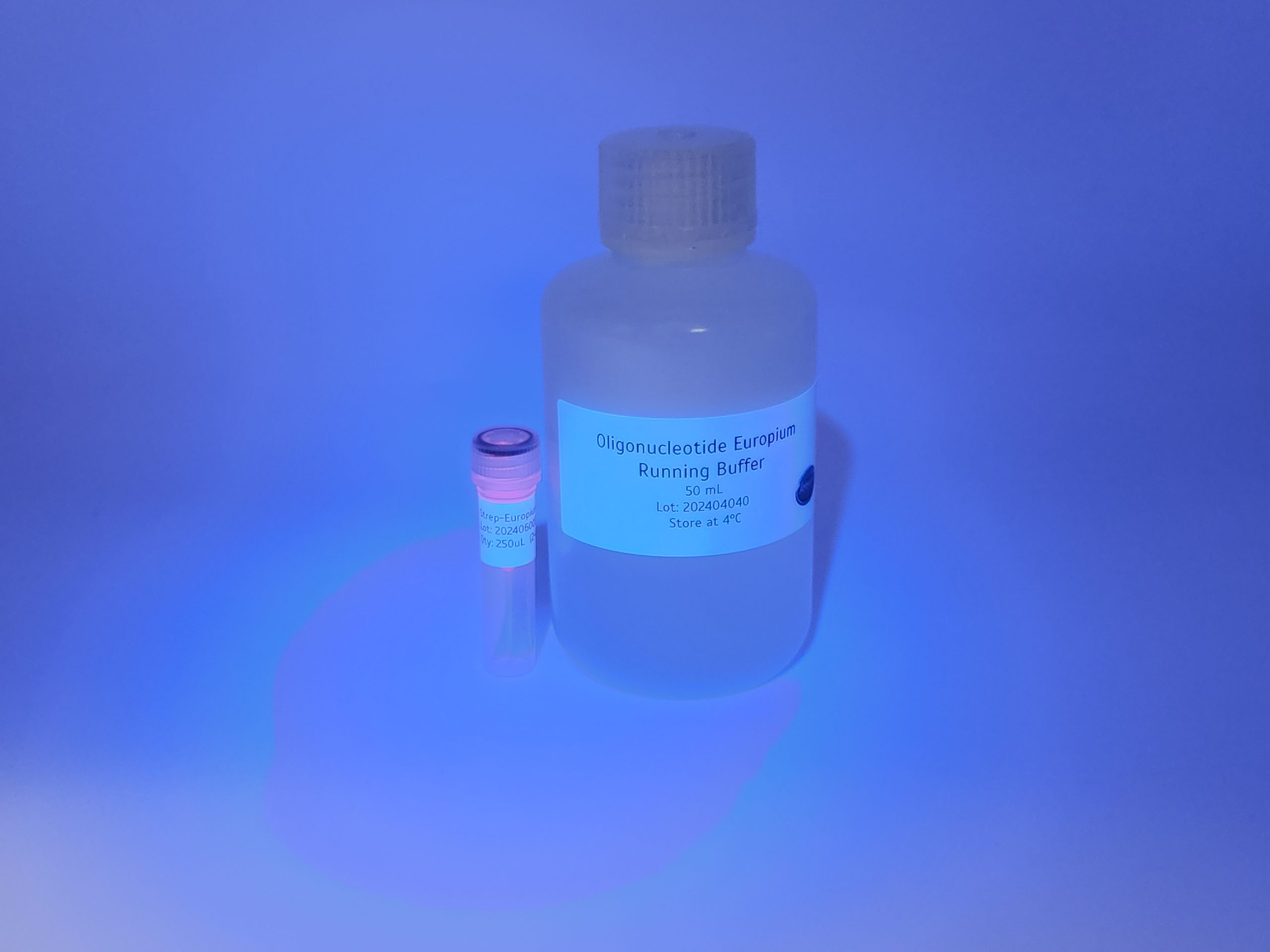
Streptavidin Europium Chelate Microspheres For Lateral Flow
Facebook
X
Pinterest
Email
Europium Chelate Microspheres Nanoparticle Streptavidin Conjugate for Lateral Flow
Our Streptavidin Europium Chelate Microspheres conjugate is manufactured using special conjugation technology and functonally tested by lateral flow. We have coated our high quality nanoparticles with a proprietary surface coat that covalently binds the biotin forming ultra stable conjugates. The resulting Streptavidin Europium Chelate Microspheres can irreversibly bind biotin.
Detail
Ready to Use Streptavidin Europium Chelate Microspheres
Europium Chelate Microspheres Nanoparticle Streptavidin Conjugate for Lateral Flow
Our Streptavidin Europium Chelate Microspheresconjugate is manufactured using special conjugation technology and functonally tested by lateral flow. We have coated our high quality nanoparticles with a proprietary surface coat that covalently binds the biotin forming ultra stable conjugates. The resulting Streptavidin Europium Chelate Microspheres can irreversibly bind biotin.
Europium dyed polystyrene beads conjugated to streptavidin
250ul of a 1mg/ml stock ready to use for Lateral Flow
50mL Lateral FLow Running Buffer designed for Streptavidin Europium Chelate Microspheres
Short term stability: 2-8oC, Long term stability: See individual component labels
Stability:
> 2 years under recommended storage conditions
Analyte:
Acetic Acid
Assay Format:
Spectrophotometer
Detection Method:
Absorbance
Wavelength (nm):
340
Signal Response:
Increase
Linear Range:
0.3 to 20 µg of acetic acid per assay
Limit of Detection:
0.14 mg/L
Reaction Time (min):
~ 14 min
Application examples:
Wine, beer, fruit and fruit juices, soft drinks, vinegar, vegetables, pickles, dairy products (e.g. cheese), meat, fish, bread, bakery products (and baking agents), ketchup, soy sauce, mayonnaise, dressings, paper (and cardboard), tea, pharmaceuticals (e.g. infusion solutions), feed and other materials (e.g. biological cultures, samples, etc.).
Method recognition:
Methods based on this principle have been accepted by EN, ISO,ICUMSA, IFU and MEBAK
The Acetic Acid (ACS Manual Format) test kit is a simple method for the rapid and reliable measurement and analysis of acetic acid/acetate in foods, beverages and other materials.
Note for Content: The number of manual tests per kit can be doubled if all volumes are halved. This can be readily accommodated using the MegaQuantTM Wave Spectrophotometer (D-MQWAVE).
No wasted ACS solution (stable suspension supplied)
PVP incorporated to prevent tannin inhibition
All reagents stable for > 2 years after preparation
Very competitive price (cost per test)
Mega-Calc™ software tool is available from our website for hassle-free raw data processing
Document
The Acetic Acid (ACS Manual Format) test kit is a simple method for the rapid and reliable measurement and analysis of acetic acid/acetate in foods, beverages and other materials.
Bis-propargyl-PEG18 has two propargyl groups at both ends. These propargyl groups reacts with azide compounds or biomolecules to form stable triazole linkages under the catalyzation of copper. The hydrophilic PEG units enhance the solubility of the molecule in aqueous environment. Reagent grade, for research purpose. Please contact us for GMP-grade inquiries.
Document
Bis-propargyl-PEG18 has two propargyl groups at both ends. These propargyl groups reacts with azide compounds or biomolecules to form stable triazole linkages under the catalyzation of copper. The hydrophilic PEG units enhance the solubility of the molecule in aqueous environment. Reagent grade, for research purpose. Please contact us for GMP-grade inquiries.
t-Boc-N-Amido-PEG8-propargyl has an alkyne group and Boc-protected amine. The alkyne group reacts with azide-bearing compounds or biomolecules via copper catalyzed Click Chemistry. The deprotection of Boc-protected amine can be peformed under mild acidic conditions. The hydrophilic PEG chain enhances the solubility of the molecule in aqueous solution. Reagent grade, for research purpose. Please contact us for GMP-grade inquiries.
Document
t-Boc-N-Amido-PEG8-propargyl has an alkyne group and Boc-protected amine. The alkyne group reacts with azide-bearing compounds or biomolecules via copper catalyzed Click Chemistry. The deprotection of Boc-protected amine can be peformed under mild acidic conditions. The hydrophilic PEG chain enhances the solubility of the molecule in aqueous solution. Reagent grade, for research purpose. Please contact us for GMP-grade inquiries.