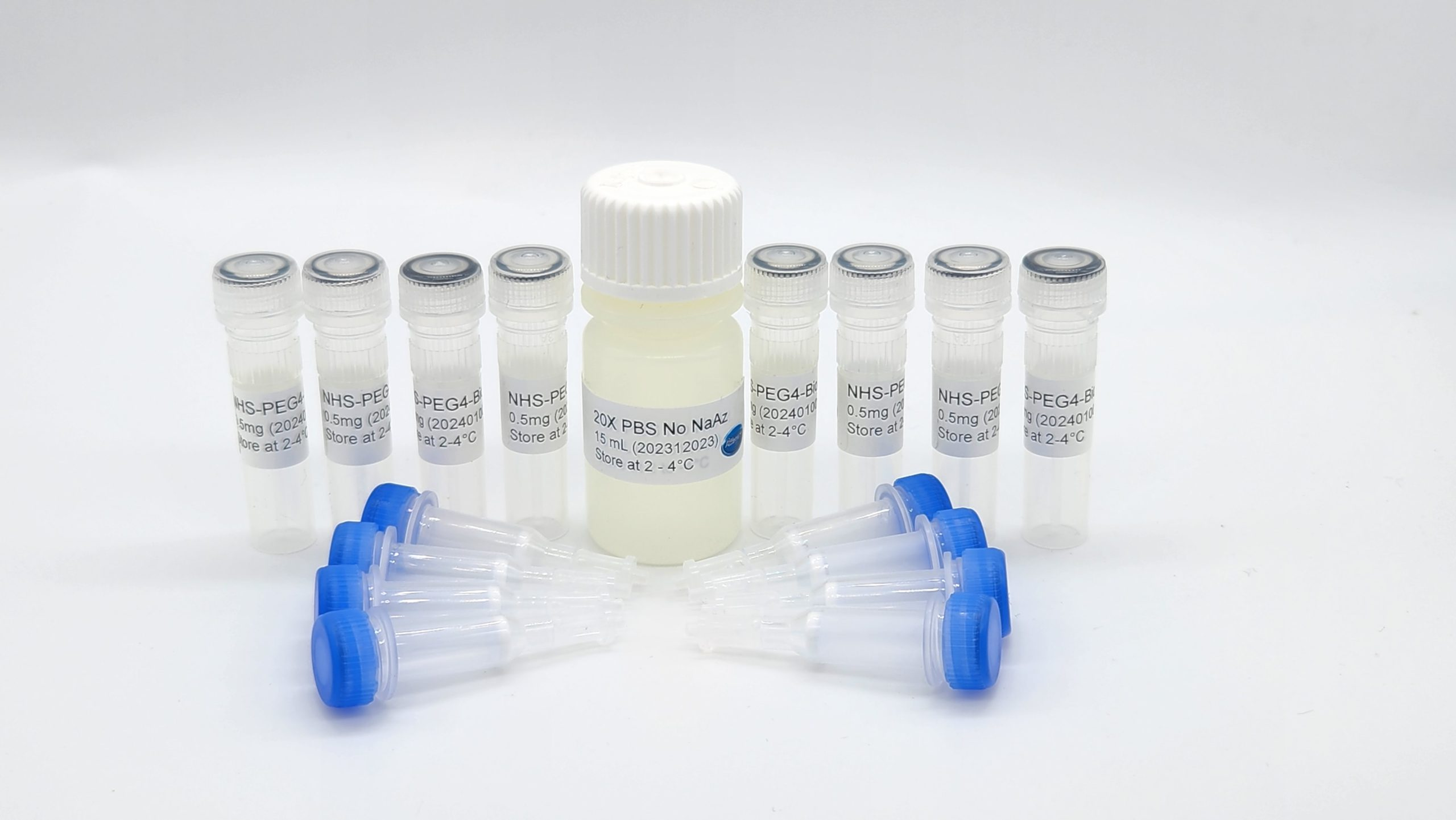
Attogene’s Protein Biotinylation kit provides the user with reagents for labeling proteins Desalting columns for purifying the labeled molecule Convenient and easy to interpret instructions on how to carry out the labeling process. Made by Attogene in the USA
The kit provides rapid, simple, and reliable components for the labeling proteins with biotin for use in lateral flow procedures. Kit enables the biotinylation of antibody or proteins to be used with the Universal Lateral Flow Kits (AU2034, AU2037 or AUAU2044 in addition to Streptavidin Colloidal (AU2017) gold or Streptavidin CdZnS Quantum Dots (AU2043).
Other Products
t-Boc-N-Amido-PEG4-propargyl
Product Info
Document
Product Info
t-Boc-N-Amido-PEG4-propargyl is a propargyl linker with one side protected by Boc group. The propargyl group can form triazole linkage with azide-bearing compounds or biomolecules via copper catalyzed Click Chemistry. The Boc protected amine can be deprotected under mild acidic conditions. Reagent grade, for research purpose. Please contact us for GMP-grade inquiries.
Document
t-Boc-N-Amido-PEG4-propargyl is a propargyl linker with one side protected by Boc group. The propargyl group can form triazole linkage with azide-bearing compounds or biomolecules via copper catalyzed Click Chemistry. The Boc protected amine can be deprotected under mild acidic conditions. Reagent grade, for research purpose. Please contact us for GMP-grade inquiries.
High Purity DNA Purification Kit Fast Extract Isolate Nucleic Acids
Product Info
Document
Product Info
High Purity DNA Purification Kit
,
12 Months DNA Purification Kit
,
Nucleic Acid dna isolation kit
Product Description
Rapid Nucleic Acid Release Reagent (DNA) – Type II
High Purity DNA Purification Kit Fast Extract Isolate Nucleic Acids
Product parameters:
Reagent component (WLD8201-ES,2Tubes/box)
Component
Specification
Quantity
LD-1
800μL=0.8mL
1 Tube
LD-2
200μL=1.2mL
1 Tube
Product features and advantages:
Product features
Simplicity
The operation is simple, and the DNA template for amplification can be obtained in just one step (conventional 5min)
Security
Non-toxic environmental protection, room temperature transport and storage
Universality
The lysate can be used for isothermal nucleic acid amplification
Product application:
It is used for pre-processing and nucleic acid release of swab samples and plant tissue samples, rapidly cracking all kinds of common samples without purification; The sample lysate can be directly used as a template for amplification reaction.
Tips: Its reverse combined with our constant temperature amplification reagent for nucleic acid detection.
Sample processing type
Liquid sample
Samples of plants or tissues
Serum, blood, saliva, ascites and other samples, swab leach solution
Brain, muscle, viscera, leaves, fruit and other samples, take liquid supernatant
[PM1600] ExcelBand™ All Blue Regular Range Plus Protein Marker (9-180 kDa), 250 μl x 2
Product Info
Document
Product Info
Description
The PM1600 ExcelBand™ All Blue Regular Range Plus Protein Marker is a blue protein standard with 11 pre-stained proteins covering a wide range of molecular weights from 10 to 180 kDa in Tris-Glycine buffer (9 to 170 kDa in Bis-Tris (MOPS) buffer and Bis-Tris (MES) buffer). Proteins are covalently coupled with a blue chromophore, and two reference bands (at 25 kDa and 72 kDa, respectively) are enhanced in intensity when separated on SDS-PAGE (Tris-Glycine buffer).
The PM1600 ExcelBand™ All Blue Regular Range Plus Protein Marker is designed for monitoring protein separation during SDS-polyacrylamide gel electrophoresis, verification of Western transfer efficiency on membranes (PVDF, nylon, or nitrocellulose) and for approximating the size of proteins.
Features
Ready-to-use — Premixed with a loading buffer for direct loading, no need to boil.
Two enhanced bands — 72 kDa and 25 kDa
Contents
Approximately 0.1~0.5 mg/ml of each protein in the buffer (20 mM Tris-phosphate (pH 7.5 at 25°C), 2% SDS, 0.2 mM DTT, 3.6 M urea, and 15% (v/v) glycerol).
Quality Control
Under suggested conditions, PM1600 ExcelBand™ All Blue Regular Range Plus Protein Marker resolves 11 major bands in 15% SDS-PAGE (Tris-Glycine buffer, MOPS, and MES buffer) and after Western blotting to nitrocellulose membrane.
Storage
4°C for 3 months -20°C for long term storage
Document
The PM1600 ExcelBand™ All Blue Regular Range Plus Protein Marker is a blue protein standard with 11 pre-stained proteins covering a wide range of molecular weights from 10 to 180 kDa in Tris-Glycine buffer (9 to 170 kDa in Bis-Tris (MOPS) buffer and Bis-Tris (MES) buffer). Proteins are covalently coupled with a blue chromophore, and two reference bands (at 25 kDa and 72 kDa, respectively) are enhanced in intensity when separated on SDS-PAGE (Tris-Glycine buffer).
The PM1600 ExcelBand™ All Blue Regular Range Plus Protein Marker is designed for monitoring protein separation during SDS-polyacrylamide gel electrophoresis, verification of Western transfer efficiency on membranes (PVDF, nylon, or nitrocellulose) and for approximating the size of proteins.