
Description
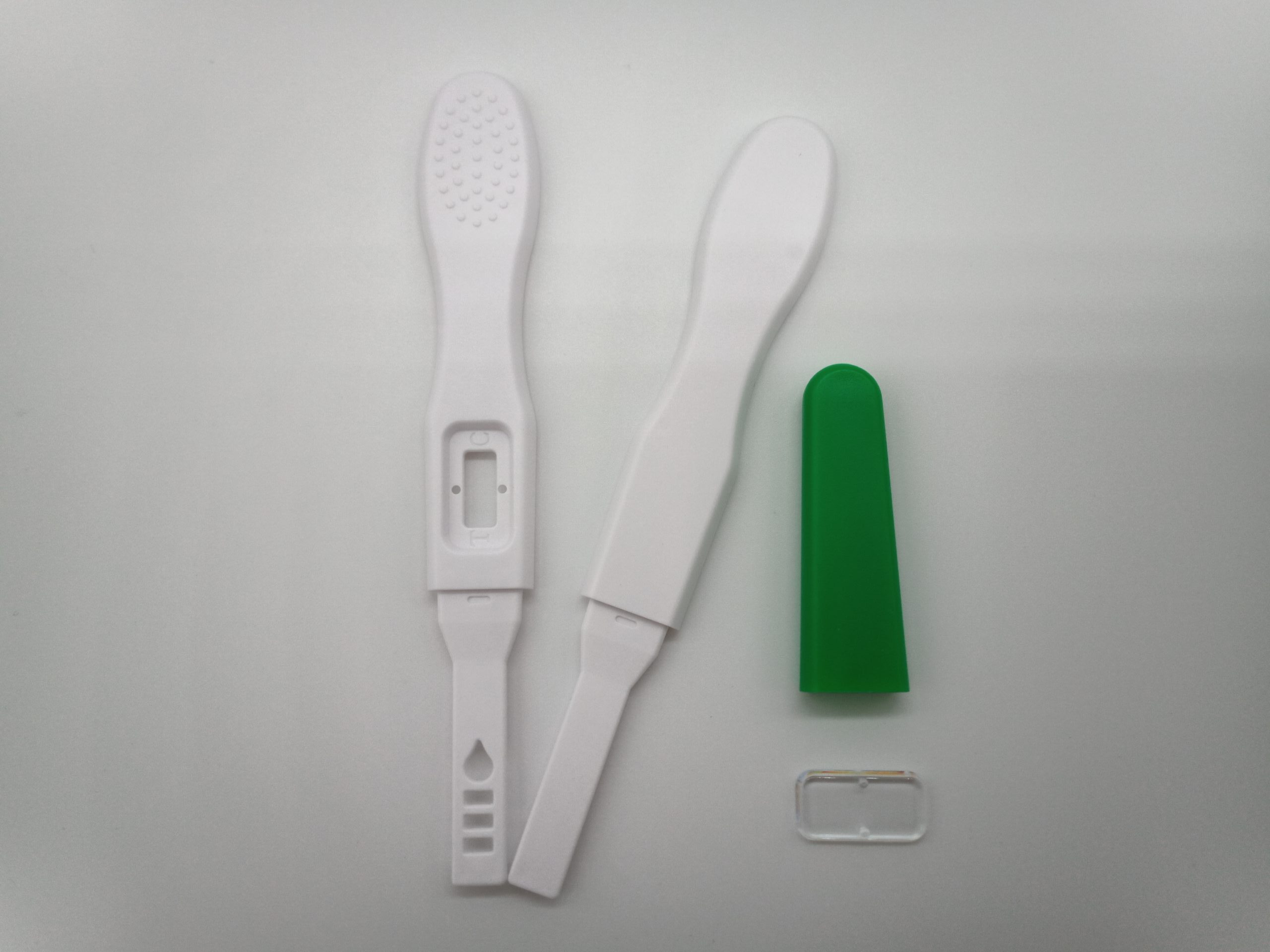
- Appearance: White/Green with lens
- • Length of strip: 86mm
- • Width of strip: 6mm
- • Length of device: 140mm
- • Width of device: 15mm


Usages:
For isolating lactose-fermenting Gram-negative enteric bacilli.
Principle:
Peptones are sources of nitrogen and other nutrients. Lactose is a fermentable carbohydrate. When lactose is fermented, alocal pH drop around the colony causes a color change in the pH indicator (neutral red) and bile precipitation. Bile salts,bile salts no. 3, oxgall and crystal violet are selective agents that inhibit growth of gram-positive organisms. Agar is the solidifying agent.
Formulation(per liter):
| Pancreatic Digest of Gelatin | 17.0 g |
| Peptones (meat and casein) | 3.0 g |
| Lactose Monohydrate | 10.0 g |
| Sodium Chloride | 5.0 g |
| Bile Salts | 1.5 g |
| Agar | 13.5 g |
| Neutral Red | 30.0 mg |
| Crystal Violet | 1 mg |
| Final pH | 7.1±0.2 |
How to use:
1.Suspend 50 g in 1 L of distilled or deionized water. Heat to boiling to dissolve completely. Autoclave at 121°C for 15 minutes.
2.Transfer 1 mL of Soybean–Casein Digest Broth to 100 mL of MacConkey Broth, and incubate at 42 to 44 for 24 to 48 hours. Subculture on a plate of MacConkey Agar at 30 to 35 deg.C for 18 to 72 hours.
Quality control:
| Item | The name and number of strain | PR/G | Reaction |
| Growth rate | E.Coli ATCC8739 | PR≥0.7 | Rose-red |
| Characteristic difference | Proteus mirabilis CMCC(b)49005 | PR≥0.7 | Colorless, no swarming |
| Selective | Staphylococcus aureus ATCC6538 | G≤1 | - |
Storage: Keep container tightly closed, store in a cool, dry place, away from bright light. Storage period of three years.
Specifications: 250g/bottle
250g
The series of DNA Size Selection Kits (Magnetic Beads) were developed for DNA size selection using magnetic beads. A total of 11 kits are available, with different selection ranges spanning from 50 bp to over 10 kb. The kits provide a simple and quick approach for the enrichment of a specific range of DNA fragments. The kit workflow allows double-sided or single-sided size selection for specific size cutoffs.

.
DNA size selection is a selective capture of DNA fragments of a specific range of size for next-generation sequencing (NGS) library preparations, PCR, ChIP assay, DNA ligations, endonuclease digestions, adapter removal, and other genomics and molecular biology applications. DNA size selection is preferred after NGS library prep in most of the cases. The NGS library preparation is related to the quality of the sequencing data. Precise NGS library size selection can increase sequencing efficiency, improve data quality, and reduce costs.
There are two types of sequencing technologies: short-read sequencing and long-read sequencing. Short-read sequencing uses DNA libraries that contain small insert DNA fragments of similar sizes, usually several hundred base pairs. The sequencing efficiency can be improved if the DNA size selection is in the right range. Cat.# 20104S and 20104L are the best kits for NGS library size selection of illumina paired-end 100 (PE100) sequencing with 100-200 bp library inserts; Cat.# 20105S and 20105L are the best kits for NGS library size selection of illumina paired-end 150 (PE150) sequencing with 150-300 bp library inserts; and Cat.# 20106S and 20106L are the best kits for NGS library size selection of illumina paired-end 300 (PE300) sequencing with 300-600 bp library inserts.
Long-read sequencing uses a large DNA fragment as input and makes very long reads. Usually, library size selection is preferred to remove smaller fragments. Cat.# 20110S and 20110L are the best kits for long-read sequencing size selection with DNA sizes >5 kb, and Cat.# 20111S and 20111L are the best kits for long-read sequencing size selection with DNA sizes >10 kb.
The magnetic beads technology uses paramagnetic particles, also known as SPRI (Solid Phase Reversible Immobilization) beads, to bind DNA reversibly and selectively. DNA fragments can be size-selected and purified by changing the properties of the magnetic beads or SPRI beads. The magnetic beads can easily separate the beads-binding DNA from the contaminants and unwanted components in the samples. The samples after DNA size selection are free of contaminants such as buffer components, enzymes, proteins, salts, dNTPs, primers, and adapters. Our proprietary magnetic beads reagents improve yield, selectivity, and reproducibility.
Specific DNA fragments at a certain length range can be purified simply using magnetic separation with different beads components, avoiding tedious and time-consuming gel extraction and column-based purification. The magnetic beads method is popular for common DNA size selection, including library size selection. The first beads-binding step, referred to as the right-side clean-up, removes large DNA fragments. The large DNA fragments are bound to the beads and are discarded. The desired DNA fragments in the supernatant are transferred to a new well, and new beads are added to the supernatant for the second beads-binding, referred to as the left-side clean-up. The double-size selected DNA fragments are eluted after ethanol rinsing.
.
A single clean-up is needed for DNA size selection with large fragments. In this case, only the large DNA fragments are bound to the beads. The selected larger DNA fragments are eluted after ethanol rinsing.
.

Mastitis is the single most costly disease of dairy cattle resulting in the reduction of milk yield and quality. The inflammation of the utter is mainly caused by bacteria, and Staphylococcus aureus is often considered the most common cause of contagious mastitis in dairy herds. S. aureus infection is estimated to be present in up to 90% of dairy farms and is responsible for 35% of the economic loss in the dairy industry (Lee et al., 2005). S. aureus is a facultatively anaerobic, Gram positive bacterium. The majority of S. aureus strains are catalase-positive and coagulasepositive, which forms the basis of traditional identification methodology.
Staphylococcus aureus TaqMan PCR Kit, 100 reactions
Staphylococcus aureus TaqMan PCR Probe/Primer Set and Controls, 100 reactions
For research use only and NOT intended for in vitro diagnostics.
Figure 1 / 3
Click for expanded view
Storage Conditions and Product Stability
All kit components can be stored for 2 years after the date of production without showing any reduction in performance.
All kit components should be stored at -20°C upon arrival.
| Component | Cat. TM29350 (100 preps) | Cat. TM29310 (100 preps) |
|---|---|---|
| MDx TaqMan 2X PCR Master Mix | 2 x 700 μL | – |
| S. aureus Primer & Probe Mix | 280 μL | 280 μL |
| S. aureus Positive Control | 150 μL | 150 μL |
| Nuclease-Free Water (Negative Control) | 1.25 mL | 1.25 mL |
| Product Insert | 1 | 1 |