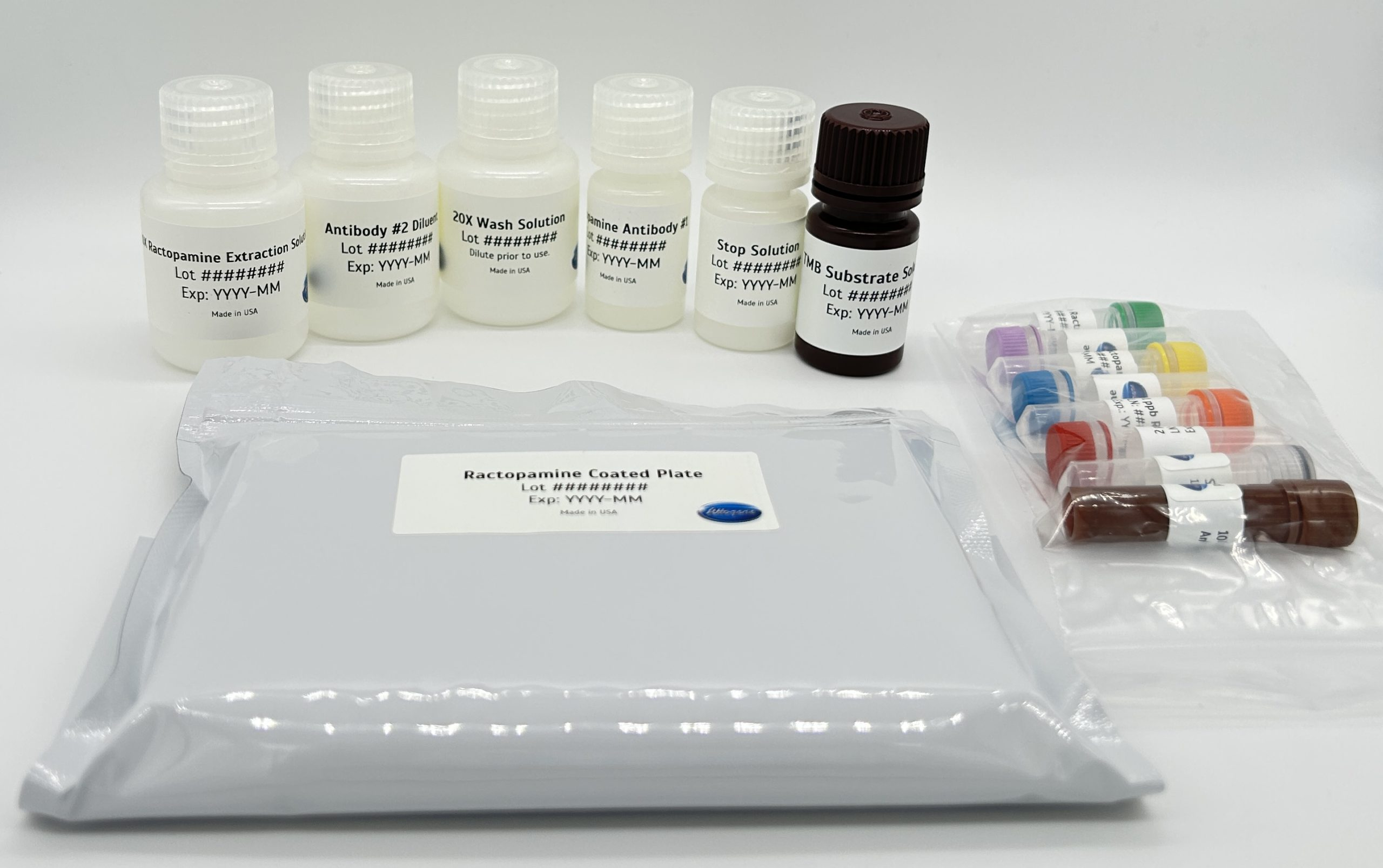
Ractopamine ELISA Test Kit is a competitive enzyme immunoassay for detection in meat, feed, liver, kidney, milk, urine, serum and plasma. Ractopamine has been banned for use as a livestock growth promoter in many countries around the world. To prevent ractopamine residues from entering the food chain, both producers and government surveillance agencies need technologies and methods that can provide rapid, accurate and reliable detection at specific sensitivities. This kit enables government agencies, food manufacturers, as well as quality assurance organizations, to detect ractopamine as low as 0.1 ng/g or ppb level in a variety of sample types.
Attogene’s Mercury Lateral Flow Kit can be used for the screening of Mercury in water and food (fish) samples at 10 ppb in a laboratory setting. Unlike the field-based kit, the lab kit is intended for a more technical end user who will be evaluating samples in a laboratory setting. The instructions include method for extraction from food samples.
Mercury contamination is a serious worldwide environmental problem. As it is difficult to detoxify by chemical or biological methods, gradual Mercury ion accumulation in the nervous and cardiovascular systems of the human body can subsequently cause serious diseases. Long-term health consequences of drinking Mercury-contaminated food and water include brain, heart, kidney, lungs and immune system problems for adults, and the physical and mental development delays in infants and children. Attogene’s Mercury Lateral Flow test gives results conforming of 10ppb or greater. Using the supplied pipette, simply fill the vial with your water sample, place the water into the sample port and wait 5 minutes.
Nucleic acid testing (NAT) is the method of choice for detection and quantification of a wide range of micro organisms. Primerdesign manufactures and supplies high quality quantitative real-time PCR kits for the detection and simultaneous quantification of numerous significant pathogens . A copy number standard curve is provided for quantification and an the internal extraction template (DNA or RNA), controls for the quality of the nucleic acid extraction and eliminates false negative results.
The kit is designed with the broadest possible detection profile to ensure that all clinically relevant strains and subtypes are detected. Target sequences are selected by working with data from key opinion leaders in the field. Multiple sequence alignments and unprecedented real-time PCR expertise in design and validation ensure the best possible kit. Details of the target and priming specificity are included in the individual handbooks above.
Packaged, optimised and ready to use. Expect Better Data.
Document
Primer and probe mix (150 reactions)
Reverse Transcription, target specific primers (RNA genome viruses only)
Copy number standard curve (sufficient for multiple standard curves)
Internal extraction control – Read through VIC channel*
The Opentrons® 3-piece Aluminum Block Set is used with our Temperature Deck. The set comes with a 24-well, 96-well and flat bottom plate format block. These are used to keep your 2mL tubes, 1.5mL tubes, 96-well PCR plates, PCR strips and flat bottom plates at a constant temperature. These blocks holds temperatures between 4°C and 95°C when used with the Opentrons Temperature Module (GEN2).
Document
The Opentrons® 3-piece Aluminum Block Set is used with our Temperature Deck. The set comes with a 24-well, 96-well and flat bottom plate format block. These are used to keep your 2mL tubes, 1.5mL tubes, 96-well PCR plates, PCR strips and flat bottom plates at a constant temperature. These blocks holds temperatures between 4°C and 95°C when used with the Opentrons Temperature Module (GEN2).