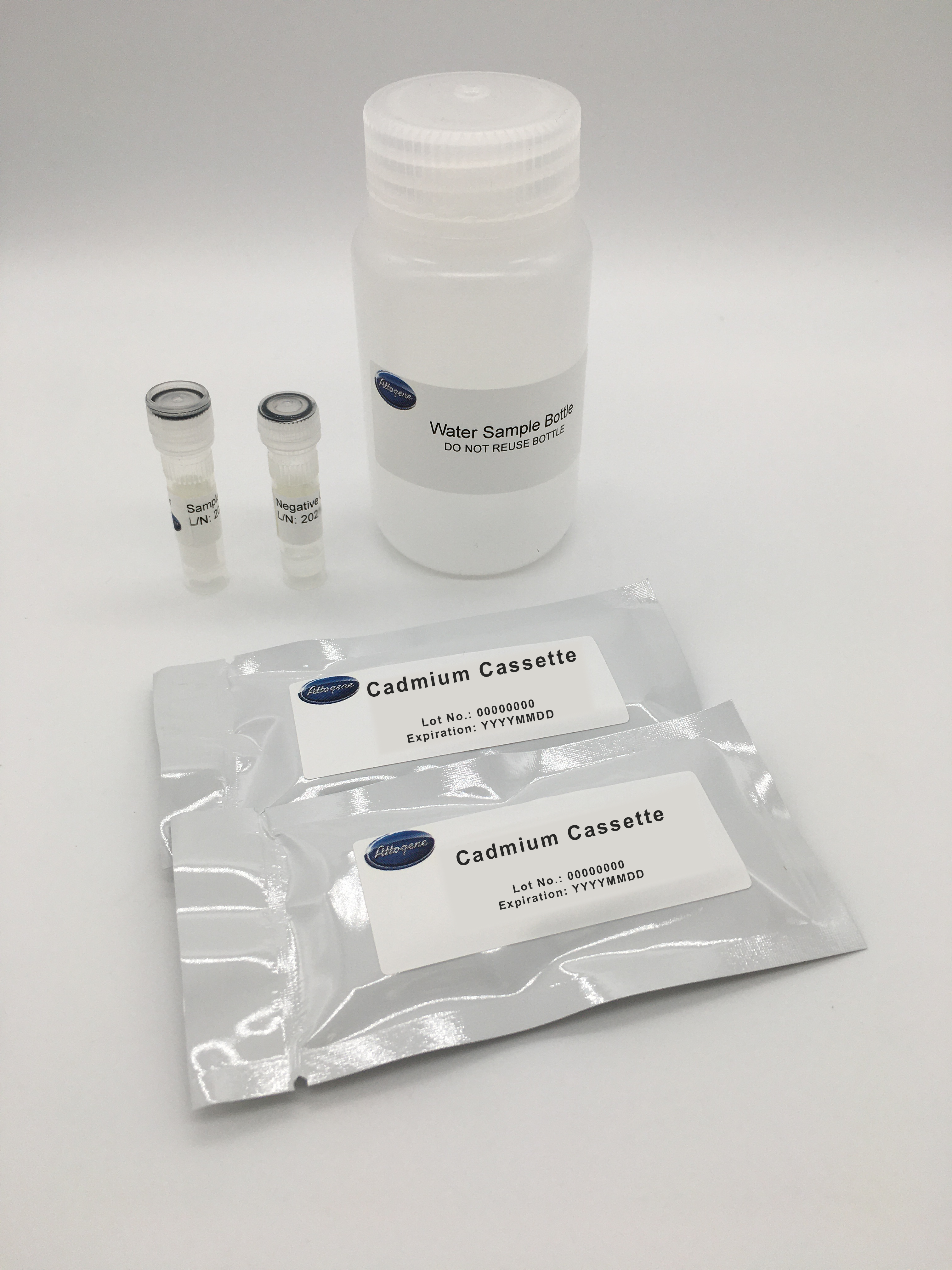
Attogene’s Cadmium Lateral Flow Kit can be used to detect Cadmium in water samples at 5 ppb in the field.
Format: 10 test cassettes
Run Time: 15-30 minutes
Cadmium contamination is a serious worldwide environmental problem. As it is difficult to detoxify by chemical or biological methods, gradual Cadmium accumulation in the nervous and cardiovascular systems of the human body can subsequently cause serious diseases. Long-term health consequences of drinking cadmium-contaminated food and water include numerous negative health effects. Attogene’s Cadmium Lateral Flow test gives results conforming of 5ppb or greater. Using the supplied pipette, simply fill the vial with your water sample, place the water into the sample port and wait 15-30 minutes.
Other Products
NGS Low Input DNA Library Prep Kit (illumina and MGI Platforms)
Product Info
Document
Product Info
The NGS Low Input DNA Library Prep Kit (illumina and MGI Platforms) was developed for construction of high quality NGS libraries with low input DNA amount from 1 ng to 400 ng. The kit allows scientist to study samples with limited DNA such as tumor samples, patient samples, and other specially collected samples (FACS sorting etc.). The kit has high library conversion efficiency with as little as 1 ng DNA input. The fast and simple 1.5-hour protocol makes libraries with even coverage and low GC-bias based our unique chemistry for DNA end-polishing and ligation.
The kit needs double strand DNA fragments (blunt and/or sticky) as input DNA for NGS library preparation, and is compatible with DNA fragments generated from both enzymatic approach (for example, BioDynami DNA fragmentation enzymes, Cat.# 40061 and Cat.# 40062) and mechanical approaches such as sonication and nebulization etc.
NGS Low Input DNA Library Prep Kit Workflow
Three index types are available for the NGS Low Input DNA Library Prep Kit of illumina platform:
Non-index (Cat.# 30022): Libraries do not have index.
Index (Cat.# 30024): Each of our index primers contains a unique barcode sequence with 6 bases that can be used to identify the low input DNA libraries. Library multiplexing up to 48 samples is possible. Index information can be downloaded here.
Unique dual index (Cat.# 30025): Library multiplexing up to 96 low input DNA libraries is possible with unique dual indexes with our Four-Base Difference Index System. The system allows us to make indexes for the libraries that have at least 4 bases different from each other in the 8-base barcode length. Our unique dual index primers can reduce sequencing errors such as de-multiplexing errors, amplification errors, mis-assignment of reads, index cross-contamination, and also index hopping. The kit includes 96 pre-mixed unique pairs of index primers. Index information can be downloaded here.
Indexes are available for the MGI platform kits (Cat.# 34024).
Kit advantages:
Fast protocol
The hands-on time is only 10 minutes
The total protocol time is around 1.5 hours
Simple procedure
Ready-to-use master mix makes it simple for reaction setup
Less reaction components
Less magnetic beads required for cleanup steps: Save the cost more than 50%
Low input DNA amount: Starts from 1 ng of DNA
Comparison of library conversion efficiency under the same NGS library preparation condition. Input DNA amounts are 1 ng and 10 ng, respectively. DNA was mechanical sheared with Covaris before library prep. BioDynami kit: NGS Low Input DNA Library Prep Kit (Cat. #30022).
Comparison of library yield under the same NGS library prep condition. Input DNA amounts are 1 ng, 10 ng, and 100 ng. DNA was mechanical sheared with Covaris before library prep. BioDynami kit (Cat. #30022). PCR cycle numbers were indicated.
Attogene’s Microcystin Test Kit (Rapid – Recreational Water) can be used to detect microcystins in liquid samples; highly sensitive, rapid, robust screening kit for algae toxins microcystins and nodularins.
The most frequently reported cyanobacterial toxins are the hepatotoxic microcystins (MCs). MCs are peptides with a molecular weight ranging from 900 to 1,100 Da. They consist of seven amino acids of which the two terminal amino acids of the linear peptide are condensed to form a cyclic compound.
A tiered notification system which takes different actions based on different numeric thresholds for microcytin-LR concentrations in recreational waters has been developed. This is guidance that allows states to take various actions—such as posting information about harmful algal blooms (HABs), issuing a recreational public health advisory, or temporarily closing recreational waters through a no contact advisory—depending on the severity of the bloom event.
Microcystin-LR
Informational sign postings about HABs at recreational waters: < 6 μg/L Recreational public health advisory: 6 μg/L Elevated recreational public health advisory (e.g. no contact): 20 μg/L
Screening of Microcystins in water samples at 6 ppb or lower Format: 10 tests (5 tests/5 control) Water Sample Bottles Negative Control 1mL Syringe Sample Dilution Buffer also sold separately Sample Filters