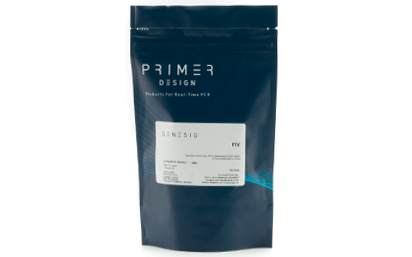
Rapid detection of specific detection profiles High priming efficiency Sensitive to < 100 copies of target
Positive copy number standard curve for quantification
Accurate controls to confirm findings
96 reactions
Our SNPsig® kits use our own proprietary genotyping method to enable the identification of SARS-CoV-2 variants of concern. These products can be used on any real-time PCR machine using familiar protocols, whilst resulting in exceptional genotyping data.
Positive control templates for wild-type and variants are supplied in every kit to make data interpretation simple.
SNPsig® EscapePLEX™ SARS-CoV-2 also incorporates the two gene (ORF1ab and M Gene) assay to provide a confirmatory detection of SARS-CoV-2.
DETECTION PROFILE: The E484K, K417N, K417T and P681R mutations which are found in Beta, Gamma, Delta and Delta Plus Variants of Concern
For general laboratory and research use only.
Other Products
6-Formyl-2-pyridine-PEG4-DBCO
Product Info
Document
Product Info
6-Formyl-2-pyridine-PEG4-DBCO is a bifunctional PEG linker featuring an aldehyde and a DBCO function. DBCO is a strained cyclooctyne which reacts with azide groups on target molecules while the aldehyde group is a versatile electrophile that is reactive towards amines, hydroxylamines, and hydrazines.
Document
6-Formyl-2-pyridine-PEG4-DBCO is a bifunctional PEG linker featuring an aldehyde and a DBCO function. DBCO is a strained cyclooctyne which reacts with azide groups on target molecules while the aldehyde group is a versatile electrophile that is reactive towards amines, hydroxylamines, and hydrazines.
【IT1100】EzRNA™ T7 High Yield RNA Synthesis Kit (Ψ-UTP), 50 RXN
Product Info
Document
Product Info
Description
The EzRNA™ T7 High Yield RNA Synthesis Kit (Ψ-UTP) is a user-friendly product for enzymatic RNA production. The enzyme mix contains adequate amount of T7 RNA polymerase, pyrophosphatase, and RNase inhibitors for in vitro transcription (IVT). Along with 10X Transcription Buffer and NTP (Ψ) Premix, users can swiftly assemble IVT reactions without compromising RNA yield. The EzRNA™ T7 High Yield RNA Synthesis Kit (Ψ-UTP) allows for the attainment of approximately up to 150 µg RNA yield within 2 hours at 37°C.
Features
High yield
Versatile- suitable for short and long transcripts
NTP premixed- Minimal pipetting and setup time
Compatible with CleanCap® Reagent AG
Lithium chloride included for RNA purification
Application
Generation of RNA from T7 promoter-driven DNA sequences
Suitable for subsequent cap-0 and cap-1 modification
Storage
-20°C for 12 months
Document
The EzRNA™ T7 High Yield RNA Synthesis Kit (Ψ-UTP) is a user-friendly product for enzymatic RNA production. The enzyme mix contains adequate amount of T7 RNA polymerase, pyrophosphatase, and RNase inhibitors for in vitro transcription (IVT). Along with 10X Transcription Buffer and NTP (Ψ) Premix, users can swiftly assemble IVT reactions without compromising RNA yield. The EzRNA™ T7 High Yield RNA Synthesis Kit (Ψ-UTP) allows for the attainment of approximately up to 150 µg RNA yield within 2 hours at 37°C.
A highly efficient, easily automated agarose gel or PCR purification system that delivers superior quality DNA with no salt carryover. Requiring no centrifugation or filtration. The Kit can be easily used in manual and automated 96 or 384-well formats.
Details
Specifications
Features
Specifications
Main Functions
Recover DNA fragments >100bp from agarose gel(<0.3g), purification of DNA from PCR, enzymatic reaction solution or crude gDNA
The Kit method contains magnetic particles in an optimized binding buffer to selectively bind DNA fragments (>100bp) and larger to paramagnetic beads. Excess primers, nucleotides, salts, and enzymes can be removed using a simple washing procedure.
Advantages
High recovery efficiency – up to 80% DNA recovery
General – recover DNA from gel or enzyme-driven reaction solutions such as PCR
Kit Contents
Contents
D500101
D500102
D500103
Purification Times
50 Preps
500 Preps
5000 Preps
Buffer GDP
30 ml
250 ml
3 x 900 ml
MagPure Particles
1.6 ml
15 ml
3 x 50 ml
Buffer DW1
20 ml
180 ml
2 x 800 ml
Elution Buffer(10mmTris, pH8.5)
10 ml
60 ml
500 ml
Storage and Stability
MagPure Particles should be stored at 2-8°C upon arrival. However, short-term storage (up to 24 weeks) at room temperature (15-25°C) does not affect their performance. The remaining kit components can be stored at room temperature (15-25°C) and are stable for at least 18 months under these conditions.
Experiment Data
Document
A highly efficient, easily automated agarose gel or PCR purification system that delivers superior quality DNA with no salt carryover. Requiring no centrifugation or filtration. The Kit can be easily used in manual and automated 96 or 384-well formats.