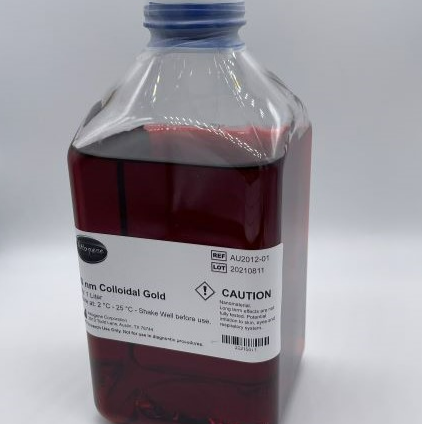
60nm Colloidal Gold for Lateral Flow is a highly stable and uniform 60 nm gold nanoparticles can be supplied in a range from 1 OD to 100 OD. The quality and performance of a conjugate is critical to successful lateral flow test manufacturing. Our products are made in USA and produced in a state-of-the-art manufacturing facility that enable rapid turnaround times while ensuring batch to batch consistency and reliability.
Functionally Tested in Lateral Flow-made by Attogene in Austin Texas
Specifications 1OD 60nm Gold (1L)
Bulk pricing and manufacturing supply contracts available.
Number of particles/mL
1.5-2 x 10¹⁰
Gold Concentration (mg/mL)
3.6-4.1 x 10⁻²
Molar Concentration (moles/liter)
2.5-3.4 x 10⁻¹¹
Particle Diameter
60 nm /- 4.5
Other Products
DBCO-NHCO-PEG5-acid
Product Info
Document
Product Info
DBCO-NHCO-PEG5-acid is an analog of DBCO-Acid with a hydrophilic PEG spacer arm, which improves water solubility. This reagent is a non-activated building block with enhanced solubility in aqueous media and can thus be used to derivatize amine-containing molecule through a stable amide bond. DBCO is commonly used for copper-free Click Chemistry reactions. Reagent grade, for research purpose. Please contact us for GMP-grade inquiries.
Document
DBCO-NHCO-PEG5-acid is an analog of DBCO-Acid with a hydrophilic PEG spacer arm, which improves water solubility. This reagent is a non-activated building block with enhanced solubility in aqueous media and can thus be used to derivatize amine-containing molecule through a stable amide bond. DBCO is commonly used for copper-free Click Chemistry reactions. Reagent grade, for research purpose. Please contact us for GMP-grade inquiries.
Norgen’s Trichomonas vaginalis End-Point PCR Kit is designed for the detection of Trichomonas vaginalis specific DNA based on the use of end-point PCR technology. This kit is designed for research use only and not for use in diagnostic procedures. The kit includes Master Mix and primers for the specific amplification of a 335 nucleotide region of the Trichomonas vaginalis genome, as well as a positive control and a negative control to confirm the integrity of the kit reagents. In addition, the kit contains loading dye and a DNA ladder to facilitate analysis of the results.
The detection of Trichomonas vaginalis specific DNA is based on end-point PCR technology, utilizing polymerase chain reaction (PCR) for the amplification of specific Trichomonas vaginalis DNA sequences. For analysis of the PCR data, the PCR reaction is loaded on an agarose DNA gel along with the provided DNA ladder for qualitative analysis.
Storage Conditions and Product Stability All kit components can be stored for 2 years after the date of production without showing any reduction in performance.
All kit components should be stored at -20°C upon arrival. Repeated thawing and freezing (> 2 x) of the Master Mix and Positive Control should be avoided, as this may affect the performance of the assay. If the reagents are to be used only intermittently, they should be frozen in aliquots.
Nucleic acid testing (NAT) is the method of choice for detection and quantification of a wide range of micro organisms. Primerdesign manufactures and supplies high quality quantitative real-time PCR kits for the detection and simultaneous quantification of numerous significant pathogens . A copy number standard curve is provided for quantification and an the internal extraction template (DNA or RNA), controls for the quality of the nucleic acid extraction and eliminates false negative results.
The kit is designed with the broadest possible detection profile to ensure that all clinically relevant strains and subtypes are detected. Target sequences are selected by working with data from key opinion leaders in the field. Multiple sequence alignments and unprecedented real-time PCR expertise in design and validation ensure the best possible kit.
Details of the target and priming specificity are included in the individual handbooks above.
Packaged, optimised and ready to use. Expect Better Data.
Document
Exceptional value for money Rapid detection of all clinically relevant subtypes Positive copy number standard curve for quantification Highly specific detection profile High priming efficiency Broad dynamic detection range (>6 logs) Sensitive to < 100 copies of target
Accurate controls to confirm findings